Let's Talk Growth
AI-Assisted Research Synthesis: Turning Qualitative Data into Actionable Insights

AI-Assisted Research Synthesis:Turning Qualitative Data into Actionable Insights

Published: Tue Sep 01 2026/by: Vrity Singh

Meera runs CRO for a D2C footwear brand. Every Monday she opens the same Notion page: 40 unread session recordings, a growing pile of product reviews, a support inbox nobody has time to tag. She calls it “the graveyard.” Her team calls it Tuesday.
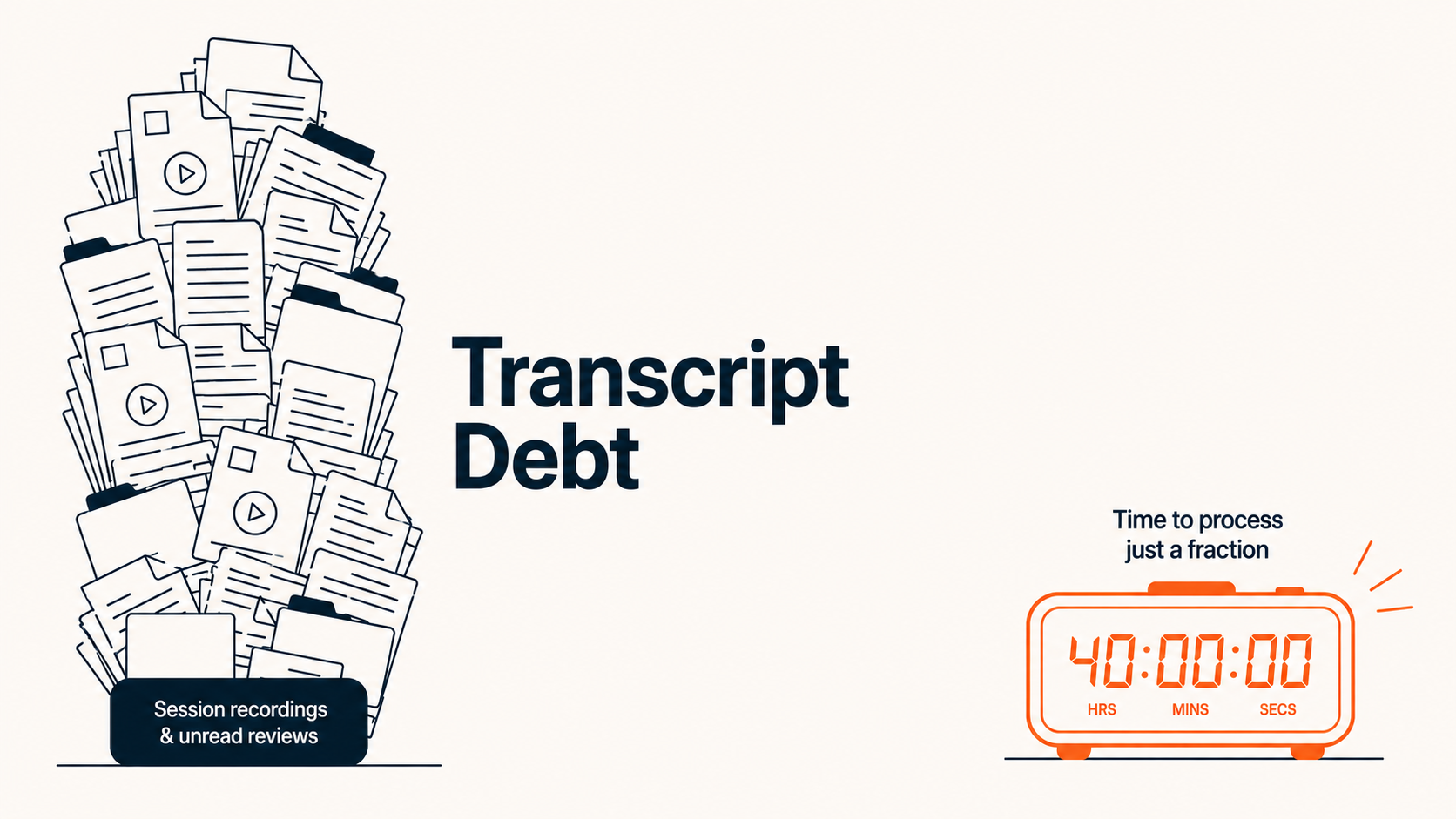
Transcript debt illustration showing a backlog of session recordings and research documents taking hours to process

She’s not lazy and she’s not understaffed by industry standards. She’s normal. And the numbers back that up:

  • 93% of customer feedback companies collect is never formally analyzed (Gartner)
  • 567 minutes: the average time human coders took to thematically code 40 qualitative items in a 2024 JMIR AI study
  • 20 minutes: how long the same task took generative AI in that study
  • 40 hours: roughly what it takes to properly re-watch and tag 50 recorded user calls by hand, the exact backlog UX researcher Elijah Mata calls “Transcript Debt”

Debt is the right word. It compounds. Every unread transcript is a decision Meera’s team makes on gut feel instead of evidence.

Free Mini Audit

Read a file

Read a file

The first attempt: fast, confident, and wrong

Meera’s first move was the one almost every team makes. She pasted 18 product reviews into an AI chat and typed: “Can you summarize what customers are saying?”

Read a file

Read a file

It read well. It also told her nothing she could act on:
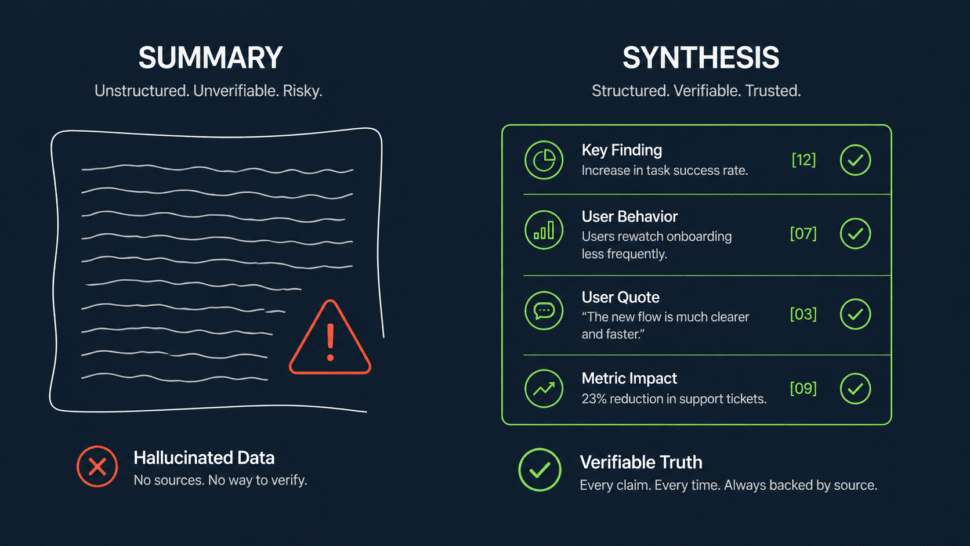
  • No counts. “A few people” and “most customers” aren’t numbers.
  • No citations. Not one claim pointed back to an actual review.
  • One quietly invented generalization: “most customers seem happy with the overall look and feel.” Nobody said that. The AI filled a gap with something plausible.

AI research synthesis comparing an unstructured summary with a structured, source-backed synthesis

This is the trap. A chronological summary feels like research. It isn’t. Real synthesis means ignoring the play-by-play and pulling out patterns that only show up when you look across every response at once, something a recap can’t do by design.

What changed: she stopped asking, and started instructing

Same 18 reviews. Different prompt. This time Meera attached the file and gave the AI rules, not a request:

  • Cluster into themes
  • Cite the review number for every mention
  • Only call something “actionable” above 3 mentions
  • Anything below that: label it “monitor,” don’t drop it, don’t dress it up

Read a file

Read a file

Same data. Same tool. A completely different, checkable output:

  • Sizing runs small or inconsistent — 6 mentions, reviews #1, #2, #6, #8, #13, #15
  • No reliable way to pick the right size — 5 mentions, reviews #3, #6, #11, #14, #15
  • Monitor only: return shipping friction (2 mentions), product photos don’t match item (2 mentions)

Every number here survives the question “show me the actual review.” That’s the entire difference between the two screenshots above: not the model, the instructions.

The six-stage pipeline Meera’s team now runs

Read a file

Read a file

  1. Raw data — recordings, tickets, reviews, surveys, collected as-is
  2. Tagging protocol — define themes, thresholds, and citation rules before anything touches AI
  3. AI clustering — let it process volume, require a source for every claim
  4. Human audit — spot-check 10-20%, full check on anything with business impact
  5. Prioritized themes — scored by frequency, severity, and impact, not who argued loudest
  6. Test hypotheses — one formula, one metric, per theme

AI owns exactly one box on this list: stage 3. Stage 4 is what makes stage 3 trustworthy. Skip it, and you’ve automated guessing instead of replacing it.

Free Mini Audit

The research question that decides how much to trust AI

Here’s the part most CRO teams never think to ask: is this a counting question or an understanding question?
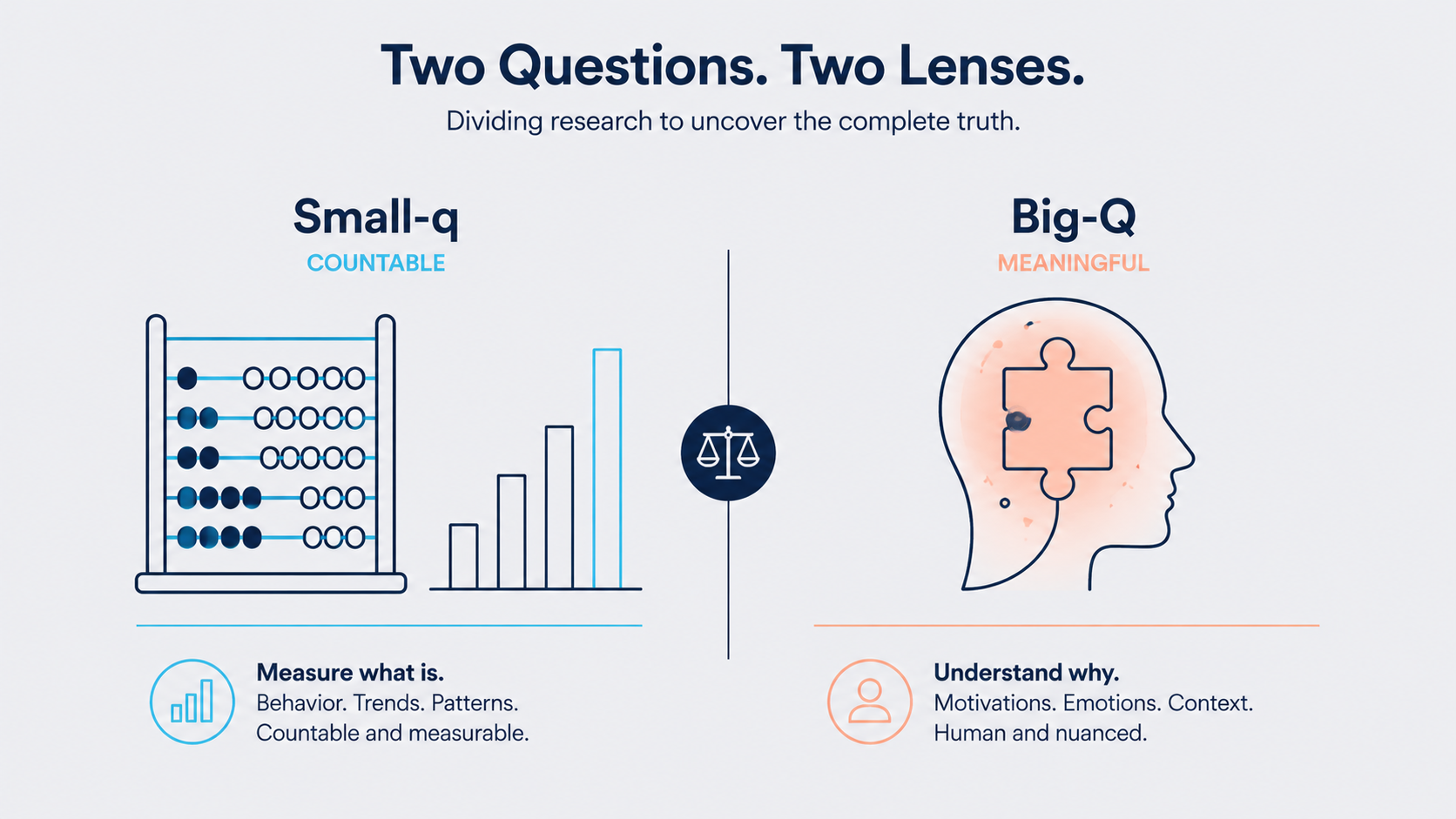
Small-q and Big-Q research comparison showing countable data analysis versus contextual qualitative research

Academic researchers have argued this distinction since 1987, calling it Small-q versus Big-Q research. A 2025 paper in the International Journal of Qualitative Methods lays out exactly why it matters for anyone using AI on qualitative data.

Read a file

Read a file

  • Small-q: “How many reviews mention sizing?” Structured, countable, checkable. AI handled this at 71% agreement with human coders in the JMIR study. Good enough to lead with, as long as a human verifies.
  • Big-Q: “Why does this loyal customer forgive a bad delivery experience but churn after a good one?” Subjective, contextual, personal. The same research is blunt: current models lack the lived experience to interpret meaning here. AI’s only honest role is a reflexive collaborator, a brainstorming partner, never the decision-maker.

Meera’s rule now: before she opens a chat window, she decides which side of that line her question is on.

When the backlog isn’t 18 reviews, it’s 1,800

The footwear example works in one prompt. It doesn’t scale. By Q3, Meera’s team had 1,800 reviews and a full year of support tickets, too much for one inductive pass to stay consistent, especially with that 36-47% intercoder reliability ceiling from the JMIR data hanging over it.
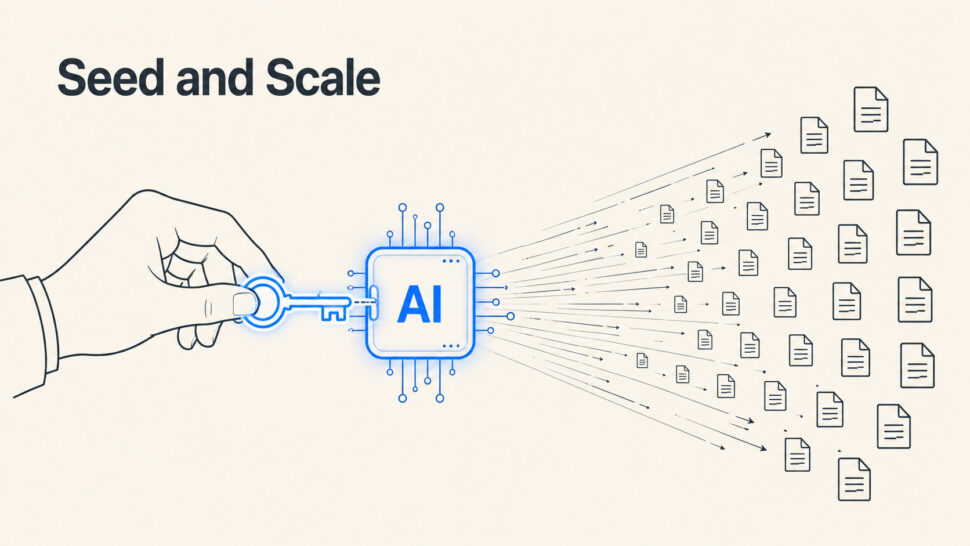
Seed-and-scale research workflow showing AI processing a large volume of qualitative research data

The fix, borrowed directly from the same academic research: seed-and-scale.

Read a file

Read a file

  • A human hand-codes a seed sample, 50-100 records, and builds the real coding structure
  • That structure gets locked: categories, definitions, edge cases, written down
  • AI applies the locked structure to everything else, citing source every time
  • Anything that doesn’t fit gets flagged back to a human, not force-fit into the nearest bucket

Use inductive AI-first clustering for small, unfamiliar datasets. Use seed-and-scale once the pile is too big to read end to end. Pick the wrong one and you get themes nobody can explain six weeks later.

The trick that costs two extra prompts

Formal inter-rater reliability testing needs a statistician. Most CRO teams don’t have one on call. There’s a shortcut, and it comes straight from the research: run the identical prompt three times, in three separate conversations.
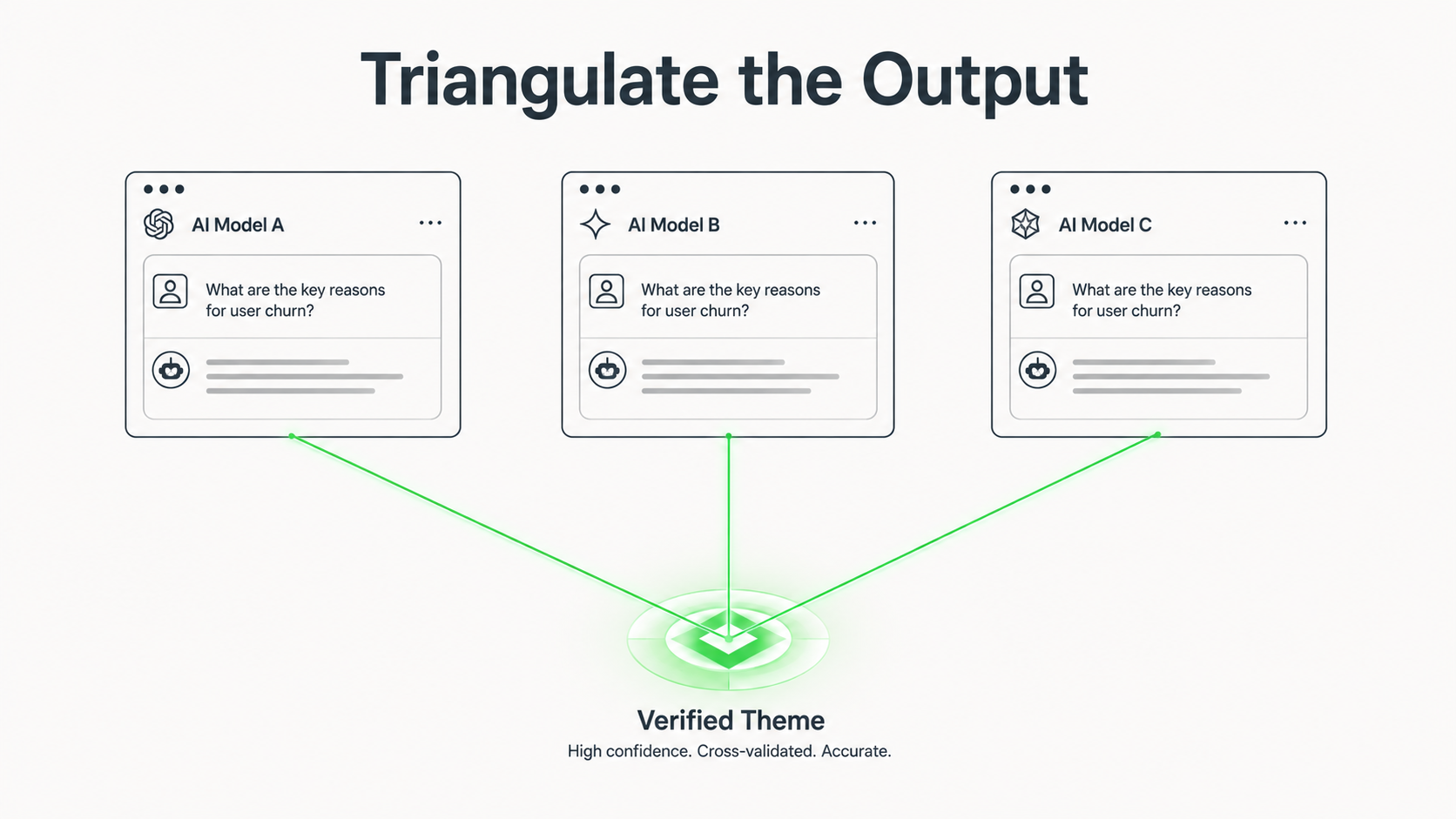
Three AI model outputs being compared to identify a verified and consistent research theme

  • Theme shows up in all 3 runs → act on it
  • Theme shows up once → it’s noise, or a hypothesis for next round, not a roadmap item

One study ran this at scale, ten independent ChatGPT passes compared against each other, and used the agreement rate as a reliability proxy. You don’t need ten. Three catches most of the wobble, for the price of two extra prompts.

Free Mini Audit

From theme to test: one formula

A clustered theme is not a test idea. It becomes one the moment it fits this sentence:

Read a file

Read a file

Can’t fill in the metric blank? The theme isn’t ready. Go find more evidence first.

Scoring the queue instead of arguing about it

Read a file

Read a file

CXL’s PXL framework does this for test ideas generally: ten objective yes/no questions, scored and summed, no gut feel allowed. Applied here:

  • Sizing runs small — 6/18 mentions, High severity → Add dynamic fit guide
  • No reliable sizing guidance — 5/18 mentions, Medium severity → Add size-comparison tool
  • Return shipping friction — 2/18 mentions → Monitor, insufficient volume
  • Photo mismatch — 2/18 mentions → Monitor, insufficient volume

Two themes ship this quarter. Two get benched, on the record, instead of quietly forgotten or forced onto the roadmap because someone felt strongly about them.

Five ways this still goes wrong

  • Deductive framing bites back. Hand AI a fixed list of themes to check for, and human-AI agreement drops from 71% to as low as 50%. It will find what you told it to look for, whether or not that’s actually the data’s center of gravity.
  • The mean swallows the tail. LLMs favor the big, common pattern over rare signals. A 2-mention theme and a 12-mention theme don’t get equal airtime by default, a problem when that 2-mention theme is an accessibility complaint or safety issue. Flag severity separately from frequency, always.
  • WEIRD bias skews cross-market data. Most LLMs train on Western, English-heavy internet text. For a brand running research across India, Australia, or wider APAC, that matters: indirect phrasing or regional English idiom can get miscoded. Sample-check non-Western phrasing before trusting the count.
  • Support tickets aren’t the whole picture. Tickets skew toward people angry enough to write in. Reviews skew toward people who stuck around long enough to post one. Use at least two source types before calling a theme validated.
  • Pasting raw data into a third-party AI tool is a privacy decision. Names, order numbers, addresses, sometimes more, all shared with a commercial platform the moment you paste them in. No formal industry-wide ethical guideline exists yet for this. Strip PII first, every time.

The seven-question audit, before anything hits a roadmap

  1. Is every claim traceable to a specific review, ticket, or recording?
  2. Did the theme come from AI discovering it, or from a prompt that told AI what to find?
  3. If this needed seed-and-scale, did a human actually build the structure?
  4. Did it survive at least 2 of 3 independent runs?
  5. Was a severe-but-rare signal checked separately from frequency?
  6. Does it draw from more than one data source?
  7. Does the hypothesis have a real metric, or does it stop at “customers seem to want this”?

Fail two or more: it’s not ready. One more round of triangulation, then it goes on the queue.

Do this now

Meera’s fix took one afternoon: pick the oldest ignored export, strip anything personally identifying, run it through the pipeline above, three passes, human audit, one hypothesis per surviving theme. That’s the whole first deposit against your own Transcript Debt.

Want a second pair of eyes on the process? OptiPhoenix runs a free mini audit checking whether your last quarter of research would survive this exact checklist. Need the tagging protocol and scoring model built from scratch? Let’s talk growth.

People also ask

Can AI replace qualitative research?


No. AI accelerates the mechanical parts of qualitative analysis, coding, clustering, summarizing at volume, but interpretation, cultural context, and judgment calls still require a human. The JMIR study behind this article found AI matched human coders on only 71% of themes in the best-case scenario (inductive coding), dropping further when AI was constrained to a predefined structure.

What is AI-assisted thematic analysis?


It’s the practice of using a large language model to help identify, cluster, and count recurring themes in qualitative data such as reviews, support tickets, or interview transcripts, with a human reviewing and validating the output before it’s used for decisions.

How accurate is AI at coding qualitative data?


Research puts inductive (AI-discovers-the-themes) coding agreement with human coders at around 71%, and intercoder reliability on matched themes at a fair-to-moderate 36-47%. Accuracy drops further with deductive coding, where AI is told what themes to look for in advance.

What’s the difference between inductive and deductive coding?


Inductive coding lets themes emerge from the data with no preset categories. Deductive coding checks data against a fixed list of themes decided in advance. AI performs measurably better at inductive coding.

Is it safe to use ChatGPT or other AI tools for customer research?


Only after removing personally identifying information. Commercial AI tools require sharing whatever is pasted in with a third-party platform, and no formal industry-wide ethical guideline yet governs AI-assisted qualitative research.

Free Mini Audit

FAQs

What’s a good starting prompt for AI-assisted research synthesis?


Attach the raw data as a file, then instruct: cluster into themes, cite the specific source for every mention, set a minimum mention threshold for “actionable,” and forbid inferring reasons not stated directly.

How many times should I run the same clustering prompt before trusting it?


Three times, in three separate conversations, is a practical minimum.

What is Small-q versus Big-Q research, and why does it matter for AI?


Small-q is structured and countable; Big-Q is interpretive and meaning-driven. AI is a reliable first-pass coder for Small-q. For Big-Q, it’s a brainstorming partner only.

When should I use seed-and-scale instead of letting AI find themes on its own?


Once the dataset is too large to read end to end, typically past a few hundred records.

What mention threshold should turn a theme into a test hypothesis?


No universal number, but three is a common practical floor, decided before you see results.

How do I protect customer privacy when using AI for research synthesis?


Strip or mask identifying fields before anything goes into a general-purpose AI tool, and check your vendor’s actual data retention policy.
Most teams fail two or three questions on this checklist without knowing it. Send us your last research cycle and we’ll show you where it breaks. Start your free audit.