AI Agent vs Chatbot: What’s the Difference for Your Store?

Executives operate in environments where uncertainty compounds faster than planning cycles. Markets shift, customer expectations evolve, and digital ecosystems introduce continuous variability in behavior. In this environment, decisions that rely on intuition alone carry risk. Data-driven experimentation provides the counterweight. It converts ambiguity into structured learning and transforms assumptions into validated insight.
CRO for CEOs is not about running tests on buttons or layouts. It is about building a disciplined decision system that reduces risk, increases clarity, and strengthens the organization’s ability to adapt. Decisions today require proof, not gut. Experimentation provides that proof.
Most leaders already use data. The challenge is that traditional analytics describe the past but do not confirm causality. An increase in conversion after a new initiative does not prove the initiative caused the shift. A period of stable performance does not mean the system is healthy. Correlation disguises itself as insight.
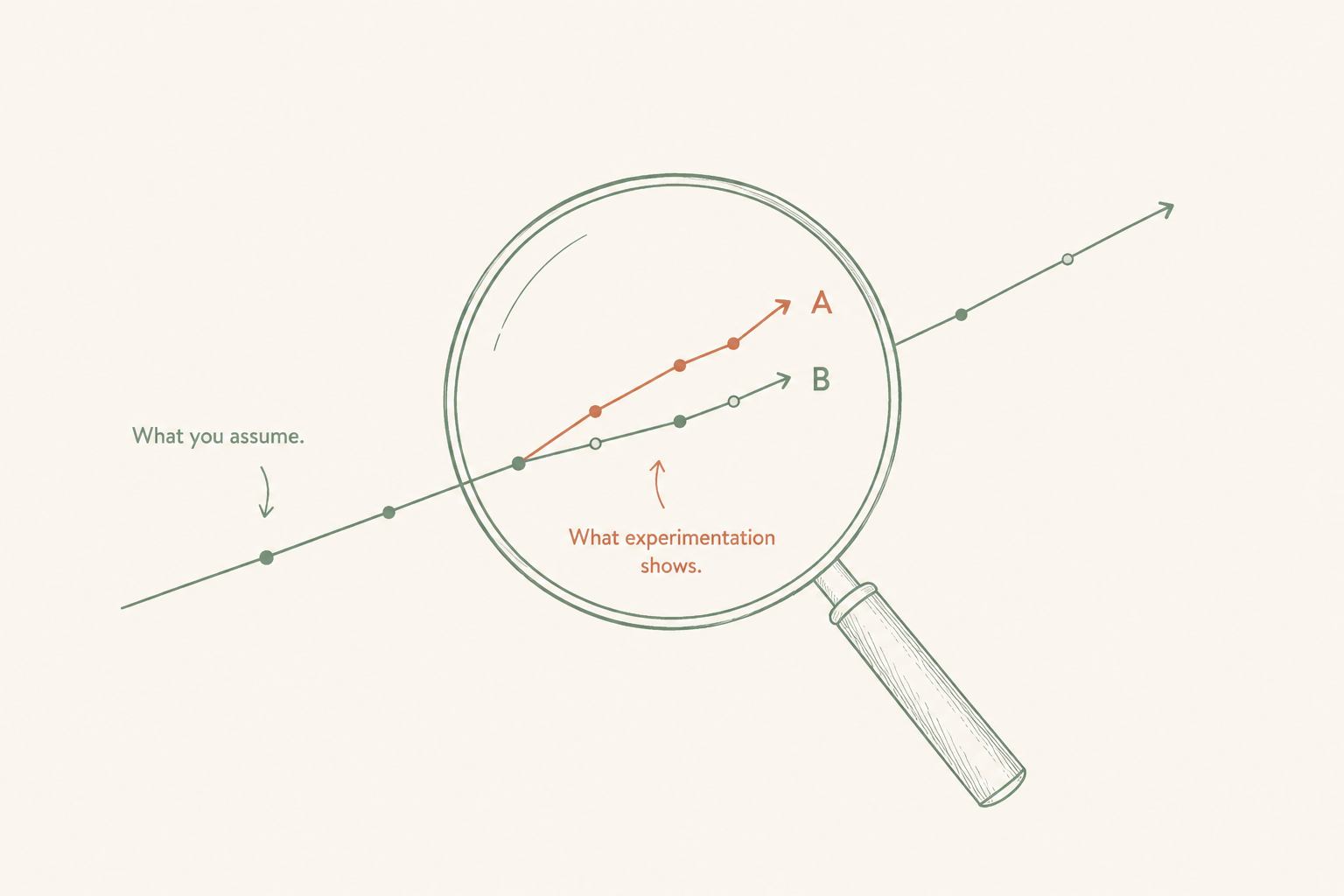
Data-driven experimentation solves this by creating controlled comparisons. It answers a single question with precision. Did the change create the outcome?
The logic is straightforward.
The power lies in its simplicity. CEOs do not need dashboards filled with vanity metrics. They need a clear view of what works, what fails, and what deserves scaling. Data-driven experimentation gives them that confidence.
It also solves a structural issue faced by senior leadership. Teams often present recommendations built on assumptions disguised as expertise. Experimentation removes ambiguity. It creates a transparent system where decisions are guided by validated evidence rather than internal persuasion.
Leaders often encounter a false choice between qualitative and quantitative data. In reality, both are essential because they answer different questions.
Examples include:
Quantitative data identifies structural friction and highlights where performance deteriorates. It is precise but not explanatory.
Examples include:
Qualitative data reveals intention, emotion, and expectation. It exposes the psychological drivers behind behavior.
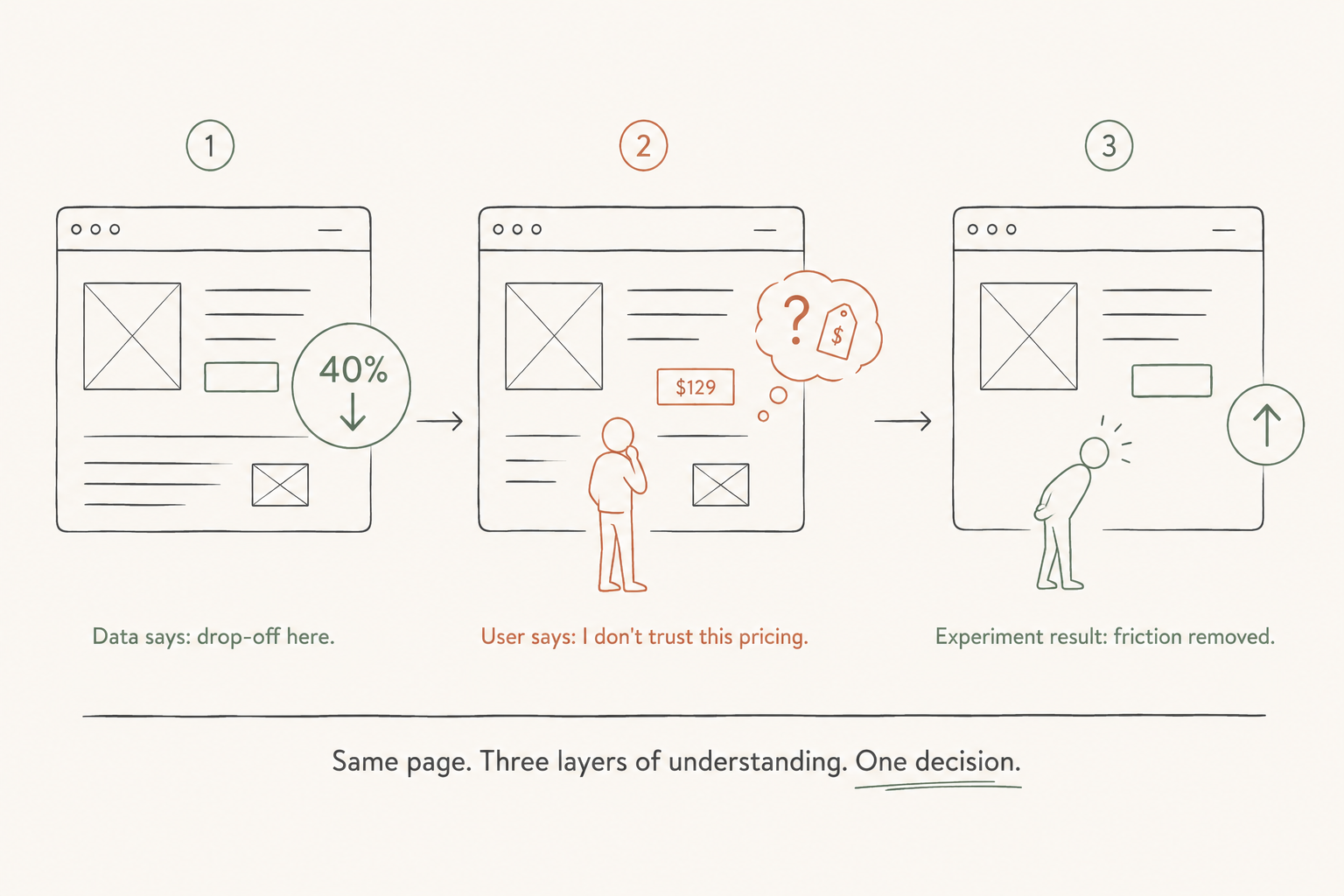
This combination matters at the CEO level because strategic decisions rely on understanding human motivations, not only metrics. A CEO who understands both what failed and why gains leverage. They make decisions that shape long-term product experience, brand trust, and commercial outcomes.
Consider a simple example. A landing page reports a 40 percent scroll drop-off. Quantitative data confirms the pattern. Qualitative insight reveals that customers feel uncertain about pricing transparency. The experiment that follows tests a simplified communication model. The result is not only a performance improvement. It becomes organizational learning that informs future communication, pricing strategy, and product positioning.
This is how behavioral insight and experimentation align to create clarity.
Experimentation is often positioned as an operational tactic. This limits its value. CEOs benefit most when experimentation becomes an organizational capability.
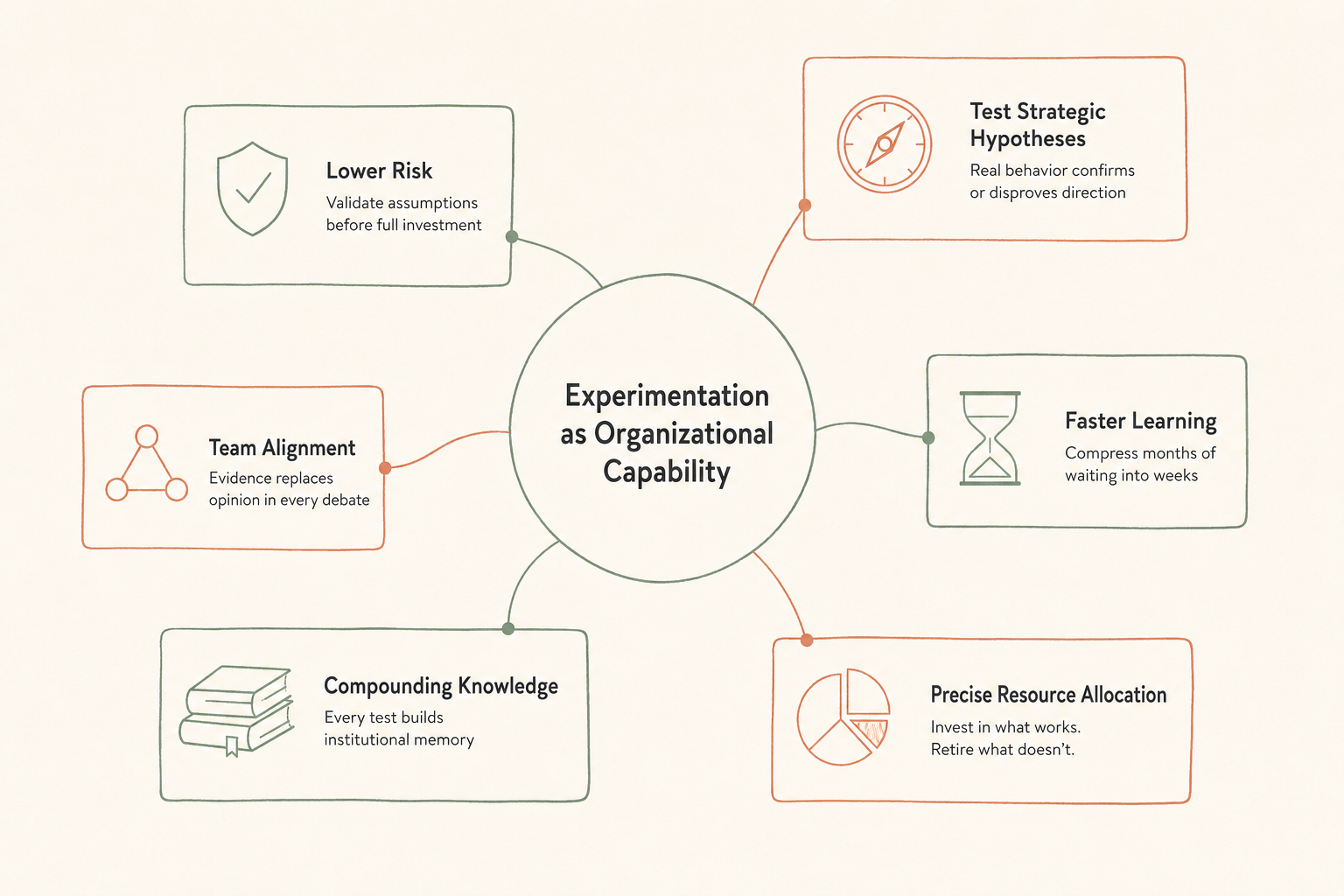
Every major initiative carries uncertainty. New pricing models, conversion strategies, product features, communication frameworks, checkout flows, or loyalty incentives involve assumptions. Experimentation isolates risk by validating the assumption before the full investment.
CEOs often carry questions that shape the next quarter or fiscal year.
Examples include:
Experimentation confirms or disproves these hypotheses with real customer behavior.
Organizations typically wait for monthly or quarterly results to evaluate decisions. Experimentation compresses learning into weeks. A shorter decision cycle gives CEOs a competitive advantage in environments where timing matters as much as direction.
When teams debate solutions, experiments resolve disagreement without conflict. The organization moves from opinion-based arguments to evidence-based alignment. This reduces friction and increases execution speed.
Experimentation creates institutional memory. Each test generates a reusable insight about what customers value, how they behave, and what shifts their decisions. Over time, the organization builds a strategic advantage that does not disappear when people change roles.
CEOs constantly make decisions about budget, engineering bandwidth, and marketing priorities. Experimentation reveals which initiatives deserve investment and which should be retired. This reduces waste and improves ROI across teams.
For CEOs, this is not about testing small UI tweaks. It is about strengthening the organization’s ability to think clearly, move quickly, and grow responsibly.
Avoiding experimentation is not neutral. It introduces structural risks that compound quietly.
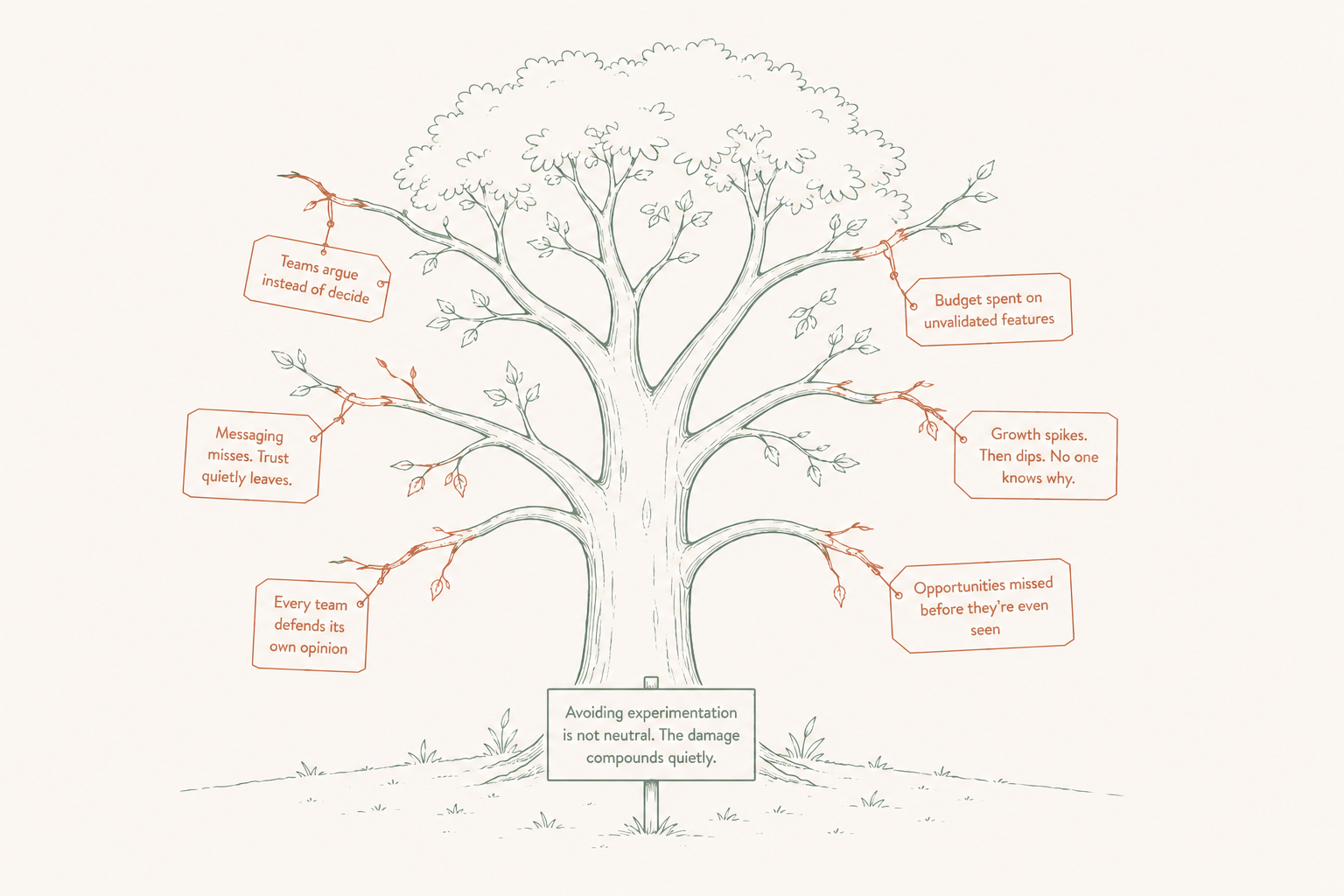
Without experimentation, teams rely on intuition, internal arguments, or partial data. This slows decision-making and increases the cost of uncertainty.
Marketing spends more to acquire customers because conversion inefficiencies remain unresolved. Product teams build features based on assumptions. Engineering time gets consumed by initiatives that lack validated value.
Without experimentation, companies rely on guesswork in messaging, pricing, personalization, and UX. Inaccurate assumptions lead to friction and confusion. Over time, this noise erodes brand trust.
When decisions are not grounded in evidence, performance fluctuates without explanation. Peaks and dips become unpredictable. Leadership struggles to understand which initiatives work and why.
Without a structure for testing ideas, teams defend their perspectives with conviction rather than evidence. This creates silos and reduces organizational cohesion.
Experimentation uncovers counterintuitive insights that teams often overlook. Without it, companies miss opportunities for better pricing models, onboarding flows, navigation simplification, and retention drivers.
The risk is not only losing revenue but losing clarity. CEOs need clarity to make decisions that shape the organization’s trajectory.
CRO for CEOs is about installing a learning engine that reduces uncertainty and clarifies decision-making. Markets move quickly, and assumptions age fast. Experimentation converts uncertainty into structured knowledge. It validates direction before investment. It amplifies learning across the organization. It strengthens the CEO’s ability to make decisions with confidence.
Growth becomes sustainable when it is de-risked. Data-driven experimentation is the discipline that enables this. It is not an optional toolkit for the digital team. It is a strategic operating system for CEOs who want to build resilient companies.
Dashboards reveal patterns but cannot prove causality. Experimentation isolates the effect of a single change, allowing CEOs to validate direction before committing resources. This reduces strategic risk and replaces guesswork with evidence.
Experimentation converts assumptions into testable hypotheses. CEOs can validate pricing changes, onboarding adjustments, new product flows, and messaging frameworks with real user behavior. This ensures big decisions are backed by proof, not persuasion.
Effective systems require a hypothesis structure, a prioritization method, clean data, consistent documentation, and cross-functional participation. Leadership alignment is essential because experimentation influences how teams plan, debate, and allocate resources.
By revealing which initiatives create measurable impact, experimentation helps CEOs allocate budget more precisely. It prevents overspending on low-value ideas and directs investment toward initiatives that improve conversion, retention, and lifetime value.
Experimentation informs decisions across product, pricing, user experience, acquisition, and retention. It becomes a governance system for reducing uncertainty, improving clarity, and stabilizing growth patterns. This elevates it from a tactical activity to a strategic operating discipline.
Ignoring experimentation increases the chance of misallocating budget, making decisions based on incomplete insight, and rolling out initiatives that create friction. It also slows learning and leads to inconsistent performance across quarters.
Experiments deliver validated insight within weeks instead of waiting for long-term performance signals. This enables leadership to react to market changes faster and with more confidence.
Website testing is a proxy for understanding customer behavior. The insights influence pricing strategy, product design, growth planning, and customer retention. CEOs benefit because it provides clarity on which experiences drive revenue and which create friction.
Quantitative data shows where the journey breaks. Qualitative data explains why. CEOs require both to understand the root cause of behavior and make informed decisions that influence long-term retention and trust.
Experimentation validates which initiatives should scale, which should be revised, and which should be abandoned. This prevents costly missteps and ensures growth plans are built on tested assumptions rather than optimism.