SAADAA × OPTIPHOENIX: A SIZE SELECTION REDESIGN DROVE A 20% CONVERSION RATE UPLIFT
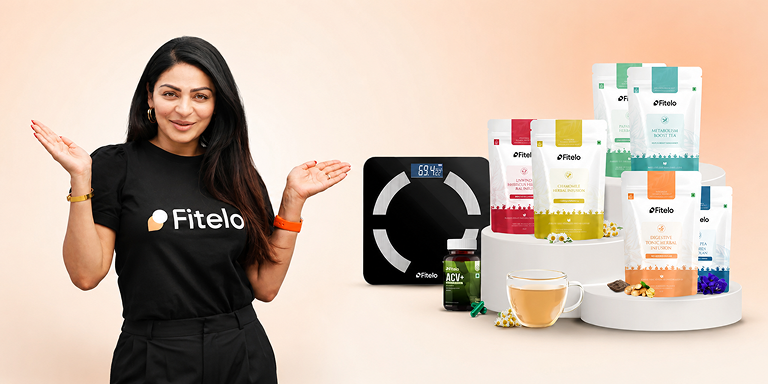
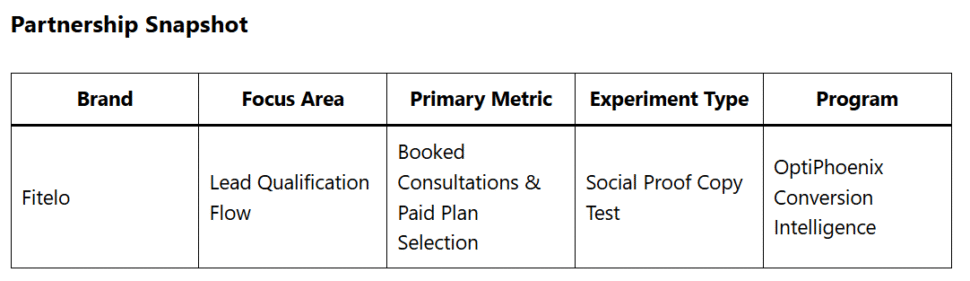
Fitelo offers personalized nutrition and lifestyle plans in India, working with users on weight loss, disease management, and overall health. Their consultation booking flow begins with a multi-step form where users provide contact information and medical history.
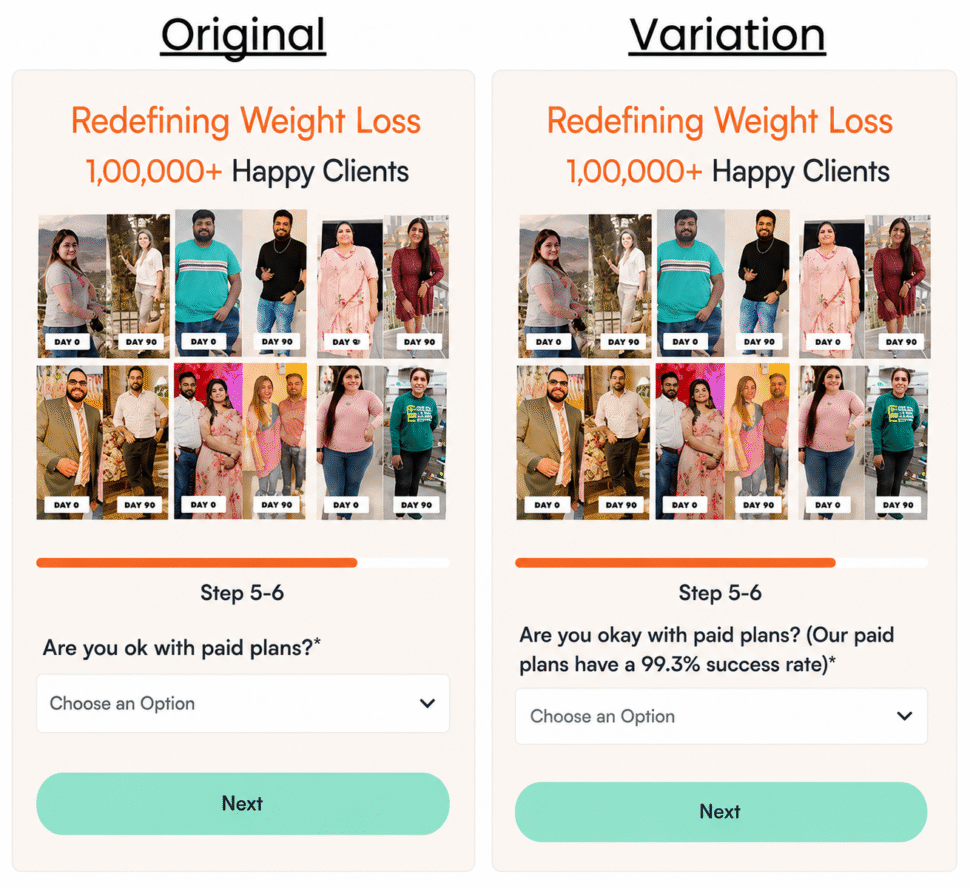
At step five of six, users were asked a single question: “Are you okay with paid plans?” The options were Yes or No.
The data showed a significant problem at this step. 50% of users dropped off at exactly this point in the form. Among those who reached the final step, only 8.9% selected Yes for paid plans.
The question was designed to segment and qualify leads. Instead, it was functioning as a funnel exit.
OptiPhoenix partnered with Fitelo to test whether adding a specific, factual incentive to the question itself would change how users responded.
The original question asked users to make a financial commitment decision with no supporting information. At that point in the form, users had already invested time providing their personal and medical details. They were engaged. But when asked whether they were open to paying for a plan, they had no frame of reference for whether a paid plan was worth it.
The answer to “Are you okay with paid plans?” in a vacuum defaults to hesitation. A question that pairs the ask with verifiable evidence of outcomes changes the frame entirely.
If the question is rewritten to include a specific success rate for paid plans — surfacing social proof at the exact moment users are being asked to make a commitment decision — more users will select Yes, increasing both qualified leads and booked consultations.
OptiPhoenix designed a focused A/B test targeting a single element: the question text at step five.
Variant A (Control): “Are you okay with paid plans?” with a dropdown to select Yes or No.
Variant B (Test): “Are you okay with paid plans? (Our paid plans have a 99.3% success rate)” with the same dropdown.
No other form elements, page design, or flow logic changed.
Metrics Measured: Paid plan selection rate, booked consultations (lead conversion), confidence level
The variation was declared a winner at 100% statistical confidence.
15% more users selected Yes for paid plans. Booked consultations increased by 25.3%. The test generated 30,156 additional annual leads at the run rate observed during the experiment.
A nine-word addition to a single form question shifted behavior across more than 25% of the funnel’s output.

Hesitation at the decision moment is often an information problem. Users who dropped off at the paid plan question weren’t necessarily unwilling to pay. They had no reason to believe paying was worth it. Giving them a specific, credible outcome at that exact moment resolved the uncertainty.
Social proof embedded in the ask is more effective than social proof displayed separately. The success rate didn’t appear on a testimonials page or in the site’s marketing. It appeared in the question itself, at the moment the user was forming their decision.
Specificity matters. “99.3% success rate” is a precise claim that invites belief in a way that vague language cannot. The specificity of the number is part of what makes it persuasive.
Qualification step design determines lead quality downstream. When more users select Yes at the intent stage, the downstream consultation pipeline fills with better-qualified leads — users who have already signaled openness to paid engagement.
Fitelo’s consultation form was losing half its users at the exact step where they were asked to make a decision. The fix wasn’t a redesign or a flow restructure. It was the addition of one data point — placed precisely where the decision was happening — that gave users a reason to say yes instead of stopping.
Thirty thousand additional annual leads from nine words is a result that illustrates something OptiPhoenix sees consistently: the highest-leverage interventions are often the smallest ones, placed at the highest-stakes moment in the funnel.