AI Agent vs Chatbot: What’s the Difference for Your Store?
The demo went well. Stakeholders were impressed. Then the project sat in “pilot” for six months and quietly disappeared. This pattern is common enough that it has its own name in enterprise AI circles: pilot purgatory.
Industry research puts real numbers behind it. IDC’s research with Lenovo found that only around 12 percent of enterprise AI proof-of-concepts reach production at scale. A separate Forrester and Anaconda analysis found close to 88 percent of AI agent pilots stall before getting there. Gartner projects that more than 40 percent of agentic AI projects will be cancelled by the end of 2027.
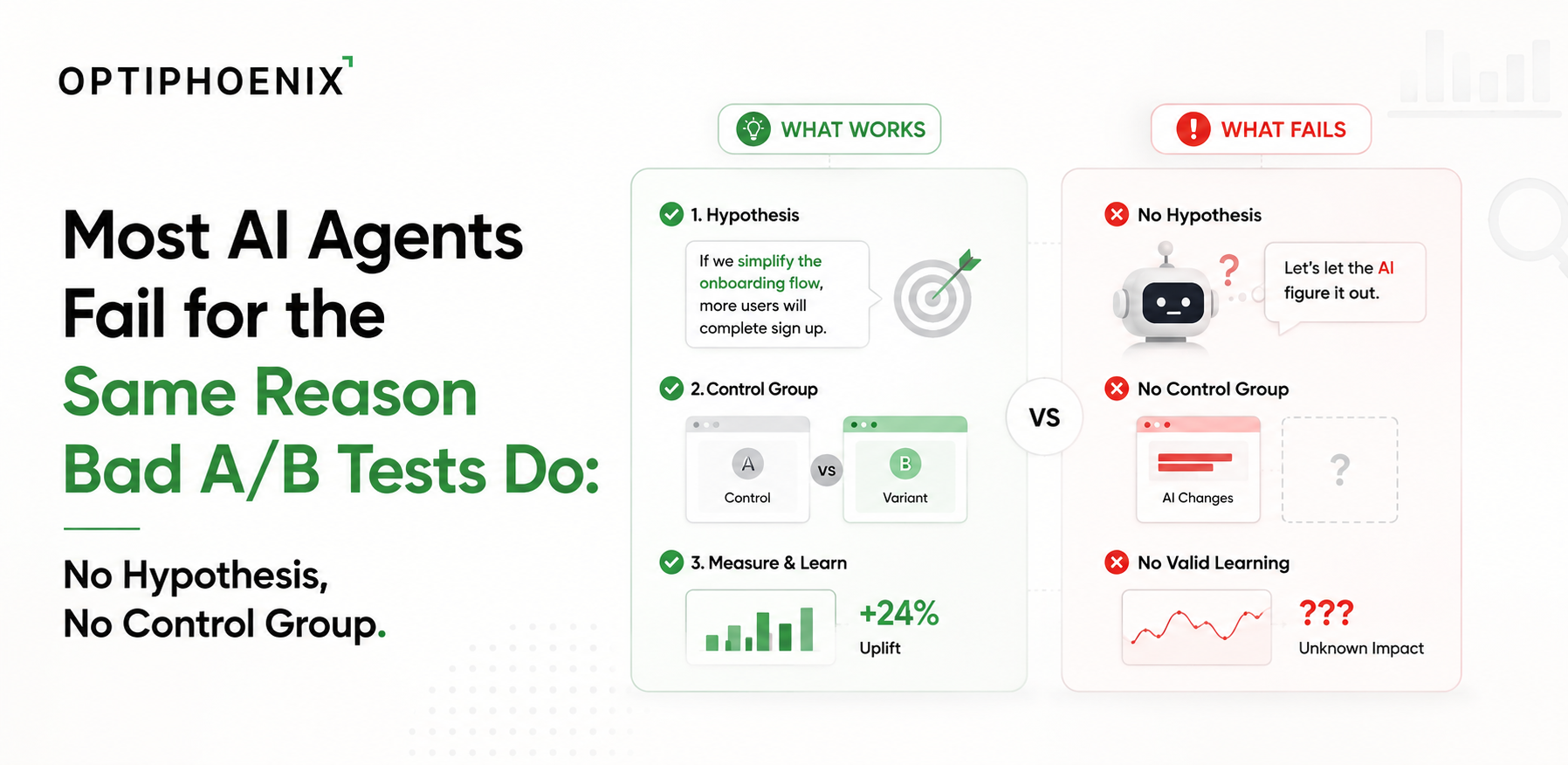
Most of the advice written about this points to governance: name an owner, involve compliance earlier, build the infrastructure first. That advice is reasonable, but it treats the symptom. The deeper problem is methodological, and it’s one that CRO teams solved for testing website changes years ago. Most AI agents never go through anything resembling a real experiment. They get evaluated. Evaluation and experimentation are not the same thing, and the gap between them is where most agents die.

An evaluation checks whether an agent produces the right output on a set of sample cases. A test asks whether the agent actually improves an outcome, compared to what would have happened without it, measured on real behavior rather than curated examples.
This distinction matters more than it sounds. An agent can pass every evaluation in a pilot and still fail once it meets production data. Evaluation only proves the agent can perform under conditions someone chose in advance. It says nothing about whether the agent changes a real outcome for the better, because there was never a comparison group to check that against.
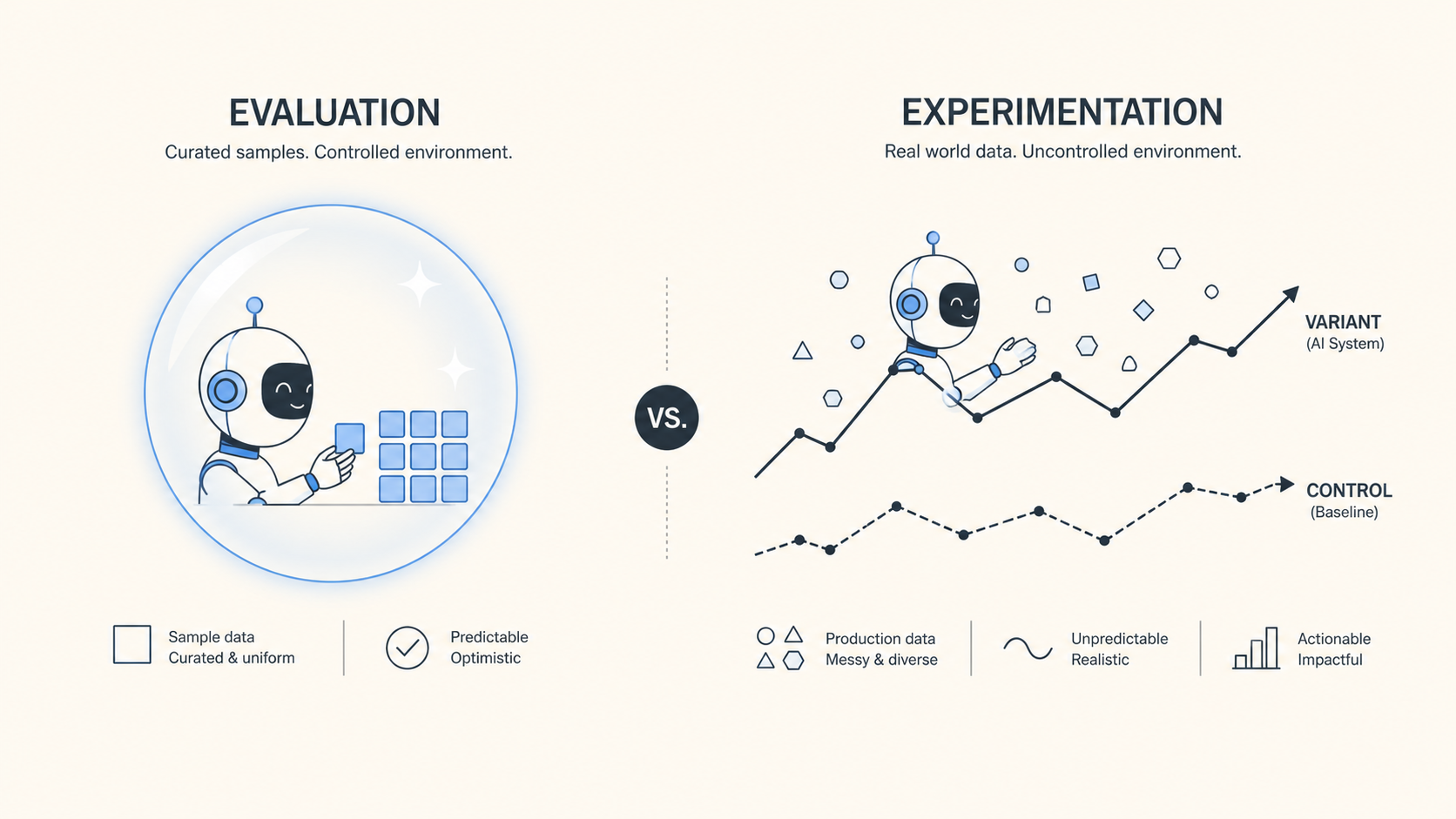
This is precisely the mistake CRO teams learned to avoid decades ago. Nobody ships a new checkout flow because it “looked right” in a walkthrough. It gets tested against the current version, with a defined hypothesis and a measured result. AI agent rollouts almost never get the same treatment. A demo that impresses a steering committee is doing the job of an evaluation. It was never built to answer the actual question: does this agent produce a measurably better outcome than not having it at all.
A hypothesis, not just a use case. “We’re building an agent to handle support tickets” is a use case. “This agent will resolve tier-one tickets with equal or higher CSAT than a human agent, without increasing escalation rate” is a hypothesis. Only the second one can be proven wrong, which is exactly what makes it useful.
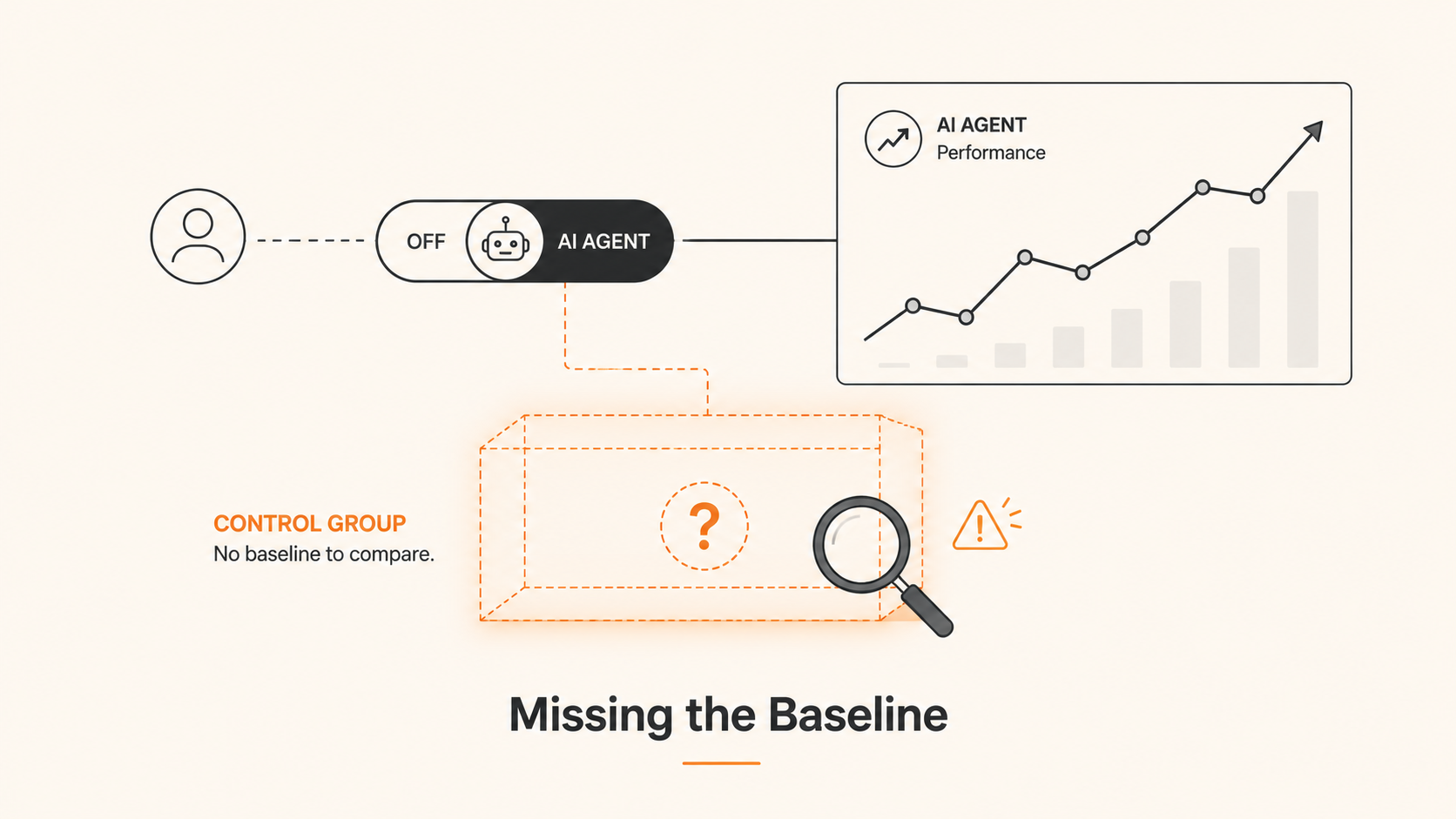
A control group, not just a pilot group. A pilot that only runs the agent gives you a before-and-after story. It can’t separate the agent’s actual effect from everything else changing at the same time: seasonality, a concurrent product update, a shift in ticket mix. Running the agent against a held-out comparison group is what makes the result trustworthy instead of anecdotal.
Production-shaped data from day one. Most failed pilots run on clean sample data and happy-path scenarios. They collapse when real production documents, edge cases, and inconsistent formats show up for the first time.
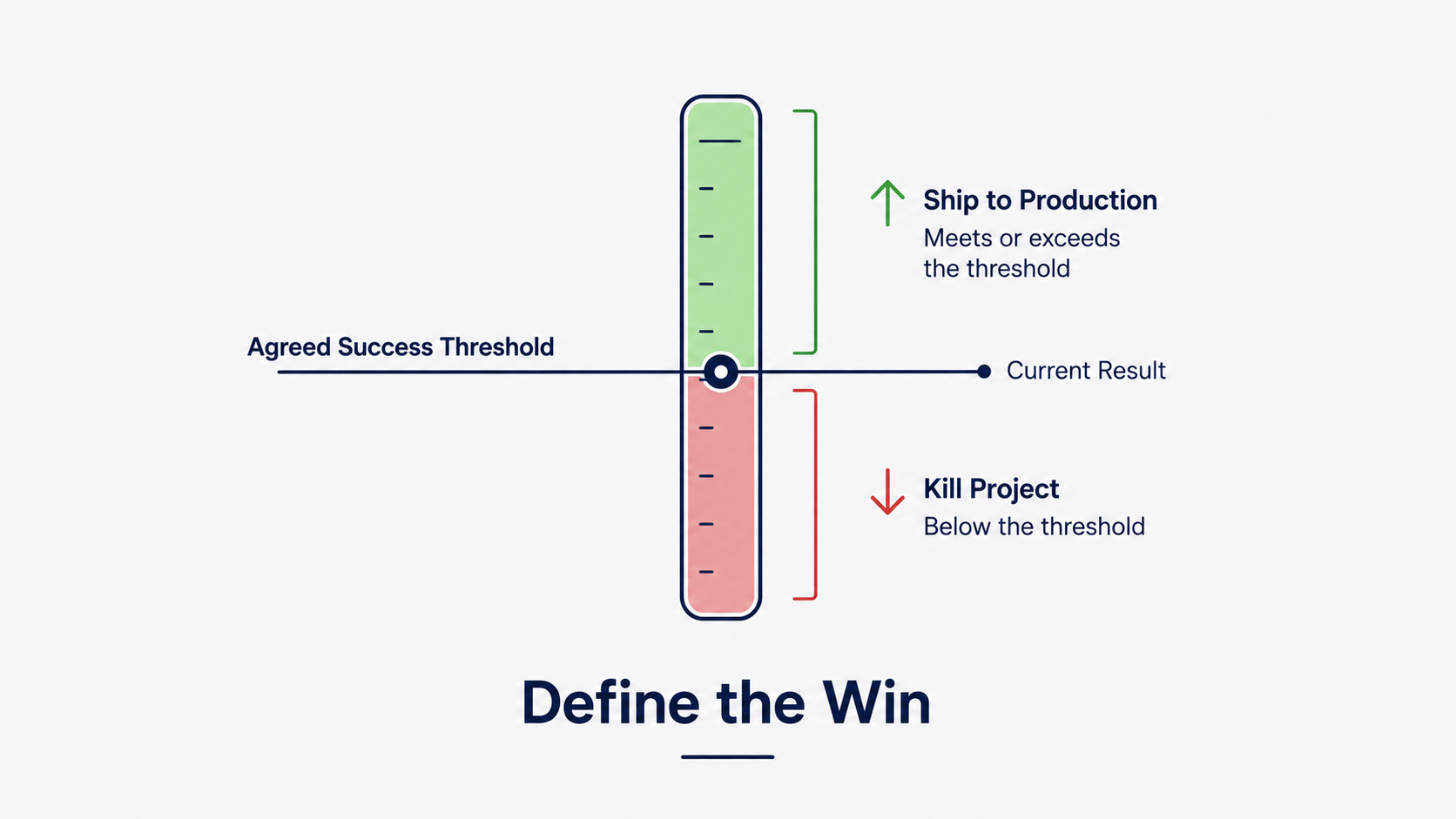
A defined threshold for success, agreed before launch. Vague success criteria set after the fact are how failed pilots get quietly reframed as learners, instead of being shut down cleanly. A number agreed in advance lets a team make the ship or kill decision without politics.

Set the hypothesis and the metric it lives or dies on before any build work starts. This forces the conversation about what “working” actually means before anyone gets emotionally attached to a specific implementation.
Roll out to a defined percentage of real traffic or real cases, not a curated sample chosen to look good. Keep a comparison group running the existing process, whether that’s a human workflow or the previous system, so you have something to measure the result against.
Track statistical confidence, not just a single number. A 15 percent improvement on 40 support tickets tells you almost nothing. The same lift measured across a properly sized sample, with a stated confidence level, tells you whether to trust it.
Decide the threshold for graduating to full rollout, and the threshold for killing the project, before the results come in. This is the step most pilots skip, and it’s exactly why so many pilots that technically “worked” never actually ship. Nobody had agreed in advance on what a real win looked like.
At OptiPhoenix, Agentic AI Development runs through the same experimentation lens as every other program we build. Before a client’s AI agent gets anywhere near production traffic, it goes through the same hypothesis-and-control-group discipline we’d apply to a checkout redesign or a pricing test. This is also why our approach to governing agentic systems inside a CRO program leans on measurable outcome metrics, not just capability checklists.
This isn’t a theoretical position. We ran our own internal pilot applying an agentic framework to 120 A/B test builds. The deciding factor in whether the framework earned a permanent place in our workflow wasn’t a demo. We measured effort reduction against a real baseline, tracking it the same way we’d track any other experiment result. Our A/B testing implementation guide covers the fundamentals this approach is built on, if you want a refresher on what a properly structured hypothesis and control group actually look like first.

If your AI agent has been in “pilot” for months with no clear graduation date, the fix usually isn’t more evaluation. It’s a hypothesis, a control group, and a number everyone agreed to before the test started.
Research from IDC and Lenovo found only around 12 percent of enterprise AI proof-of-concepts reach production at scale. Most advice attributes this to governance and infrastructure gaps. A deeper cause is methodological: agents are typically evaluated against curated sample cases rather than tested against a real comparison group. Teams often can’t tell whether the agent actually improves outcomes, or just looked good in a demo.
Evaluation checks whether an agent produces correct outputs on a chosen set of sample cases. Testing measures whether the agent improves a real outcome compared to a control group that didn’t use it. An agent can pass every evaluation and still fail in production, because evaluation never proves the agent changes anything for the better in the real world.
Yes, if you want a trustworthy result. Without a comparison group running the existing process, there’s no way to separate the agent’s actual effect from other factors changing at the same time, like seasonality or a product update. This is the same principle behind every A/B test.
Agree on the success metric and threshold before the pilot starts, not after the results come in. Pilots that lack this often get reframed as “promising” or “a learning experience,” regardless of the actual outcome. There was never a number that would have forced a clear ship or kill decision.
Real, messy production-shaped data whenever possible. Pilots that run only on clean, curated samples tend to succeed in the demo. They collapse once they meet real edge cases, inconsistent formats, and scenarios the sample data never included.