AI Agent vs Chatbot: What’s the Difference for Your Store?
The main objective of an online store, digital service, or brick and mortar store is to have maximum visitors and conversions. Thus, to fulfill this aim, one of your first tasks while setting up your business is to get your website development and design in order. Once you have achieved that, then comes the role of conversion rate optimization.
While you have got your website developed, do you think having a vibrant look and an attractive web design is enough?
Guess not!! As most branding agencies today are focused on attracting traffic to websites with the goal of converting that traffic into leads. It is crucial to optimize your web pages for conversions, which for many businesses implies leads and/or purchases.
Though, misconceptions, ambiguities, and half-truths haunt every industry, hence conversion optimization is no exception. When performed improperly, CRO can be underutilized. Myths cause misconceptions among experts and perplex newcomers. Hence, the below discussed Conversion Rate Optimization Myths are amongst the most common fallacies and preconceptions that are commonly held by most firms and people.
Whether you’re implementing new design on the website, upgrading your content to match your new marketing approach, or using a new strategy, every marketing campaign should be researched well before testing and monitoring the results. No matter how well you believe you understand your target audience, you should continue to research your weak points and updates to understand where you should begin. For CRO, it’s crucial to understand exactly what the target goal is.
If you believe in this most common Conversion Rate Optimization Myth to start with A/B Test, then you should check your facts again. Well! Everything we’re doing at CRO is research. Research is actually required to begin the optimization procedure. Despite this, it does not receive many broadcasts. It’s critical to start with the end aim of what one wants to achieve: more leads or more traffic while conducting research. “Conversion” may appear to be the aim, but it isn’t.

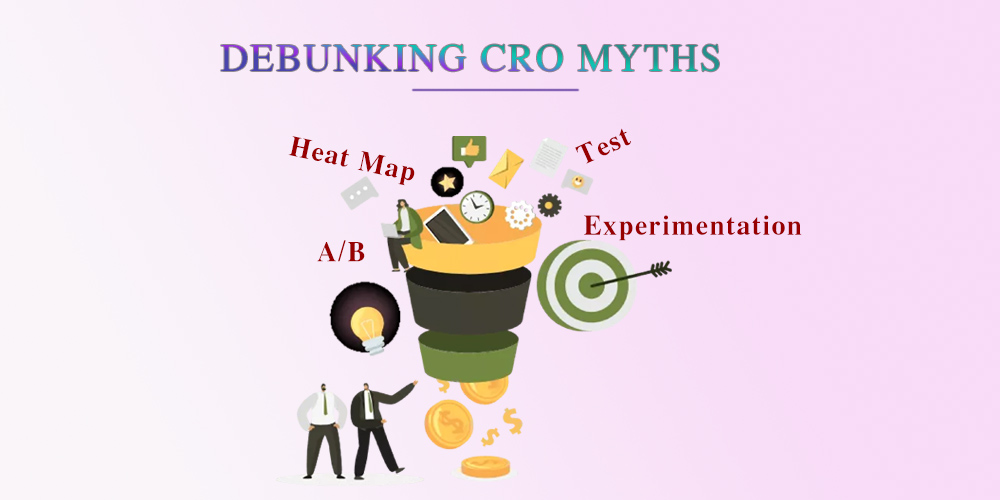
Most people believe that CRO is a fancy term for running an A/B test. Hence, they are completely mistaken. A/B testing makes sure that modifications done to a website are driven by data rather than instinct or impulse. However, there are many other ways to raise conversion optimization rates. Conversion Optimization is not just testing.
For example, analyzing the funnel is the first step in any optimization process. You create hypotheses based on the analysis, which are subsequently A/B tested. The effective hypotheses then are put into practice. The unsuccessful ones are reformulated, put through more testing, and so on. To know what is being tested is important.
One of the most important things while developing a website is smart web design. This is because of the psychological impact it has on visitors and how it may either compel them to convert or repel them. Although web designers may not be CRO experts and may not think of CRO first when developing your brand’s image, their ability as designers has a significant impact on the success of CRO.
This is another CRO myth that we can not change elements of the website after launch. In fact we can change the element by continuous improvement and optimizations. Such as doing A/B testing or even launching totally new revamped websites. If you’re acquainted with HTML tags, you could very well use the same method to modify images, update formatting styles, and more on web sites. There are a variety of common CRO tests that anybody can use on their own website, even after it has been launched.
It is a common CRO myth that adding a test’s winning variant to your website would immediately result in a big increase in conversions. Your adjustments can result in a marginal improvement. Understanding, measuring, and growing conversion optimization rate, all play a huge role in the success of your website- whether you’re a seasoned CRO company or new to the area. To accomplish sales targets, one must first attract and then convert audiences. But, overall, you should know the nitty gritties regarding what is the average conversion rate? What objectives should you set for your advertising or content strategy? It all relies on your speciality: the marketing channels you employ and your client connection.
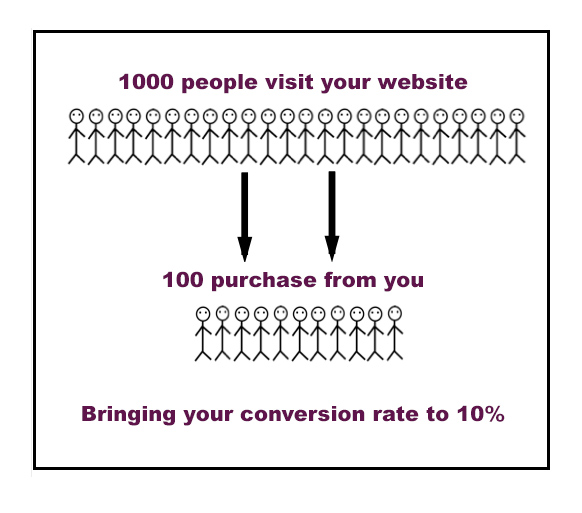
CRO is a long process. Even while it takes time, your efforts might not always yield the desired results. Conversion rate optimization in digital marketing gives you the chance to gain a better understanding of your audience. You learn more about your audience’s preferences as you conduct more A/B tests, and you can benefit much from the wealth of information.
When it comes to getting a high click-to-conversion rate percentage, you must take a well researched conversion rate optimization services action outlined below:
a. Make landing pages for different campaigns.
b. Ensure that every keyword matches the advertisement copy.
c. Aim for an Adwords quality score of at least 8/10.
d. Monitor your conversion rate and alter any campaigns with a low conversion rate.
Many people have a misconception that CRO is a temporary process. Well!! It’s a myth. In reality CRO is said to be a constant state of testing. It is considered as a constant process of making little, incremental adjustments for incremental improvement.
For instance, you might want to change the “purchase now” button. Like the button size, colour, its placement and so forth. As a result you see there is an improvement. But this does not indicate that these changes will last forever. Changes are the result of updation and market trends that keep on evolving and shuffling. Hence, you never know when you might want to make another change. Making minor and frequent adjustments to ensure more accurate findings is a key component of CRO.
This is one of the key causes for the continual aspect of CRO. You simply won’t have enough data points from significant adjustments evaluated in a small number of studies to determine what made the difference. The key is patience, and patience breeds careful planning. Some tests will coexist while others won’t.
The probability that a difference in conversion rates between Version A and Version B of a split test or A/B test is not due to random chance is measured by statistical significance. If you execute an A/B testing trial with a 95% significance threshold, for example, you may be 95% convinced that the observed findings are real and not a random error. It also implies that there is a 5% possibility that you are mistaken.
A statistically significant result isn’t due to chance and is determined by two essential factors: sample size and effect size.
The majority of people who conduct A/B testing do it sparingly, focusing on only one variable at a time. They test headlines, pictures, button wording, and other essential conversion-related website components. This is reasonable. These aspects are simple to test, the results are evident, and the next step is straightforward. You can be more confident in the results if you limit the testing to one isolated variable. However, there has been a lot of debate concerning the drawbacks of this stepwise strategy. The idea is that you won’t be able to iterate your approach to a much better design if you keep testing little elements over time.
Hence, it has resulted in people believing myths related to CRO. We suggest you to not confine yourself to minor adjustments. The solution is straightforward: use the full page as a variable. Rather than testing individual design components like headlines, graphics, or call-to-action buttons, it is better to create two totally distinct sites and compare them. The entire page will become the variable you’re testing in this method. It’s still a valid exam, but you’re working at a higher level this time. Small modifications are not really the focus of A/B testing. Page-level testing (and even flow-level testing) may produce highly fascinating findings that are frequently faster and more informative than A/B testing’s gradual, tiny modifications. Change your testing technique to incorporate large leaps and increase conversion rate.
This is another Conversion Rate Optimization Myth. It may appear challenging, but time is crucial when optimizing for conversions. If you stop an A/B test too soon, the findings will be statistically insignificant. To state the former sentence, let’s suppose that if a page typically receives 1000 visitors per week and you make a choice based on only 10 visitors, you are not considering all of the facts. Those 990 visitors who remain can make a tremendous difference.
Executing a test for too long, on the other hand, might be expensive because you are not effectively testing other things while you wait for results. So, how can you strike the right balance? Regularly check in on your test. Your statistical analysis will most likely be automated by your testing tool, such as Google Optimize. A/B testing software will most likely provide you with a percentage that indicates the amount of trust in your results. Keep in mind that more self-assurance is preferable.
Anyone can suggest an A/B test concept of reconsidering the attached symbol from yellow to blue or re-write that title. The true meaning of CRO is not about executing a single test, but about running several experiments over time and knowing how to analyze and interpret the results.
A/B testing and conversion rate optimization are only a small portion of your total marketing, so design the tests wisely to acquire long-term benefits. Make no adjustments unless you have a credible and relevant theory. This is an important stage in every CRO trial.
According to Verified Market Research, Conversion Rate Optimization (CRO) Software Market size was valued at USD 771.2 Million in 2018 and is projected to reach USD 1932.2 Million by 2026, growing at a CAGR of 9.6% from 2019 to 2026.

When it comes to A/B testing, there is a misunderstanding regarding the modification of only one element every test. Following one change per test advice can restrict your results. Although, it is easier to determine which modification resulted in a conversion rate shift when only one element is changed at a time. However, you can certainly modify more than one element in a single landing page or email. We’re attempting to test a theory rather than a modification. If they’re all seeking to verify or contradict the same hypothesis, many changes in a single user experience might be on the same test.
It is advisable to design numerous iterations of your website that each focus on a single minor change. You can create different versions of your headline to test, and then direct an equal amount of traffic to each to see which generates the most conversions.
Now that we have busted the most frequently asked CRO myths and doubts about the CRO process, let us take note of the fact that regardless of all these myths surrounding the process, CRO is the process of determining what your website visitors require in order to take action. It’s all about breaking the mould, trying new things, and pushing the boundaries. The brilliance of CRO is that, whenever done correctly, even simple onsite tweaks can help convert existing leads into paying customers. That is, even if traffic remains the same, your business can generate more sales or leads. Prior to testing, gather a few critical data points to get a better understanding of what topics to concentrate on, you can also take help of conversion rate optimization agency.
As CRO becomes more popular, you should expect additional myths to emerge. The one thing to remember is that any tip, trick, or technique that guarantees speedy results without taking into account your specific aim, objective, or measurement is almost certainly false. Remember that true CRO necessitates you to roll up your sleeves and determine what is best for your website. You can take