Your Audit Is Done. Now What Do You Test First?

The appearance of a website is critical to its success. A website must be both aesthetically beautiful and easy to use in order to be appealing to users. Conversion rate optimization (CRO) campaigns operate in concert with design and development processes since design and development adjustments have a significant influence on a site’s conversion rate.
The similarities between Conversion Rate Optimization (CRO) and User Experience (UX) are useful when analyzing website performance. Both CRO and UX are aimed at assisting users in accomplishing the objective with the least amount of effort. They both entail the usage of specific activities like user input and usability testing. They are not, however, the same.
The approach to user experience design is straightforward: You make sure that every navigation on your website is simple to do, and that the overall flow of the site meets visitors’ expectations. Furthermore, you actively identify and attempt to resolve any type of hurdle faced by your website users.
User surveys, eye-tracking research, usability lab investigations, and customer feedback are all prominent methodologies. For example, According to the findings, online users’ sight follows an F-shaped pattern.
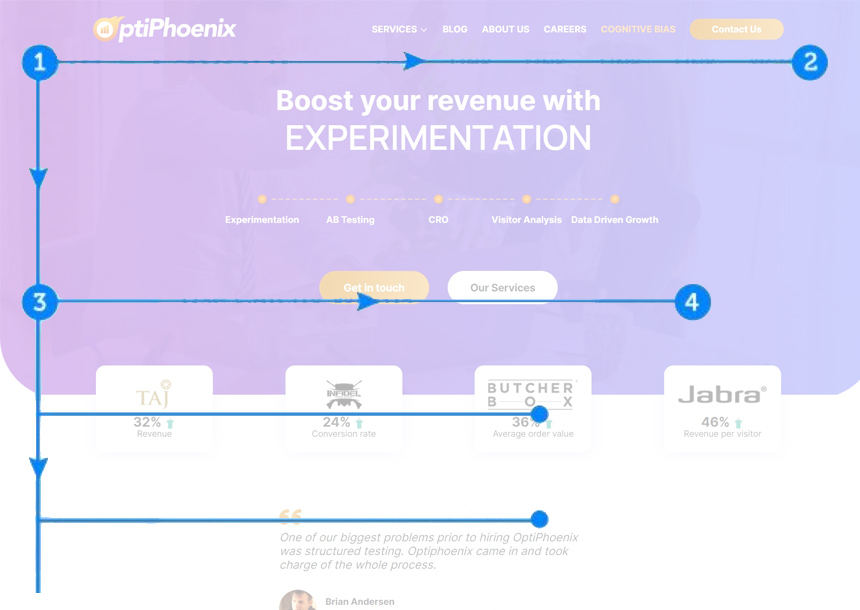
The approach to UX design allows a CRO team to concentrate on areas that have a significant influence on website conversions. While prioritizing various testing hypotheses, the team might take this as one of the variables. Certainly, improving an element like an add-to-cart icon on an eCommerce product detail page can boost conversions. Thus, you should make sure to work on the major issues first.

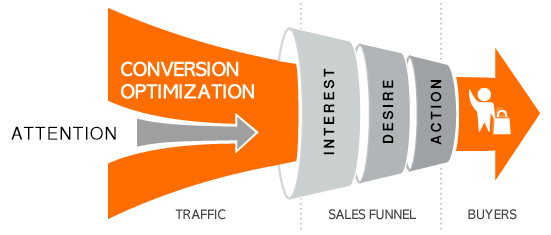
User journey— It is the process that users follow to attain their objective on a website. The user experience method is important because it strives to offer great experiences that encourage users to engage with a brand. User experience includes identifying numerous user journey pathways, often known as conversion funnels, that are available on a website.
The distinction between excellent and poor web design may have a significant impact on how people perceive your company. Whether it’s providing product information, industry statistics, or information about your service offers and capabilities to your audience. The bulk of the first connections between a person and your company are made through your website. This is where CRO design comes into play.
User Experience is at the heart of the roles web development and design play in bringing that website to life (UX). Following the completion of the analysis and testing, the design is based on the findings and what we now know is helpful to enhance conversions. If testing shows that integrating a video, upgrading content, making CTAs more apparent, and other changes improve CRO, the design team will make sure to incorporate them.
Color palettes (aka branding), graphic design, clarity, and simplicity are some of the other design factors that might improve conversion rate. The web development team then turns this optimal design into reality. The marketing, design, and website development teams must collaborate closely to determine which functions were evaluated and how they should be integrated with the final edition.
You won’t give much attention to the user’s needs if you only focus on conversions. In the long run, this might be harmful to the user experience, resulting in the following issues:
Let’s imagine you want to increase your lead generation. Increase the amount of CTAs, pop-up windows, or push alerts throughout your website or app to accomplish this. You could find that after three months or so, you’ve actually generated fewer leads than before you started your trial.
To put it other way, concentrating too much on CRO has reduced the quality of the user experience. Because the user experience has an influence on conversion rates, you tend to end yourself in a worse situation.
Finally, you may discover that while the quantity and size of your CTAs were enough, critical UX adjustments such as upgrading your Web site or app’s navigation or refining your checkout process resulted in increased conversions.
You must focus on your UX assessment if you want to increase the value of your user’s trip on your site. On the other hand, putting too much emphasis on UX might hurt your CRO and vice versa. As a result, you should strike a careful balance between the two, which will enable you to provide an exceptional customer experience. Here are some pointers on how to keep the right balance.
User experience design influences CRO. UX research may help you identify areas of potential and confirm the design ideas you’ve come up with. Repetitive testing is beneficial for both UX and CRO design. To provide a seamless user experience, UX design ensures that your website’s complete user flow fits users’ expectations and the points of friction are discovered and resolved.
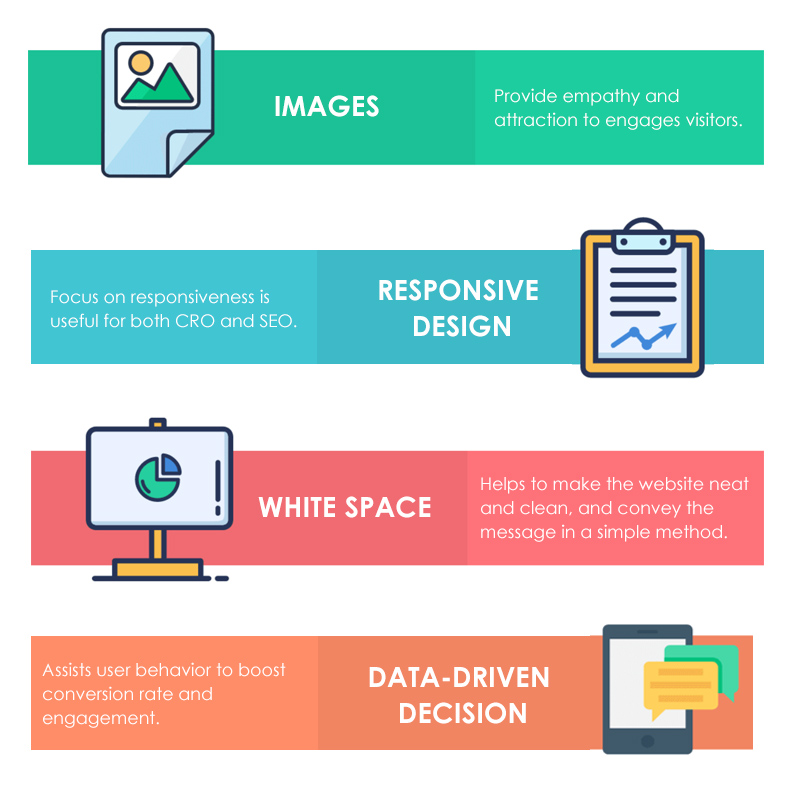
CRO on the other hand, analyses your visitors’ actions, allowing you to create hypotheses, run A/B tests, and iteratively make whatever design changes will have the biggest impact on encouraging users to do the desired action.
CRO tests that are influenced by UX research are more likely to produce valuable results because they assist CRO teams in focusing on areas that have a major impact on website conversions. You may wind up with an engaging customer experience that doesn’t sacrifice conversion rates when your UX design solutions incorporate CRO.
To achieve the required commercial goals, the UX and CRO design teams must collaborate. Here are some suggestions for achieving a healthy balance:
When a firm chooses to use UX design to improve its customer experience, both its ROI and KPIs benefit. A ten percent investment in user experience may boost your conversion rate by 83 percent.
If you look at well-known platforms, you’ll see that they’ve significantly increased their ROI by iterating on their extremely efficient UX throughout the buyer’s journey. They also make an effort to evaluate their user experience on a regular basis. As a result, doing usability testing on a regular basis can have a significant influence on the performance of your website. You should consider running A/B testing on all of your user interfaces on a regular basis. Also, depending on analytics data, it’s a good idea to change and rename the tools in your UI from time to time. You may hire a UX agency to undertake appropriate usability testing for the user interface.
When a firm employs user experience design to improve the customer experience, it improves both its key performance indicators (KPIs) and its return on investment (ROI). As a consequence, a 10% increase in User Experience resulted in an 83% increase in conversions. As per the CRO tool users survey by VentureBeat, the average ROI of CRO tools is 223%.
A long-term emphasis on customer experience is better than a short-term business focus. As a result:
You must concentrate on your analytics, which should contain a variety of methods for obtaining input from your prospects. It will assist you in increasing the profitability of your platform. The helpful data may assist you in gaining a better understanding of the critical areas on which you should focus and what you should avoid. On your website, you may track or measure your customer’s activity. It’s also a good idea to examine all of your conversion’s dips, spikes, and fluctuations.
It’s also a good idea to keep track of all your site visits, sources, and referrers, as this will help you keep a proper balance on your website. Data is crucial in determining the finest UX or UI feature that clients would enjoy or despise. It is sometimes insufficient to just have data. It is necessary for you to be able to analyze it.
Concentrating on analytics, such as easy ways to gain direct input from your prospects, may benefit your platform’s bottom line. You’ll obtain helpful information that will help you figure out what you should be concentrating on and what to avoid. Analytics are also used to perform the following functions:
Although the disciplines can coexist, the section below outlines elements to keep an eye out for to verify that they complement rather than compete.
In split testing, data integrity is critical. And any modifications to the page where tests are running might invalidate the results. Worse, the modifications may be incompatible with the variant code, rendering your visitors unable to convert. Changes should be meticulously planned, with both the CRO design and development teams informed of each other’s activities. It’s a good idea to stop an experiment while updates are being made in case something goes wrong. The development team may rapidly undo the modification, preserving the validity of the experimental data.
People create trust in well-established and trustworthy procedures because change takes effort. It might be difficult to persuade anyone to invest time and expense to a project where the benefits of CRO aren’t recognised. To avoid stakeholder opposition, the rationale for incorporating CRO into the design and development process must be made explicit.
According to Verified Market Research, the Conversion Rate Optimization Software market size was valued USD 771.2 Million in 2018 and it is projected to reach USD 1932.2 Million by 2026.

CRO team should work towards integration and understanding of current procedures. Also, any successful variations must be fed back into the development change control process. They should also discuss the planned variants with internal teams before putting them online, and allow them to preview them. To obtain the greatest outcomes, clear communication between the CRO and the design and development teams is essential.
We can optimize how websites work for organizations when we understand how design and web development affect CRO. Every phase in the Growth Driven Design (GDD) procedure serves as a foundation, laying the groundwork for businesses to effectively influence visitors towards conversion.