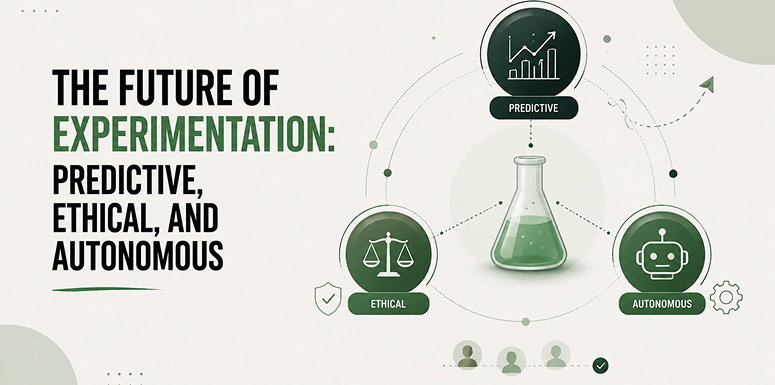
The Future of Experimentation: Predictive, Ethical, and Autonomous
Personalization entered the last decade as an algorithmic promise. Better predictions meant better conversions. Businesses invested in models, data pipelines, and automation layers. The logic was simple: if the experience feels relevant, customers respond.
The constraint was never the model. The constraint was trust. Personalization systems matured faster than the governance around them. As a result, companies optimized for short-term gains without understanding the long-term cost of intrusive or opaque experiences.
The next stage in personalization is not higher accuracy. It is higher integrity. Systems that adapt to people must also respect their boundaries. Personalization in 2026 becomes a trust system first and a prediction engine second.
1. The Shift: From Prediction Accuracy to Relationship Quality
2. Why Trust Becomes the Growth Constraint in 2026
3. Redefining Personalization as a Trust-Based System
4. The Architecture of Ethical Personalization
5. The Behavioral Logic Behind Ethical Personalization
6. The Economics of Ethical Personalization
7. A First-Principles Model for Ethical Personalization Decisions
8. How AI Strengthens Ethical Personalization
9. Personalization Experiments in an Ethical Framework
10. The Roadmap to Ethical Personalization Maturity
11. Why Ethical Personalization is a Leadership Problem
Most personalization engines optimize for near-term behavior. Clicks. Adds to cart. Session depth. The incentives push towards hyper-targeting and silent data extraction. Customers eventually notice, even if the interface hides it.
The core failure is asymmetry. The company knows more about the customer than the customer knows about what the system observes. When asymmetry grows unchecked, personalization becomes surveillance dressed as convenience.
The next era requires symmetry. Customers understand what is collected, how it is used, and what value they gain. When value is mutual, personalization becomes a relationship lever rather than a behavioral nudge.
Three converging forces shape the personalization landscape.
Jurisdictions are introducing explicit consent requirements, purpose limitation rules, and stricter penalties for misuse. Algorithms that operate without transparent data lineage become liabilities.
Browsers, devices, and ecosystems are removing passive tracking primitives. Businesses lose the ability to infer intent silently. Consent becomes an operational dependency, not a compliance checkbox.
People tolerate convenience until it crosses into discomfort. When recommendations feel invasive, they disengage, reduce repeat behavior, or move to brands that respect boundaries.
This means the next wave of competitive advantage belongs to brands that design personalization systems around clarity, consent, and choice.
When viewed through an ethical lens, personalization serves three functions.
Intent is not extracted. It is volunteered when customers believe the system uses it responsibly. Ethical personalization encourages transparency in how intent is captured and applied.
Long-term retention depends on repeated trust confirmations. Each interaction should reinforce the expectation that the system works in the customer’s interest.
Customers must have the ability to tune, disable, or inspect personalization logic. Control is not a UX feature. It is part of how trust compounds.
This shifts the definition of personalization. It is no longer a mechanism for extracting behavior. It is an infrastructure that supports informed choices and respects individual boundaries.
Ethical personalization behaves like a controlled system. It has clear inputs, transparent processing, and observable outputs. The architecture contains five layers.
Consent is not a popup. It is a permission boundary written into the personalization engine. The system records:
This becomes the access control layer for all downstream personalization logic.
Ethical systems collect only what is required. Instead of hoarding signals, the model defines the minimum viable data set for relevance. Fewer data points reduce risk and simplify governance.
The system must explain:
This removes the black-box nature of personalization and establishes symmetry between user knowledge and system behavior.
Customers should not need to repeat their choices. Personalization systems must remember preferences accurately and allow customers to update them easily. The memory layer becomes a record of voluntary signals, not inferred ones.
These rules govern limits. They define where personalization can operate and where it must stop. Sensitive categories, emotional vulnerabilities, and edge-case behaviors require additional control.
This architecture ensures the system evolves with consent, retains clarity, and embeds ethics at the center of personalization.
Ethical personalization works because it aligns with fundamental human behavior patterns.
People trust systems when boundaries are visible and consistent. Personalization that explains itself reduces cognitive risk. Customers understand how the system behaves and what it will never do.
Autonomy increases satisfaction. When customers can tune personalization or switch modes, they invest more willingly in the experience. This shifts personalization from an imposed system to a chosen one.
When recommendations look too accurate, users question how the system knew. Transparency removes the suspicion loop. Customers understand the reasoning rather than imagining hidden mechanisms.
When personalization is transparent and respectful, customers share more. Voluntary data often has higher signal quality than inferred data. Ethical systems unlock more value from fewer signals.
This is the compounding effect. Trust enables richer interaction. Richer interaction strengthens personalization. Personalization reinforces trust when it stays within boundaries.
Ethics is not a concession. It is a long-term growth driver.
Customers stay longer with brands they trust. Retention reduces acquisition dependence and stabilizes revenue.
Opaque personalization creates compliance exposure. Ethical design reduces legal, reputational, and operational risk.
Voluntary signals have higher intent density. They reduce noise and improve the quality of recommendations.
Clear boundaries simplify data pipelines, model logic, and testing frameworks.
The result is not only a safer system but a more efficient one.
To operationalize ethical personalization, organizations can use a simple decision model.
Has the customer offered this data intentionally?
Does the customer understand why the system is using it?
Does personalization improve the customer’s experience, not merely the company’s metrics?
Is the level of personalization appropriate for the context?
Can the customer withdraw consent easily and verify that the system has stopped using the data?
This model builds guardrails that are simple enough to govern but strong enough to hold under scale.
AI is often viewed as a threat to privacy. It becomes an enabler when placed inside ethical boundaries.
AI checks whether a recommendation or experience violates a customer’s preferences or permissions. It prevents unauthorized personalization before it occurs.
AI can translate model reasoning into explanations that customers understand. This builds clarity around why specific content or actions appear.
AI detects when preferences change and adjusts personalization without forcing customers to update settings manually.
AI can highlight cases where personalization disproportionately favors or excludes certain groups, enabling corrective action.
AI ensures preference histories are accurate, current, and free from inferred assumptions that violate ethical principles.
AI becomes a governance tool as much as a personalization tool.
Experimentation remains essential, but the ethics layer adds constraints that redefine how tests run.
Only customers with explicit permission enter personalization tests.
The system informs customers when they are part of a personalization experiment and why.
Experiments track trust indicators such as opt-out rates, complaint patterns, and change in willingness to share data.
Insights from past personalization experiments surface automatically to prevent intrusive or repeated tests.
This ensures experimentation contributes to trust rather than eroding it.
Organizations move through four maturity phases.
Systems operate silently. Customers accept relevance but do not understand why it appears.
Systems explain recommendations. Customers begin to understand how personalization works.
Systems adapt only within explicit boundaries defined by customers.
Systems operate as mutual agreements. Customers opt in because they perceive clear value and strong governance.
Phase 4 becomes the competitive frontier in 2026.
Ethical personalization is not a data problem or a UX problem. It is a leadership problem because it requires:
Leaders shape the incentives that define how personalization behaves. Without leadership clarity, personalization defaults to opportunistic behavior because systems optimize toward measurable outcomes, not ethical ones.
OptiPhoenix treats personalization as a trust infrastructure. The focus is not on squeezing incremental conversions from predictive models. It is on building systems where:
The objective is simple. Build personalization systems where relevance and integrity coexist. When customers feel respected, they engage more, reveal more, and stay longer. That is the compounding advantage in 2026.
Accuracy improves relevance, but trust governs willingness to participate. When customers understand what data is collected, how it is used, and what boundaries exist, they share higher-quality signals. This expands the personalization opportunity set. Without trust, even the most accurate system operates with restricted data and rising disengagement.
Consent becomes an access-control layer. Every downstream process—data ingestion, model inference, recommendation generation, and experimentation—operates only within permissions granted by the customer. This reduces operational risk and establishes a predictable structure for long-term retention.
Transparency converts a black-box experience into a predictable system. When customers understand why they see something, they evaluate relevance rather than question intent. This stabilizes engagement and strengthens recall across sessions and channels.
Experiments shift from maximizing short-term conversions to validating trust indicators. Metrics include opt-out behavior, preference changes, and sentiment drift. Experiment boundaries become consent-driven, and insights feed into preference memory rather than isolated reports.
Minimization lowers compliance exposure, decreases model complexity, and improves explainability. Ethical personalization focuses on extracting maximal value from a compact set of volunteered signals that carry higher intent density than broad, inferred data pools.
By designing systems with visible boundaries, using only consented data, and providing clear explanations for each personalized output. Privacy becomes an engineering constraint, not a post-processing fix.
Yes. AI can monitor consent compliance, prevent unauthorized recommendations, detect bias, and generate customer-facing explanations. It acts as an internal auditor that operates continuously.
Voluntary data reflects explicit intent. It is more stable, more accurate, and more predictive of long-term behavior. Ethical systems trade breadth of signals for depth of meaning.
Transparency reduces cognitive friction. When users understand the logic behind personalization, they perceive the brand as predictable and aligned with their interests. Predictability reinforces repeat behavior and increases lifetime value.
Privacy restrictions are compressing access to passive data. Brands that rely on opaque inference will lose signal density. Brands that earn trust gain permission to collect richer data, enabling stronger personalization loops and higher retention.