AI Agent vs Chatbot: What’s the Difference for Your Store?
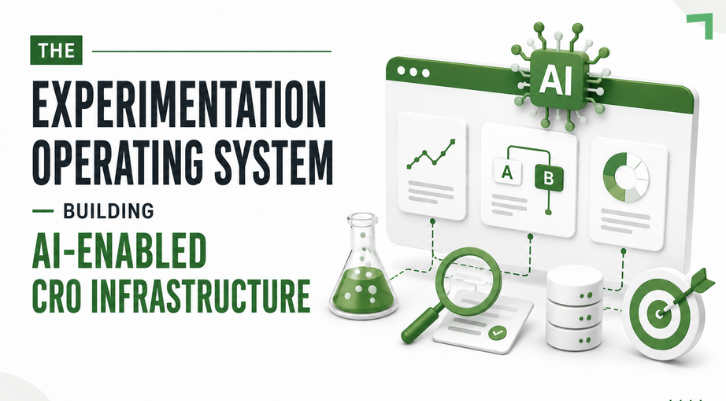
Organizations scale through systems that upgrade judgment, reduce noise, and preserve what works. A testing program gives you activity. An experimentation operating system gives you compound learning.
AI is the missing layer that makes such an operating system practical. It can structure workflows, standardize decisions, and maintain a living memory of what the business has already learned. The result is not a faster queue of A or B tests. It is an AI-enabled CRO infrastructure that behaves like a growth operating system.
This article lays out how to design that system, where AI belongs inside it, and what it means for a company that wants to treat experimentation as infrastructure rather than campaign support.
1. Why an Experimentation OS is Different from a Testing Program
2. What AI Actually Changes in the Architecture
2.2 Standardized learning protocols
2.3 Persistent organizational memory
3. The Core Layers of an AI-Enabled Experimentation OS
3.1 Strategy and hypothesis map
3.2 Opportunity sensing and backlog creation
3.3 Prioritization and portfolio design
3.5 Insight extraction and sensemaking
3.6 Knowledge memory and recall
4. A Practical Implementation Blueprint
4.2 Foundation and standardization
4.3 AI integration in key friction points
4.4 From workflow assistance to operating system
5. Metrics that Define OS Health
6. Governance, Risk, and Human Control
7. Common Failure Modes in AI-Enabled Experimentation
8. What This Means for Organizations in 2025 to 2026
9. How OptiPhoenix Fits into This Picture
A testing program answers the question “what should we test next.” An experimentation operating system answers “how does this organization discover truth at scale and reuse it.”
In most companies, experimentation breaks down in the same places:
The limitation is not the intelligence of the people involved. The limitation is the absence of a system that connects strategy, execution, analysis, and memory.
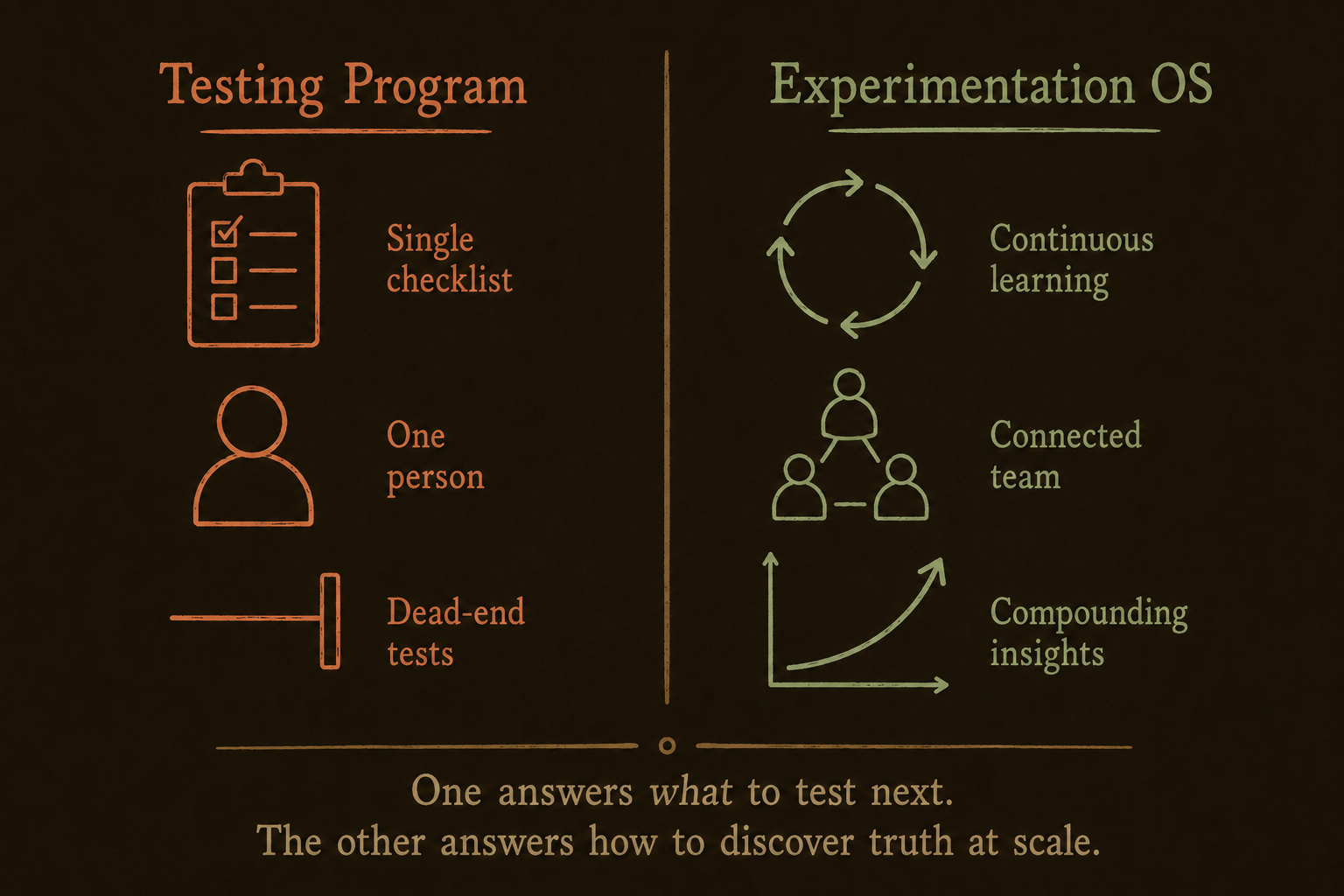
AI does not magically fix this. It does something more useful. It makes discipline cheaper. It removes the manual weight required to maintain structure and history. That is why AI belongs at the infrastructure layer, not as a shiny tool for copy or visuals.
AI strengthens three specific properties of an experimentation OS.
Instead of waiting for a channel team to notice a problem, models can continuously scan behavioral data, funnel drop-offs, search queries, support tickets, and qualitative feedback. They highlight zones of friction and opportunity that deserve experimentation.
The practical effect is that the backlog is seeded by evidence rather than anecdote. When a team proposes an experiment, they tie it to a pattern that the system has already observed.
Most organizations reinvent the experiment template for every test. Hypotheses vary in quality. Metrics are chosen late. Documentation is inconsistent.
AI can enforce a simple rule. No experiment enters the queue unless the hypothesis, target segment, success metric, risk, and decision rule are clearly specified. The system can auto-validate whether the metric is measurable, whether the sample size is realistic, and whether the experiment conflicts with another live test.
This does two things. It raises the floor on experiment quality and it makes outcomes comparable across time, teams, and markets.
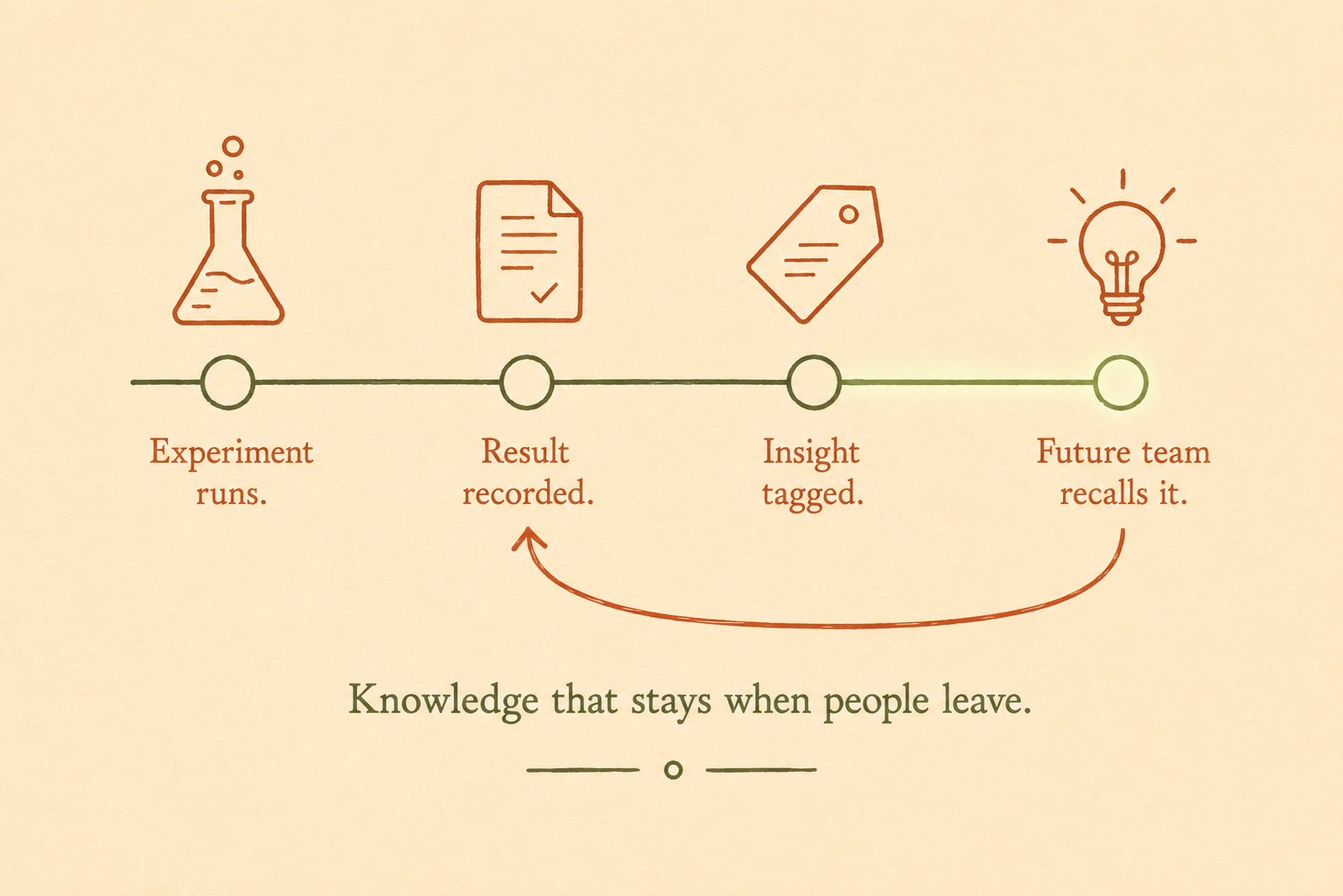
Every experiment produces a result, but very few produce reusable knowledge. AI solves this in two steps.
The OS starts behaving less like a spreadsheet archive and more like a living brain.
A functioning experimentation OS can be understood through six layers. Each layer has a clear responsibility. AI touches all of them, but never replaces human judgment.
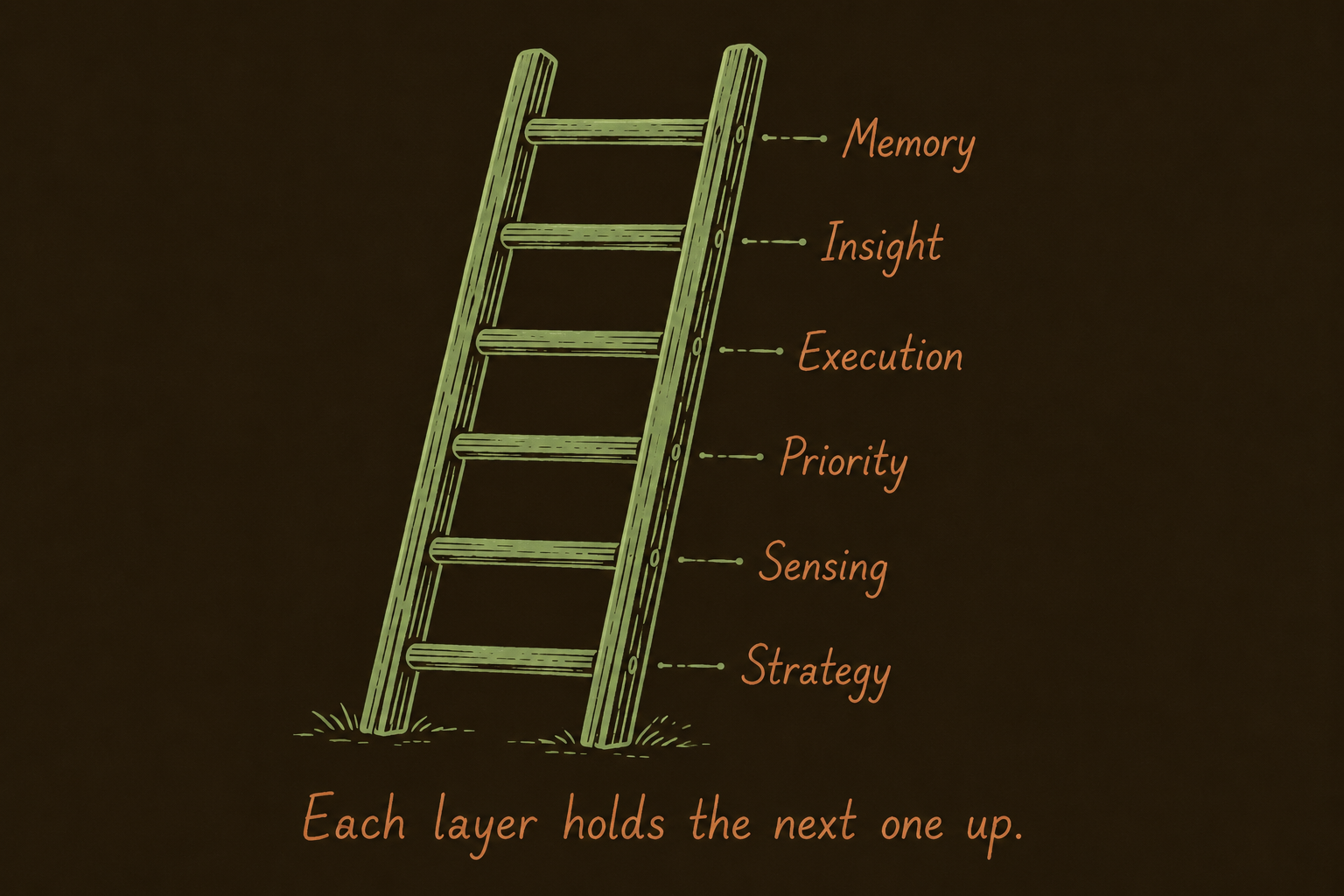
This layer connects experimentation to commercial reality. It defines where growth should come from and which behavioral shifts matter.
AI can help by:
Output: a hypothesis map that links outcomes like revenue, activation, repeat rate, and referral to concrete behavioral problems.
This layer turns hypotheses into specific experiment opportunities.
AI reviews behavioral data, session replays, and historical tests to suggest discrete opportunities, for example:
Each suggestion arrives with context, supporting evidence, and a draft experiment idea.
Output: a living backlog with opportunities scored for impact, confidence, and effort.
An organization that runs ten disconnected experiments does not build an OS. It needs a portfolio.
AI supports prioritization by simulating likely impact based on historical patterns and by surfacing constraints such as available traffic or overlap between tests. It can also help design a balanced portfolio across:
Output: a quarterly or monthly experiment portfolio that aligns with leadership objectives and resource constraints.
The execution layer is where operational risk lives. Bad targeting, broken tracking, interfering campaigns, or delayed QA can destroy trust in experimentation.
AI reduces risk by:
Output: cleaner launches, fewer errors, and a consistent standard of execution across teams and regions.
This is where most teams are already experimenting with AI. The opportunity is deeper than summary generation.
AI can:
The aim is to ensure that each experiment produces an insight that a decision maker can use, not just a set of numbers.
Output: consistent experiment reports that translate into clear decisions and next moves.
This is the compounding layer.
AI maintains a graph of relationships between hypotheses, tests, segments, and outcomes. When a product manager in a different market proposes a similar idea, the system can surface:
Output: less repeated work, faster learning cycles, and a shared library of proven and disproven ideas.
Conceptual framing is useful only if it leads to execution. A realistic path to an AI-enabled experimentation OS usually follows four phases.
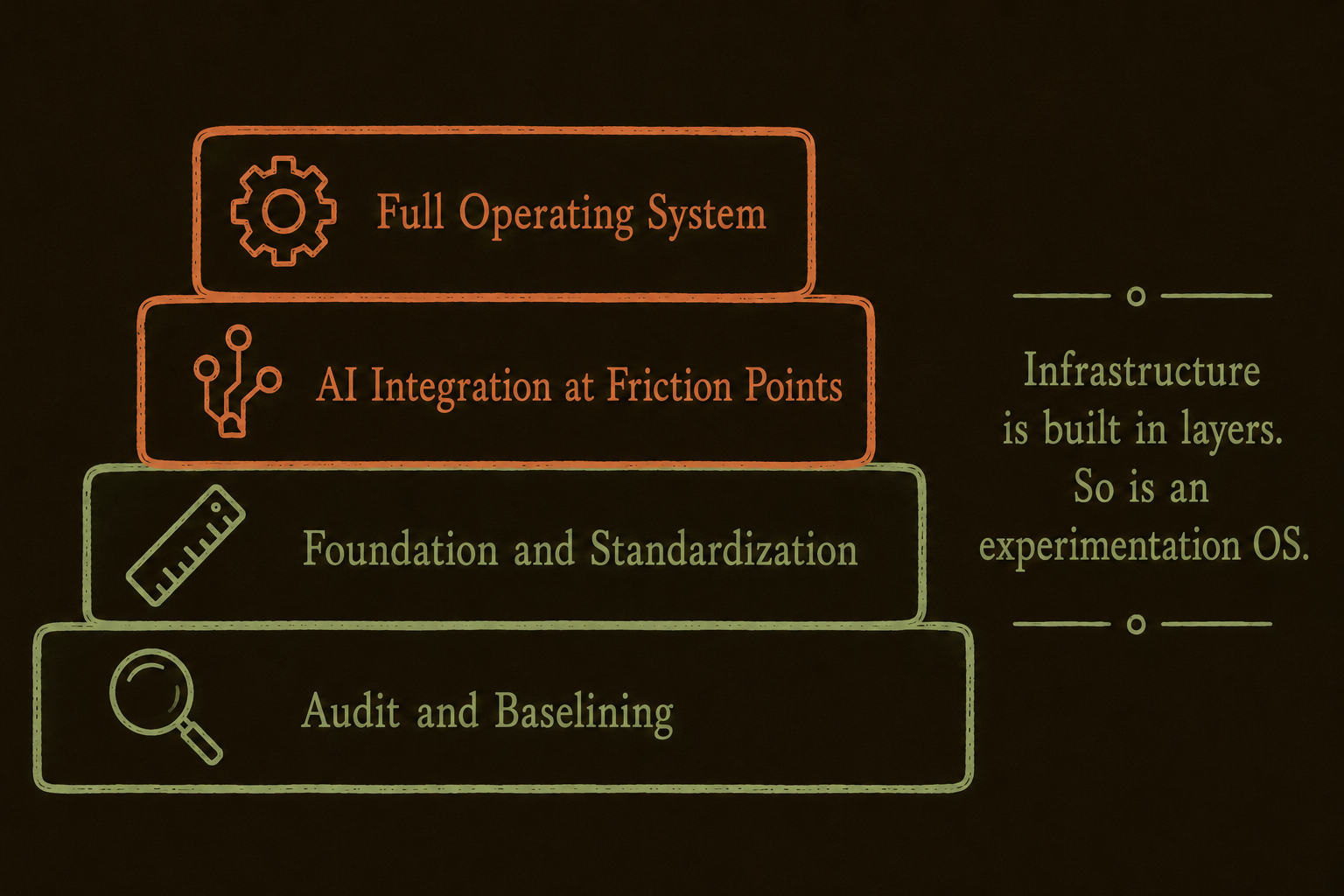
First, map what exists.
Outcome: a baseline of discipline, speed, and data health. Without this, AI simply accelerates existing chaos.
Next, introduce standard templates and minimum viable processes.
AI starts here as a helper, not an owner. It nudges teams when fields are missing, highlights conflicts, and ensures coherence.
Once the foundation is stable, integrate AI in the highest friction points.
Typical candidates:
Outcome: real time saved and fewer quality gaps in the process.
The final step is cultural and architectural.
At this stage, experimentation is no longer aqn isolated function. It operates as a growth operating system that influences channel strategy, UX decisions, and commercial planning.
Traditional CRO reports focus on uplift percentages. An experimentation OS adds a different layer of metrics.
AI can track and visualize these metrics continuously. The OS then becomes measurable, not aspirational.
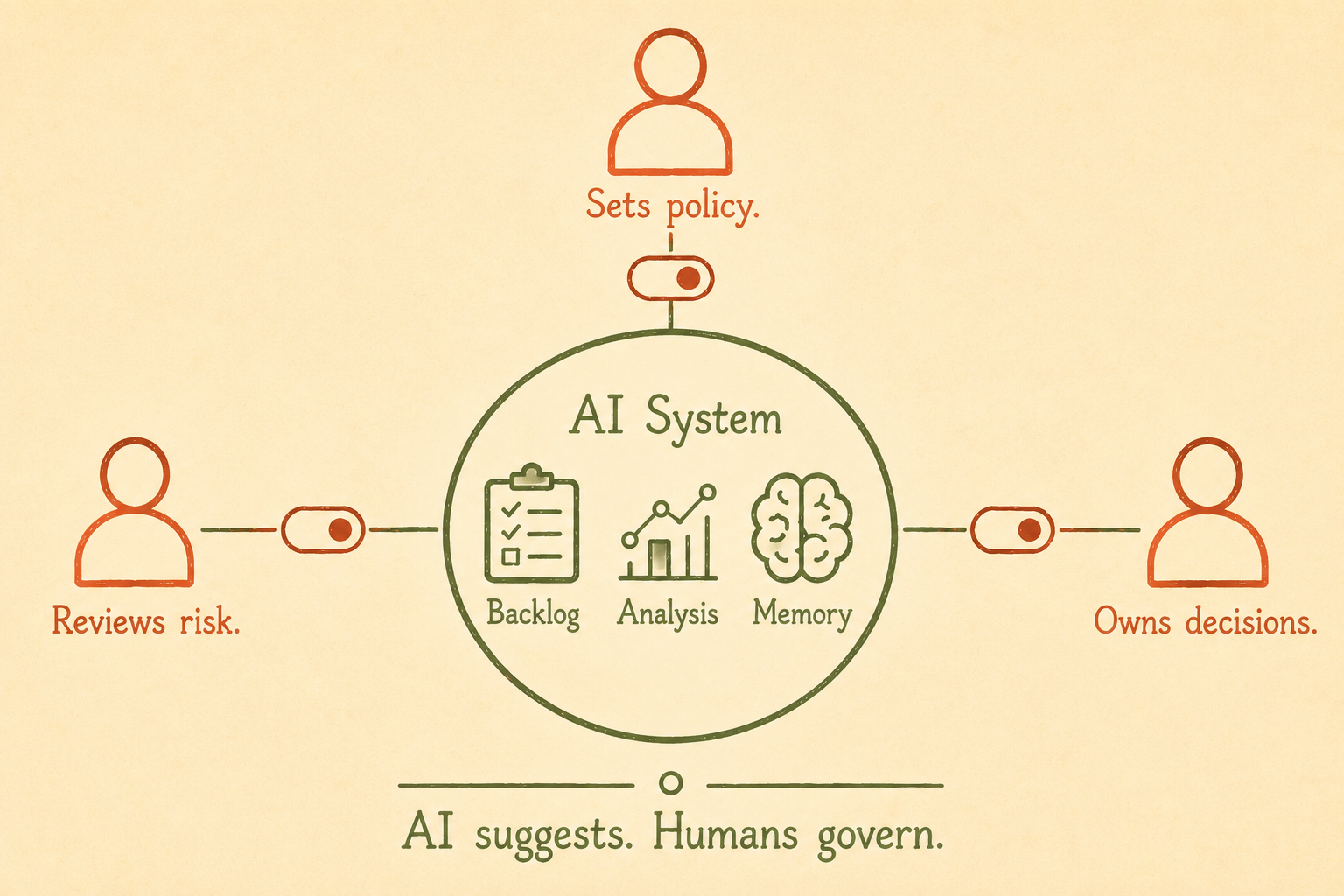
As AI assumes more responsibility in suggestion and analysis, governance becomes a design requirement.
Clear boundaries are essential:
A small governance group, often a mix of product, data, and risk leaders, sets policies for:
The aim is practical. Scale experimentation without eroding trust with customers or internal stakeholders.
Misuse of AI in experimentation tends to repeat in similar patterns.
An experimentation OS addresses these by design. It defines which parts of the loop can be automated, which stay human, and how outputs are stored.
The competitive advantage in the next cycle will not come from having more ideas. It will come from having an operating system that can test, learn, and reuse ideas with minimal friction.
An organization with an AI-enabled experimentation OS will:
CRO then stops being a narrow function that adjusts buttons and headlines. It becomes the learning spine of the business.
Also Read: How AI is going to redefine CRO in 2026
OptiPhoenix approaches experimentation as infrastructure. The focus is not on stacking more tests on a calendar. It is on designing the operating system that governs how those tests are imagined, run, interpreted, and remembered.
In practice, this means:
AI is treated as an enabler of discipline, speed, and memory, not as a shortcut. The ambition is clear. Create growth operating systems that help organizations think more clearly about their customers and act with more confidence in the face of uncertainty.
This is the promise of an experimental operating system. Not endless testing activity, but an AI-enabled CRO infrastructure that compounds learning and protects the organization from guesswork.
A CRO program focuses on individual tests. An experimentation operating system structures how an organization senses friction, runs controlled tests, extracts insight, and reuses that insight. It behaves like infrastructure. AI strengthens this system by reducing variance, maintaining memory, and enforcing standardized decision logic.
AI reviews behavioral data, historical experiments, and qualitative signals to surface evidence-backed friction points. It then structures hypothesis components into consistent formats. This removes intuition-led variability and ensures prioritization reflects real behavioral patterns rather than internal preference.
Without memory, teams repeat tests, lose insight during transitions, and fail to compound learning. AI captures insights, tags them across dimensions, and retrieves relevant history at the point of decision. This converts experiments into durable knowledge assets.
Leadership defines guardrails: strategic alignment, acceptable customer exposure, sensitive segments, and non-negotiable metrics. AI operates within these boundaries. Human oversight ensures that accelerated learning does not compromise ethics, brand trust, or long-term objectives.
Strong systems show compression of idea-to-launch time, consistent hypothesis quality, higher reuse of insights, reduced operational errors, and a balanced portfolio of short-term revenue tests and long-term learning tests. AI enables continuous tracking of these structural metrics.
AI validates targeting logic, checks metric integrity, detects anomalies during test runs, and ensures documentation completeness. This reduces the operational noise that typically erodes trust in experimentation.
AI can propose roadmap candidates based on behavioral patterns and past results, but governance requires human oversight. Autonomy accelerates discovery; judgment assigns priority and defines trade-offs.
AI identifies heterogeneous effects and behavioral sub-patterns that humans often miss. It isolates segment-specific drivers and recommends targeted follow-up tests to deepen learning.
It provides shared frameworks, consistent metrics, standardized documentation, and a unified backlog. AI ensures that insights surface when teams across product, marketing, and analytics engage with similar patterns.
As volume increases, the variance in hypotheses, metrics, and execution grows. Without AI enforcing structure and maintaining memory, experimentation becomes activity without learning. AI creates discipline at scale.