SAADAA × OPTIPHOENIX: A SIZE SELECTION REDESIGN DROVE A 20% CONVERSION RATE UPLIFT

AlterCall’s business question page is where non-qualified prospects work through a short application before reaching the calendar page to book a call. The form felt more like an application filter than a supportive entry point. Its phrasing risked making people defensive or doubtful about their own fit, discouraging openness. This aligned with the underlying data, nearly half of users, a 48% drop-off, abandoned the flow before ever reaching the calendar page.

OptiPhoenix partnered with AlterCall to test whether redesigning the question page would reduce that drop-off and move more prospects through to the calendar.
A question meant to qualify a prospect can easily read as a question meant to screen them out. When phrasing leans toward evaluation rather than support, prospects who are genuinely a good fit may still hesitate, unsure whether they measure up before they have even finished the form.
Open-ended questions with no visible structure compound that uncertainty. Without a sense of how many steps remain, a prospect has no way to judge how much more effort the form will take, which makes abandoning it at any point feel low-cost. The gap sat between a form designed to filter and prospects who needed to feel supported enough to finish it.
OptiPhoenix proposed that optimizing the question phrasing, providing selectable options instead of open-ended fields, and adding a progress bar for clarity of steps would make the form feel more supportive and less like a filter. This was expected to reduce drop-off and increase movement to the calendar page.
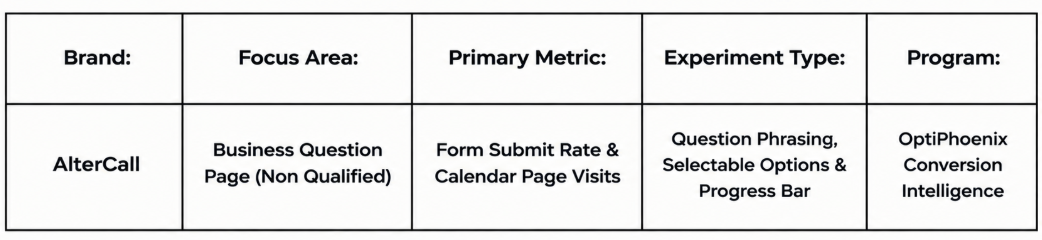
OptiPhoenix ran a controlled A/B test on AlterCall’s mobile Non Qualified business question page, over 13 days (14 to 28 January 2026), split 50/50.
Variant A (Original): The existing question page, using open-ended phrasing with no progress indicator.
Variant B (Test): The questions optimized for tone, selectable options provided in place of open-ended fields, and a progress bar added to give prospects clarity on how many steps remained.

Metrics measured: Form Submit rate, Calendar Page visits, AI Platform Trial Page visits, and interaction rates with individual form questions.
Making the form feel more supportive, and less uncertain to complete, moved more prospects through to the calendar.
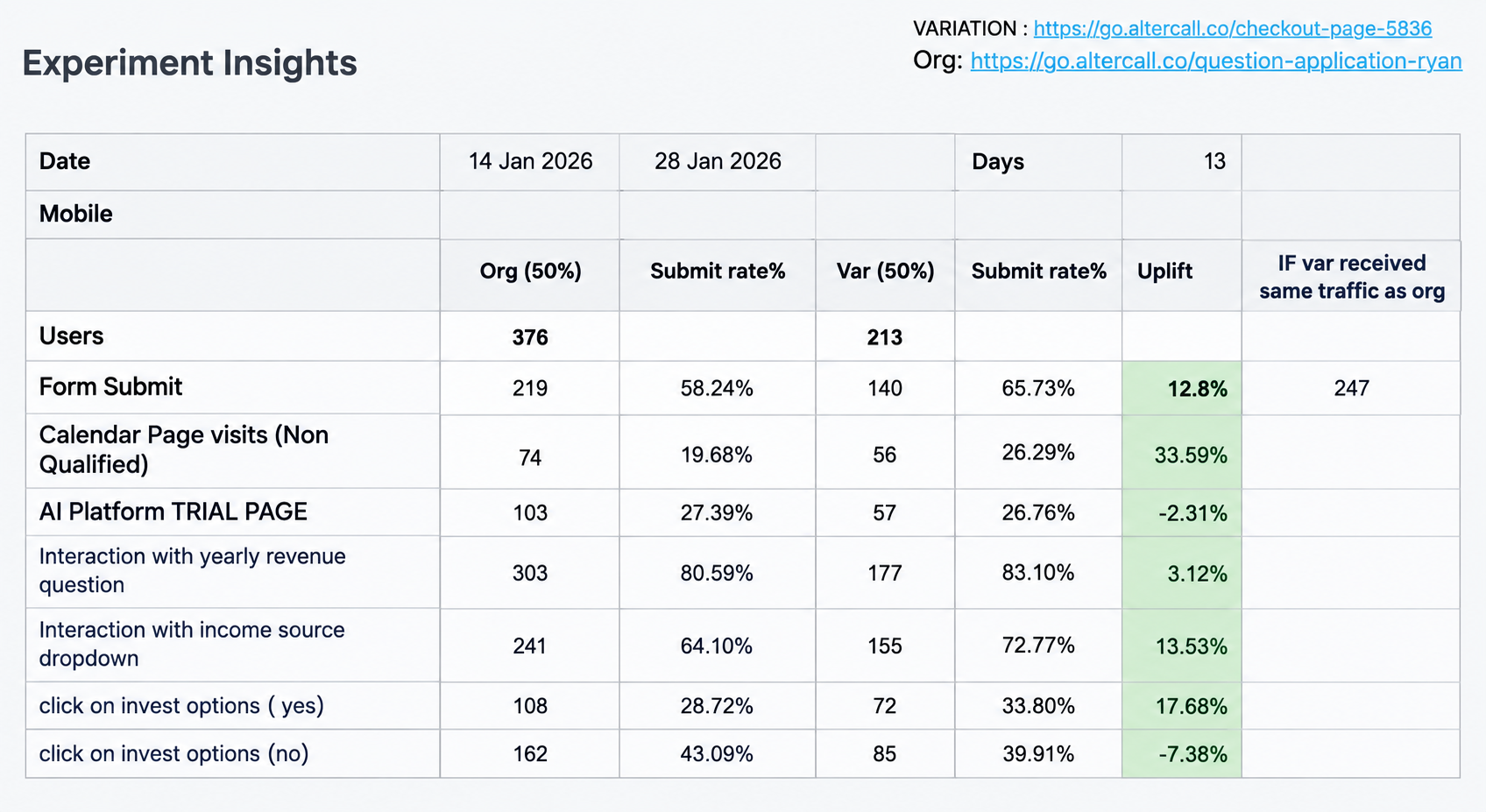
Form Submit rate rose from 58.24% to 65.73%, a 12.8% increase. Calendar Page visits among Non Qualified prospects rose from 19.68% to 26.29%, a 33.59% increase. Interaction with the income source dropdown rose 13.53%, and clicks on “yes” for the invest options question rose 17.68%. Interaction with the yearly revenue question rose 3.12%.
Two metrics moved in the opposite direction. AI Platform Trial Page visits declined 2.31%, and clicks on “no” for the invest options question declined 7.38%.

Reducing perceived filtering increases follow-through. The 33.59% increase in Calendar Page visits, well above the 12.8% Form Submit increase, suggests that prospects who completed the form under the redesigned version were also more likely to continue past it, not just more likely to finish the form itself.
A decline in one metric does not always mean a worse outcome. The 7.38% drop in “no” clicks on the invest options question moved alongside a 17.68% increase in “yes” clicks, a shift worth watching rather than treating as a loss on its own.
Not every downstream metric moved with the test. AI Platform Trial Page visits declined slightly, a reminder that a change aimed at one part of the funnel does not automatically lift every metric that follows it, and that later steps may need their own attention.
AlterCall’s non-qualified prospects were not disengaged from the start, they were responding to a form that felt like a filter rather than an invitation. By optimizing the phrasing, replacing open fields with selectable options, and adding a progress bar, OptiPhoenix closed that gap, and more prospects carried their momentum through to the calendar page.