SAADAA × OPTIPHOENIX: A SIZE SELECTION REDESIGN DROVE A 20% CONVERSION RATE UPLIFT

The product detail page is where a shopper decides, and the offers that lower the price are often what tips that decision. On Neeman’s PDP, those offers were hard to reach. Coupon and payment offers sat behind a “View Offer” CTA that triggered an auto-scroll to a lower section of the page. A shopper had to tap, wait for the scroll, and read before they understood what they could save.
The savings were real. A shopper looking at a 50% launch discount, with stacked coupon and payment offers on top, was sitting on meaningful value. The page just kept that value one interaction removed from the moment of decision.
OptiPhoenix partnered with Neeman’s to test whether surfacing those offers earlier on the PDP would improve conversion and the value of each order.
The problem was not that shoppers disliked the offers. It was that they never saw them in time.
A coupon a buyer never discovers does the same behavioral work as no coupon at all. By gating the offer behind a CTA and an auto-scroll, the page asked shoppers to work for the information that should have been doing the persuading. The countdown timer that created urgency was also low in the visual order, so the one element designed to push a decision was easy to miss. The gap was discovery, sitting between an offer that existed and an offer a shopper could act on before they left.
If active coupons and payment offers are surfaced directly on the PDP, with the most relevant coupons shown first and the countdown timer made more visible, shoppers will discover their savings before they decide and proceed to purchase at a higher rate.
OptiPhoenix ran a controlled test on the PDP offer experience with one control and three variations:
Variant A (Control): The original PDP, with offers hidden behind a “View Offers” CTA that auto-scrolled the shopper to a lower section.
Variant B (Variation 1): Offers surfaced inline through a carousel, with upsell coupons prioritized first and the countdown timer moved into the pricing section.
Variant C (Variation 2): The inline carousel retained, with payment offers prioritized ahead of upsell coupons and a cleaner visual treatment.
Variant D (Variation 3, Winner): The inline carousel combined with tabbed navigation, letting shoppers switch between Active Coupons and Payment Offers. Active Coupons showed by default, the countdown timer was made clearer, and the offer hierarchy was tightened.
Duration: 9 days
Metrics Measured: conversion rate, revenue per visitor, average order value
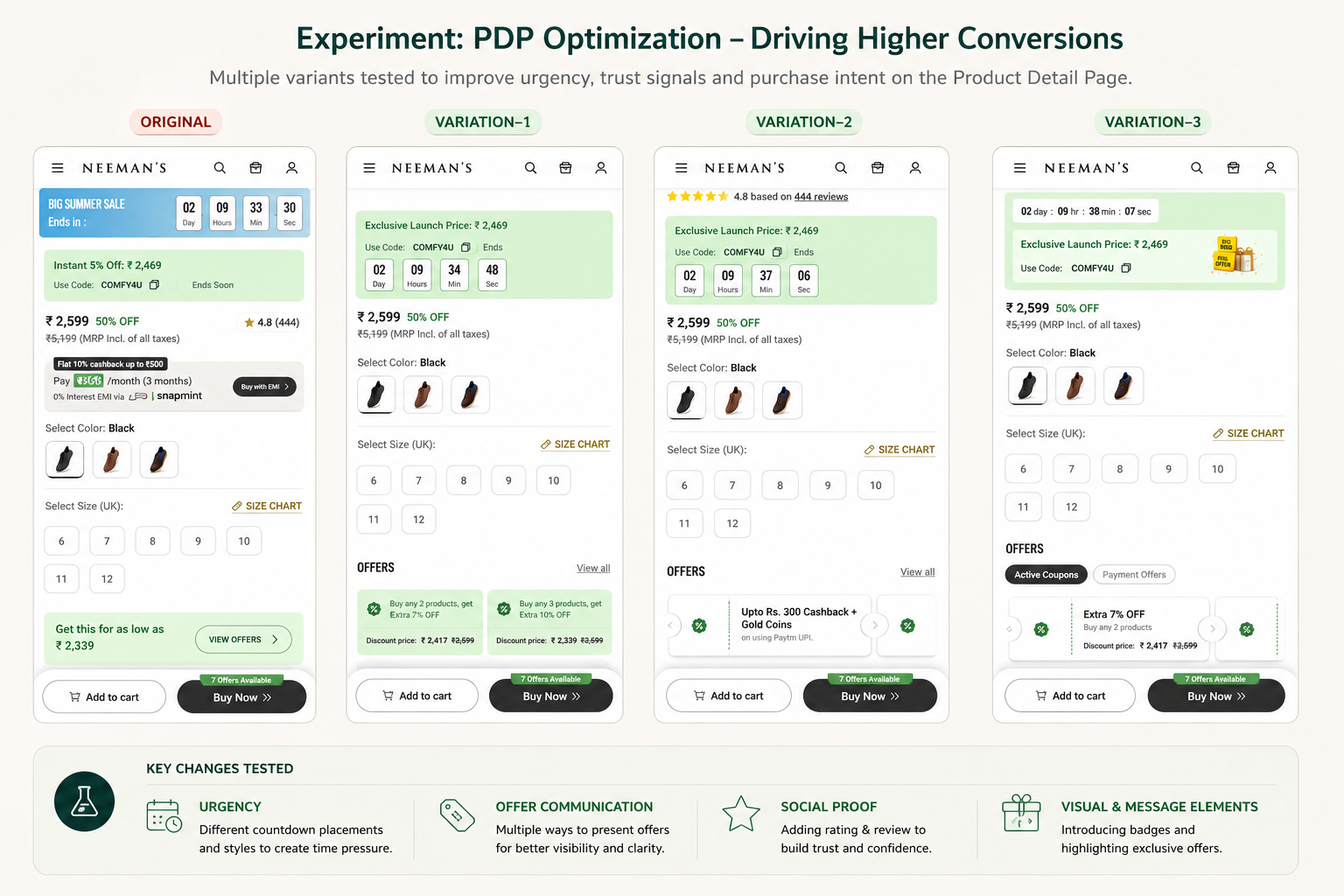
Variation 3 won. Giving shoppers a tabbed, default-visible view of their savings, with a clearer countdown, moved more of them through to purchase and raised the value of each order.
Revenue per visitor rose 6.02%. Average order value rose 3.05%. The shoppers who could see and switch between coupons and payment offers without leaving the page behaved measurably better than those who had to go looking.
A change to where and how offers appeared on the PDP, with no new discounts and no change to product or pricing, lifted revenue per visitor by 6.02%.

A discoverable offer is the only kind that converts. The coupons and payment offers were already there. Surfacing them at the moment of decision, rather than behind a CTA, is what turned them into revenue.
Hierarchy decides what gets seen. Active Coupons shown by default, with the timer made visible, outperformed versions that buried the same content one tab or one scroll deeper. The content was identical; the ordering was not.
Tabs beat scrolling for dense offer content. When shoppers could switch between coupon types in place, they engaged with more of the offer set than when offers were stacked in a carousel they had to scroll through.

The offers already existed. The discounts were already live. The only thing missing was a layout that let shoppers see their savings clearly at the moment they decided. This experiment showed that in D2C footwear, the difference between a purchase completed and a product page abandoned can come down to whether a shopper sees the offer before they look away.