SAADAA × OPTIPHOENIX: A SIZE SELECTION REDESIGN DROVE A 20% CONVERSION RATE UPLIFT
Flo Mattress is a D2C sleep and bedding brand from India, focused on delivering high-quality, comfortable sleep solutions by blending thoughtful engineering with customer-centric design. The brand re-engineers traditional mattress supply chains to remove unnecessary middlemen and pass cost savings directly to customers. On the Product Detail Page for its Ergo mattress, product imagery relied on static and technical visuals. Understanding the product’s value meant navigating an image carousel filled with technical content rather than real-world context, which created friction in the decision-making process and could slow comprehension.

OptiPhoenix partnered with Flo Mattress to test whether replacing that technical imagery with benefit-led lifestyle visuals would reduce that friction and improve conversion.
A technical diagram can explain what a feature is. It does not always explain what that feature means for the person lying on the mattress.
Shoppers evaluating a mattress are trying to picture how it will actually feel and perform in their own life, not just read a specification. Static, technical imagery left that translation up to the shopper. The gap sat between features that were technically accurate and a shopper who needed to understand what those features would mean for them in practice.
OptiPhoenix proposed that replacing static and technical product imagery with benefit-led lifestyle visuals would communicate key mattress features and real-world benefits more quickly. This was expected to enable faster value comprehension, strengthen purchase intent, and drive a higher conversion rate.

OptiPhoenix ran a controlled A/B test on the Ergo PDP.
Variant A (Control): The original image gallery, relying on static product shots and technical imagery to communicate mattress features.
Variant B (Test): Four images replaced with benefit-led lifestyle visuals. The first demonstrated Motion Isolation in a real-world scenario, the second highlighted Responsive Foam and body contouring benefits, the third showcased 3D Air-Flow Technology and cooling performance, and the fourth emphasized the Hydrating Aloe Vera Gel Cashmere Cover and its comfort benefits.

Metrics measured: Conversion Rate and Revenue.
Showing shoppers what each feature meant in real life, rather than what it looked like technically, moved more of them toward a purchase.
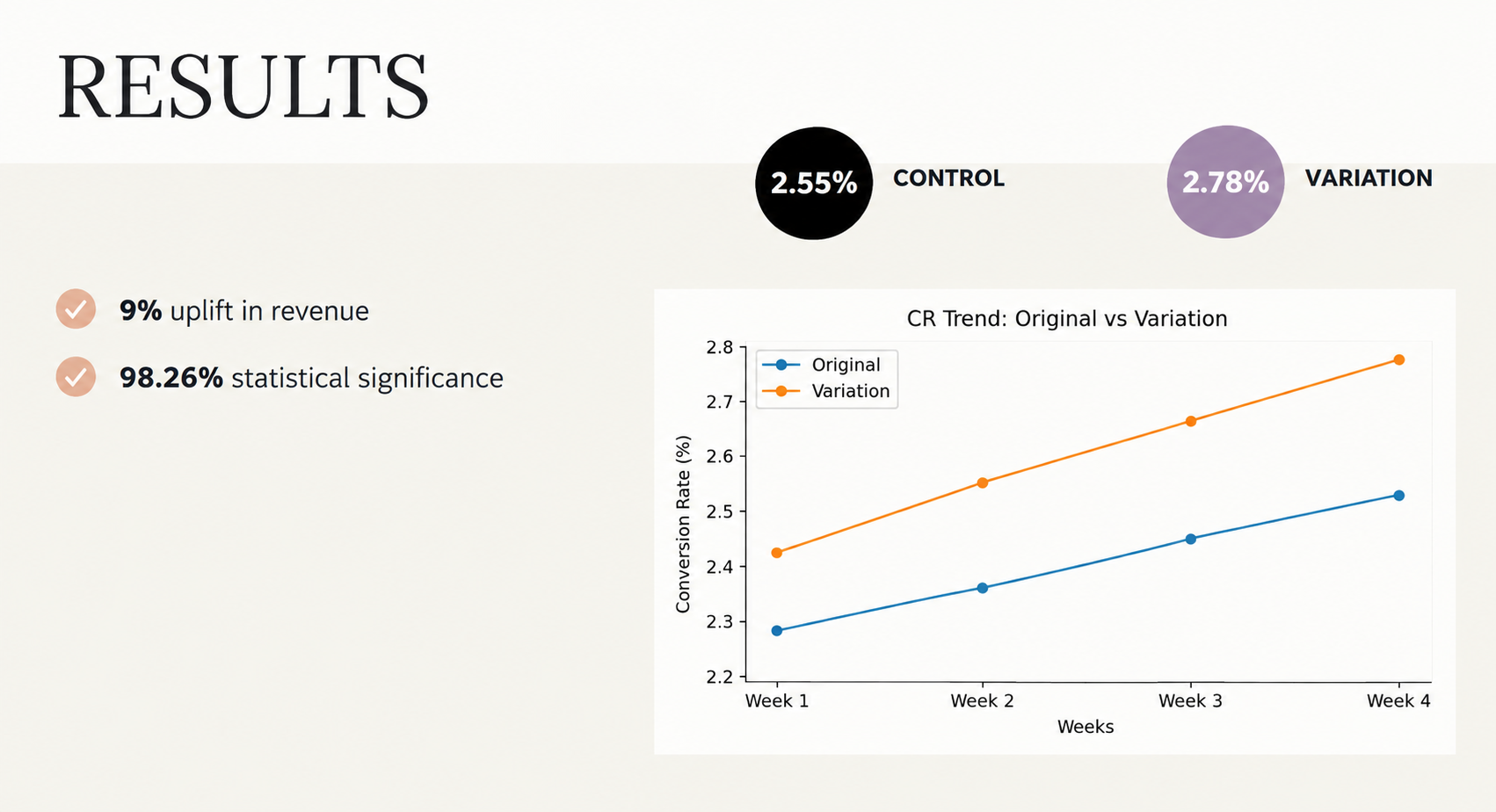
Conversion Rate rose from 2.55% to 2.78%, an 9% increase, reaching 98.26% statistical significance. Revenue rose 9% over the same test.

A feature only sells once a shopper understands what it does for them. Motion Isolation, Responsive Foam, and Air-Flow Technology were present in the product either way. Showing them in a real-world lifestyle context, rather than as technical callouts, closed the gap between what the product does and what the shopper stood to gain.
Comprehension speed affects purchase intent. When shoppers had to interpret technical imagery themselves, that extra mental step slowed the path to a purchase decision. Lifestyle visuals removed that interpretation step entirely.
This result carries strong statistical confidence. At 98.26% significance, this is one of the more reliable results in Flo Mattress’s testing program, giving clear grounds to apply the same benefit-led imagery approach to other product pages.

Flo Mattress’s Ergo PDP was not short on information, it had technical detail on every feature. What it lacked was a way to show shoppers what that detail actually meant for their own comfort. By replacing static, technical imagery with benefit-led lifestyle visuals, OptiPhoenix closed that gap and shoppers understood the product’s value faster.