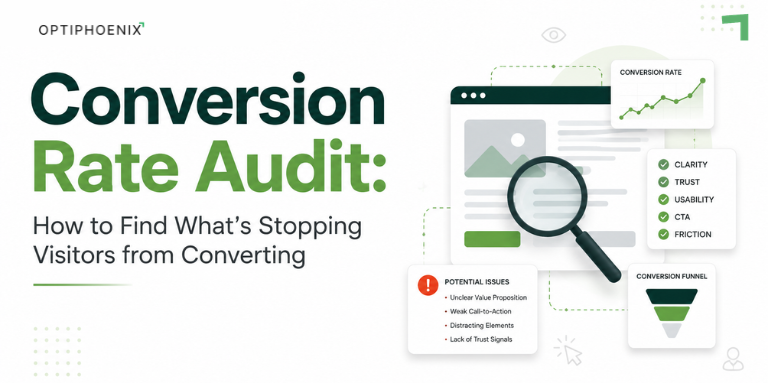
Conversion Rate Audit: How to Find What’s Stopping Visitors from Converting
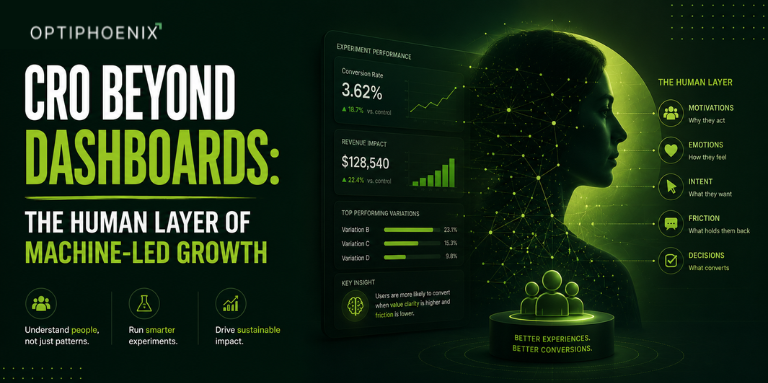
Organizations often assume that increased automation leads to better decisions. Dashboards become richer, models more accurate, and workflows more autonomous. Yet growth stalls. The reason is structural. Machines accelerate execution, but judgment determines direction. Without a disciplined human layer guiding AI systems, businesses optimize faster but not necessarily smarter.
CRO in 2026 requires a blended intelligence model. The machine identifies patterns. The human interprets meaning. The system evolves only when both layers work in sequence. Dashboards and algorithms are instruments; judgment is the operating logic that makes them useful.
1. Why Automation Alone Does Not Produce Sustainable Growth
2. The Missing Layer: Human Judgment as Infrastructure
3. The Evolution of CRO: From Measurement to Meaning
4. The Judgment Stack: A Practical Model for AI-Enabled CRO
5. Where Machines Excel and Where Humans Must Lead
6. The Cost of Weak Judgment in AI Systems
7. The Human Role: Turning Data Into Understanding
8. The Leadership Responsibility in Machine-Led Growth
9. Structures That Support Judgment
10. The Role of Behavioral Insight in Machine-Led Systems
11. A First-Principles View of AI-Augmented Judgment
12. The Future: Judgment-Led AI Systems
Automation improves speed. It does not improve judgment. Most dashboards describe the past with precision but cannot interpret why behavior shifted or what decisions matter next. AI systems predict patterns but cannot understand context, strategy, or human motivation without guidance.
Businesses that rely solely on automation fall into three traps:
Machine-led growth becomes sustainable only when humans define the guardrails, interpret signals with empathy, and correct AI-driven drift.
Traditional CRO frames judgment as a skill. In a machine-led environment, judgment becomes infrastructure. It operates as the logic layer that connects predictions to decisions.
Judgment has four responsibilities:
Machines detect what happened. Humans understand why. Judgment distinguishes between friction caused by UX gaps, cognitive overload, unmet expectations, or emotional discomfort.
Not all uplift is equal. Judgment determines which outcomes compound over time and which create short-lived gains.
AI can optimize without principles. Humans ensure that optimization respects autonomy, privacy, and brand integrity.
Every decision influences opportunity cost. Judgment assesses these trade-offs across channels, journeys, and teams.
This human layer ensures that machine-led systems do not drift into narrow optimizations that weaken long-term growth.
Early CRO focused on measurement: numbers, lifts, charts, and dashboards. The goal was accuracy. AI introduced predictions. The goal became speed.
The next stage requires meaning. Organizations must transition from “What changed?” to “What matters?” and then to “What should we learn next?” This shift demands human interpretation built on behavioral insight, domain expertise, and structured reasoning.
Measurement without meaning produces noise. Meaning without structure produces inconsistency. The system succeeds only when both integrate.
To operate reliably, judgment needs structure. A judgment stack creates that structure across five layers.
Understand the behavioral context behind the data. What anxieties, motivations, or expectations shaped the observed pattern? AI shows the symptom; humans identify the underlying cause.
Translate observations into precise questions. What decision does the organization need to make? What unknowns matter? Framing defines the boundary of the experiment.
Compare experimental outcomes against strategic priorities, ethical constraints, and customer well-being. Evaluation prevents over-reliance on metrics that distort reality.
Make a choice that fits both evidence and long-term value creation. Machines suggest. Humans decide. Clarity of decision logic matters more than speed.
Feed the outcome back into the system in a form that AI can learn from. This closes the loop. The organization becomes smarter with each cycle.
This stack transforms judgment from intuition into an operational asset.
Machines reduce cognitive load. Humans elevate cognitive quality. Both must operate but never in isolation.
When judgment is absent or inconsistent, automation magnifies errors.
Systems chase the easiest measurable uplift, ignoring long-term levers such as trust, retention, or brand perception.
AI detects micro-patterns that lack strategic significance. Teams start optimizing edge cases rather than core journeys.
Without boundaries, AI personalizes in ways that feel intrusive, manipulative, or insensitive.
Dashboards create an illusion of clarity. Decision-makers assume accuracy equals correctness. Growth plateaus because decisions lack depth.
These failure modes do not come from weak models. They come from weak interpretation.
Data explains behavior at the surface level. Understanding explains behavior below it.
Empathy is not sentiment. It is the ability to reconstruct the customer’s cognitive and emotional state during the interaction.
Humans form narratives to interpret patterns. These narratives guide trade-offs, risk assessments, and prioritization.
AI finds correlations. Humans determine relevance. Without relevance, optimization becomes random motion.
CRO teams must evolve from analysts to interpreters of behavior.
Leadership must redefine how growth decisions are made. This involves:
Which decisions can machines make? Which requires human oversight? Where are the risks unacceptable?
AI needs direction. Leadership clarifies which outcomes matter this quarter, this year, and over the customer lifetime.
Teams must articulate their reasoning, not only their numbers. Judgment becomes explicit, documented, and teachable.
Growth systems must operate in ways that reinforce customer confidence. Leaders ensure that machine decisions respect the brand’s values.
The machine accelerates. Leadership steers.
Judgment improves when organizations build systems around it. Three structures matter most.
Clear models for evaluating trade-offs ensure consistency across teams. Examples include:
These frameworks help teams reason from first principles rather than preference.
AI retrieves prior tests. Humans interpret why they succeeded or failed. Memory prevents repetition and establishes cumulative learning.
Interpretation strengthens when product, marketing, design, and data debate insights together. Different lenses reveal deeper understanding.
Machines optimize efficiently. Humans optimize wisely.
Behavioral insight acts as the decoder for machine predictions. It converts a statistical lift into an understanding of underlying motivation.
Why did users hesitate? Was the barrier informational, emotional, or contextual?
What promise did the interface fail to meet?
Did users see the cost as higher than the benefit?
Behavioral insight provides the missing structure that dashboards cannot supply.
A machine-led CRO system operates on probability. A human-led CRO system operates on meaning. Growth depends on merging both.
The first-principles model is simple:
This loop builds a resilient growth system that adapts to evolving customer behavior, not just historical data.
The next generation of growth systems will not be fully autonomous. They will be judgment-led. AI handles volume, complexity, and speed. Humans establish purpose, ethics, and direction.
A judgment-led AI system has four properties:
This structure produces growth that compounds rather than oscillates.
OptiPhoenix designs growth systems where AI and human judgment operate together. The focus is not on automation for its own sake. It is on clarity. Machines accelerate experimentation loops. Human leaders define purpose, ethics, and direction. Behavioral insight translates signals into meaning. Structured decision frameworks convert meaning into action.
OptiPhoenix functions as a thinking partner. The objective is to help organizations build growth systems that learn quickly, adapt responsibly, and make decisions with confidence. Automation strengthens execution. Judgment strengthens strategy. The combination creates sustainable, machine-led growth grounded in human clarity.
Automation identifies patterns, predicts outcomes, and accelerates execution. It does not understand intention, emotion, or strategic relevance. The judgment layer evaluates whether a predicted outcome aligns with long-term value, ethical boundaries, and customer well-being. This prevents AI-driven systems from optimizing in ways that undermine retention or trust.
Judgment clarifies hypotheses, interprets behavioral drivers behind data, and determines which insights matter. It defines trade-offs, sets guardrails, and ensures that experiments answer strategic questions rather than chasing superficial lifts. AI produces information. Judgment produces understanding.
Dashboards create a false sense of clarity. Teams mistake visibility for comprehension. This leads to misaligned optimization, overreaction to noise, and decisions based solely on what the dashboard can measure rather than what actually influences customer behavior or lifetime value.
Organizations can establish decision frameworks, hypothesis templates, evaluation matrices, and ethical boundaries that standardize reasoning. This transforms judgment from individual intuition into an operational capability that survives team changes and scales across markets.
Behavioral insight explains the motivations, anxieties, and expectations behind observed patterns. AI detects friction. Behavioral insight explains its origin. This combination enables experiments that solve real human problems rather than surface-level interface issues.
AI handles pattern detection and predictive tasks. Human judgment frames the problem, interprets intent, and makes decisions that consider ethical, strategic, and emotional dimensions. Both layers create a learning system that adapts reliably.
It can become highly automated, but it cannot become judgment-free. Certain decisions require ethical reasoning, strategic framing, and contextual understanding that machines cannot replicate. Automation will amplify execution, not replace leadership.
Framing defines which questions AI should answer and which outcomes matter. Without framing, AI optimizes toward locally efficient metrics that may have little impact on retention, trust, or profitability.
By defining clear boundaries for what AI can and cannot optimize, setting guardrail metrics focused on customer trust and long-term value, and reviewing machine recommendations through a structured judgment framework.
Accuracy describes the past. Interpretation explains meaning. Without interpretation, teams cannot distinguish between patterns worth acting on and patterns caused by noise, seasonality, or unobservable factors.