AI Agent vs Chatbot: What’s the Difference for Your Store?

Competitor analysis for CRO goes wrong the moment it turns into copying. Say someone screenshots a rival’s product page, decides “they must have tested this,” and the team copies it by Friday. Sometimes that works. Other times you’ve copied a change nobody proved, onto a site with different customers and a different price. This post covers how to study other sites without doing that. We’ll look at who to study, how to compare them, what’s worth taking and what to skip.
You can see what a competitor shows. You can’t see what it did to their numbers. That gap matters.
Ron Kohavi and Stefan Thomke put figures on how often ideas work, even inside companies with huge testing programs. Writing in Harvard Business Review, they report: “At Google and Bing, only about 10% to 20% of experiments generate positive results.” At Microsoft as a whole, “one-third prove effective, one-third have neutral results, and one-third have negative results.” They add that “even experts often misjudge which ones will pay off.”
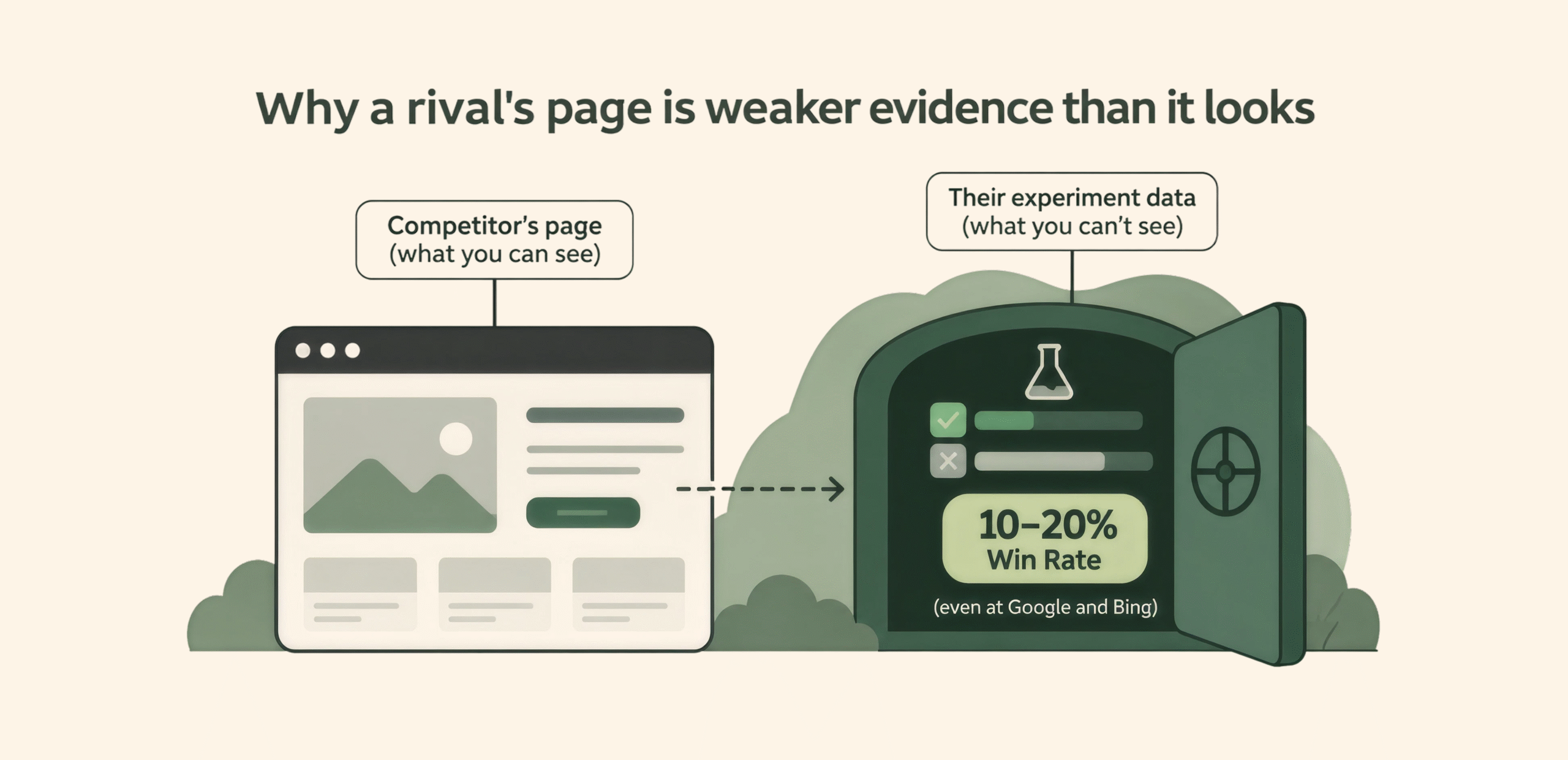
Now look at a rival’s page with that in mind. The new badge or layout might be a winner. It might also be a loser nobody has caught yet. From the outside you can’t tell.

CXL’s guide to competitive analysis makes a related point. Competitors’ choices are often untested, so treat whatever you borrow as a hypothesis. We’d go a little further and treat a rival’s page as a list of questions to ask your own customers.
It’s tempting to study the three rivals you already know. That’s a start, but it’s narrow.
Add the alternatives your customers actually weigh. Sometimes that’s a marketplace, a different kind of product, or doing nothing. You don’t have to guess. A line in a post-purchase survey, such as “Where else did you look before buying from us?”, can tell you.
Then add a few sites from other categories that do one task well, like returns or checkout. Invesp’s guide suggests three to five brands, including indirect ones. We’d keep the list short enough that you can study every site closely.
Skip the homepage review. Pick the jobs a shopper hires a site to do. Find a product that fits. Work out the real price with delivery. Get an answer to a question before buying. Pay.
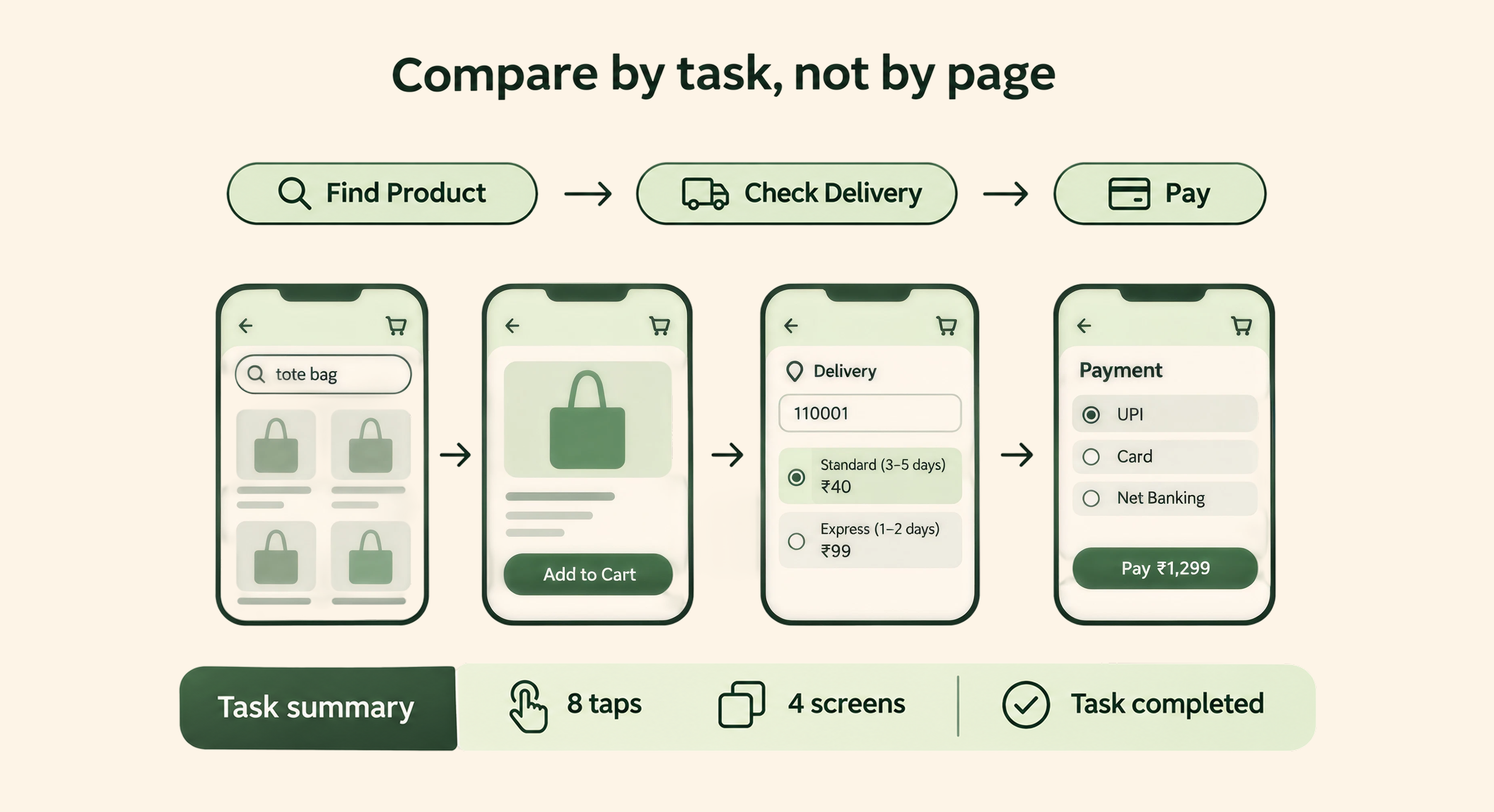
Do each job on every site, on a phone first. Write down how many taps, fields and screens it took. Take dated screenshots as you go. Archived copies of pages (the Internet Archive keeps many) show how long something has been there. Time on a page isn’t proof that it works, though.
Then run the same jobs on your own site, on the same device. Counts give you something to compare. Screenshots and opinions don’t. The gaps that show up are friction you can measure, which beats arguing about taste.

Not every competitor deserves the same weight. CXL’s guide describes a scoring method from Brian Massey of Conversion Sciences. You give a competitor points for the optimization tools its site runs, with the most points for an A/B testing tool. The higher the score, the more weight he gives that competitor’s choices, and a low score calls for skepticism.
It’s a rough filter, since you still see only the page and never the results.
Even a proven idea can fail when it moves to a different site. Before you copy something, check two things.
Do their visitors arrive the way yours do, and is their price and buying decision close to yours? Then ask whether you can deliver what the page promises.
If any answer is no, take the idea to your own customers as a question.
Once your notes are done, put every observation into one of three bins. This is the method we use.
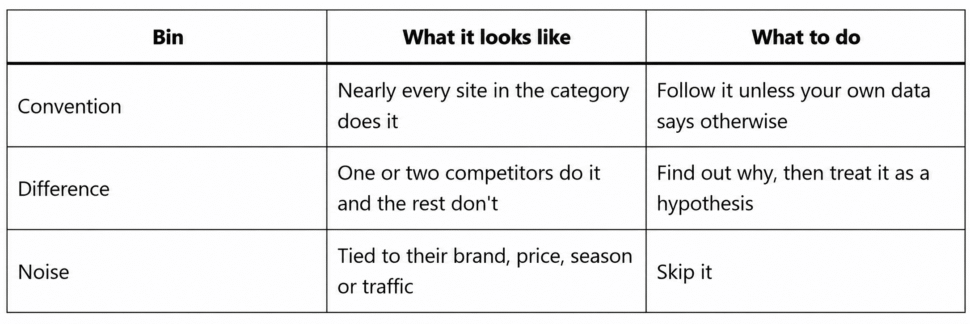
Conventions come first. Jakob Nielsen’s law says “users spend most of their time on other sites.” That “means that users prefer your site to work the same way as all the other sites they already know.” When every site you checked does something the same way, a clever alternative asks your visitors to learn something new.
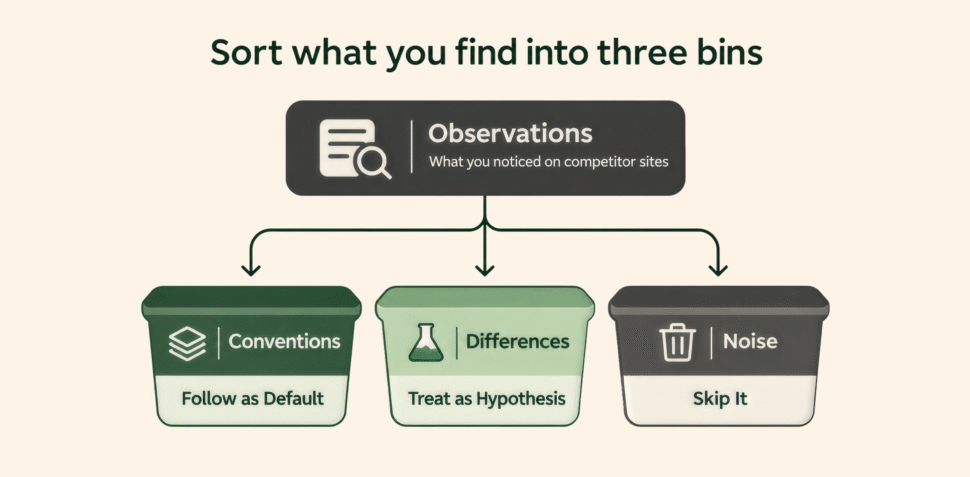
Agreement among competitors isn’t proof either. We treat a convention as the default, and your own data can overrule it.
Differences are where the learning is. Say one competitor shows an estimated delivery date right under the add-to-cart button, and nobody else does. Before you copy it, ask what problem it solves. If your support inbox is full of “when will it arrive?” messages, you have a reason. If it isn’t, the delivery date is interesting but not a priority.
Public reviews of a competitor show what buyers wanted and where the product or service let them down. The complaints show gaps you could answer. A pattern of “sizing runs small” or “returns took weeks” on a rival’s page is one example.
Pull a batch of reviews, tag them by theme and count. Reviews skew toward people who stuck around long enough to post one, so the counts only describe the people who posted. Use them to find themes. Our post on AI-assisted research synthesis covers how to cluster text like this and check each claim against its source. CXL also suggests interviewing a competitor’s customers directly, which takes more effort.
Write each keeper as a hypothesis, with your own evidence beside it. Note what you saw on their site, what your data says, what you’ll change, and which number should move. If you can’t fill in the line about your data, the idea drops to the bottom of the list.
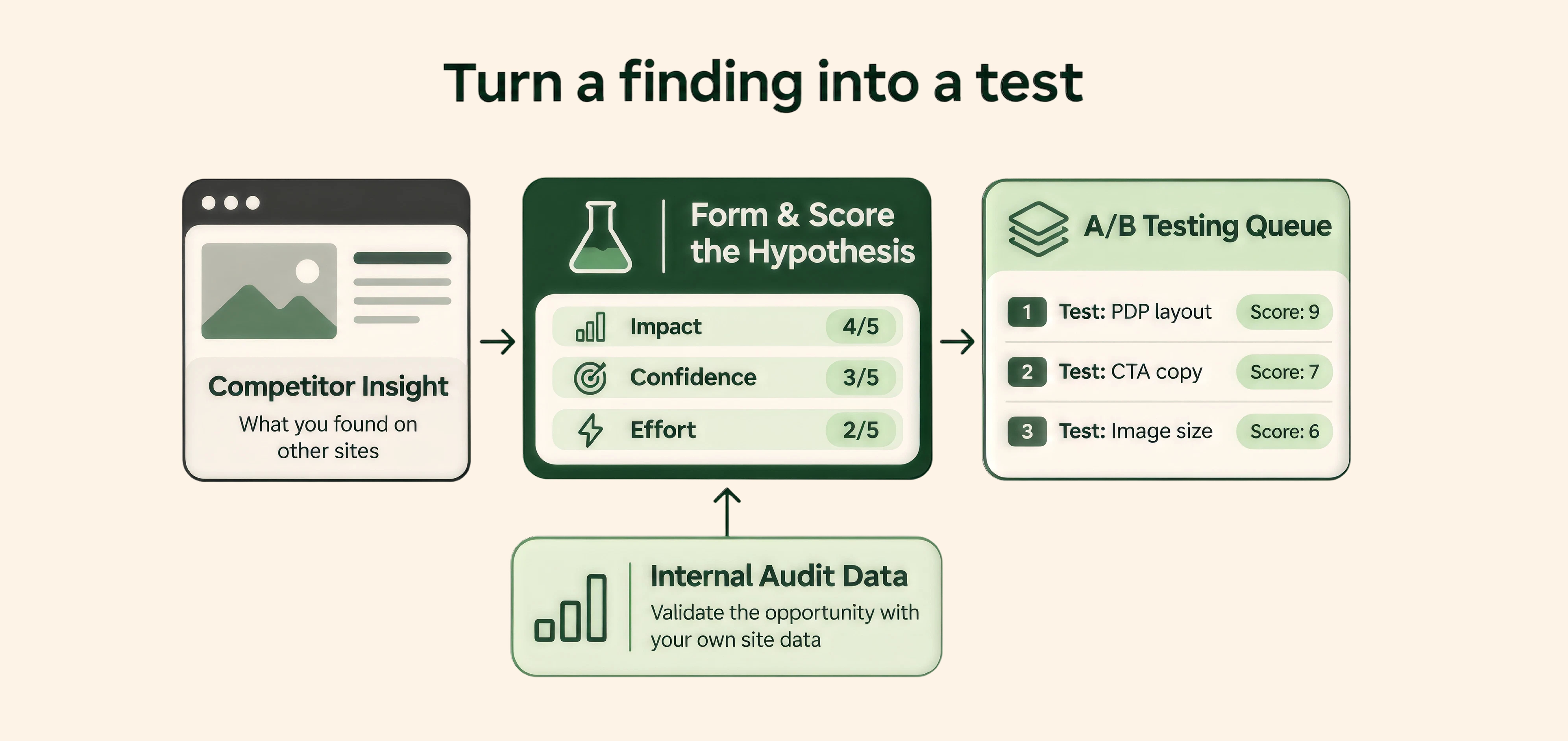
Your own site is the better source of evidence. A conversion rate audit shows where your visitors actually get stuck, and that’s what a competitor idea has to answer to.
Then score it like anything else. Have people score on their own before you talk, since seeing someone else’s number pulls your own toward it. Our post on why conversion audit scores feel objective but aren’t explains the research. After that, decide what to test first and plan how long each test needs.

Plan for some of these ideas to lose. Even at Google and Bing, only 10% to 20% of experiments win, and a competitor-inspired idea gets no special pass.
If you’d like a second pair of eyes on how your site compares, we’ll walk through it with you. Talk to our team about a competitor review.
Invesp’s guide suggests three to five brands, including indirect ones. Whatever number you pick, keep it small enough to study each site closely, and include the alternatives your customers consider.
Learn from the idea and write your own copy and design. Then test it before you roll it out. We’re not lawyers, so check with one before you reuse anything that might be protected.
Not from outside the company. Tools can estimate traffic and conversions, but those are modeled figures. Treat them as rough.
Set a fixed schedule and run one review before any redesign. A schedule keeps the work from turning into a reaction to every rival launch.