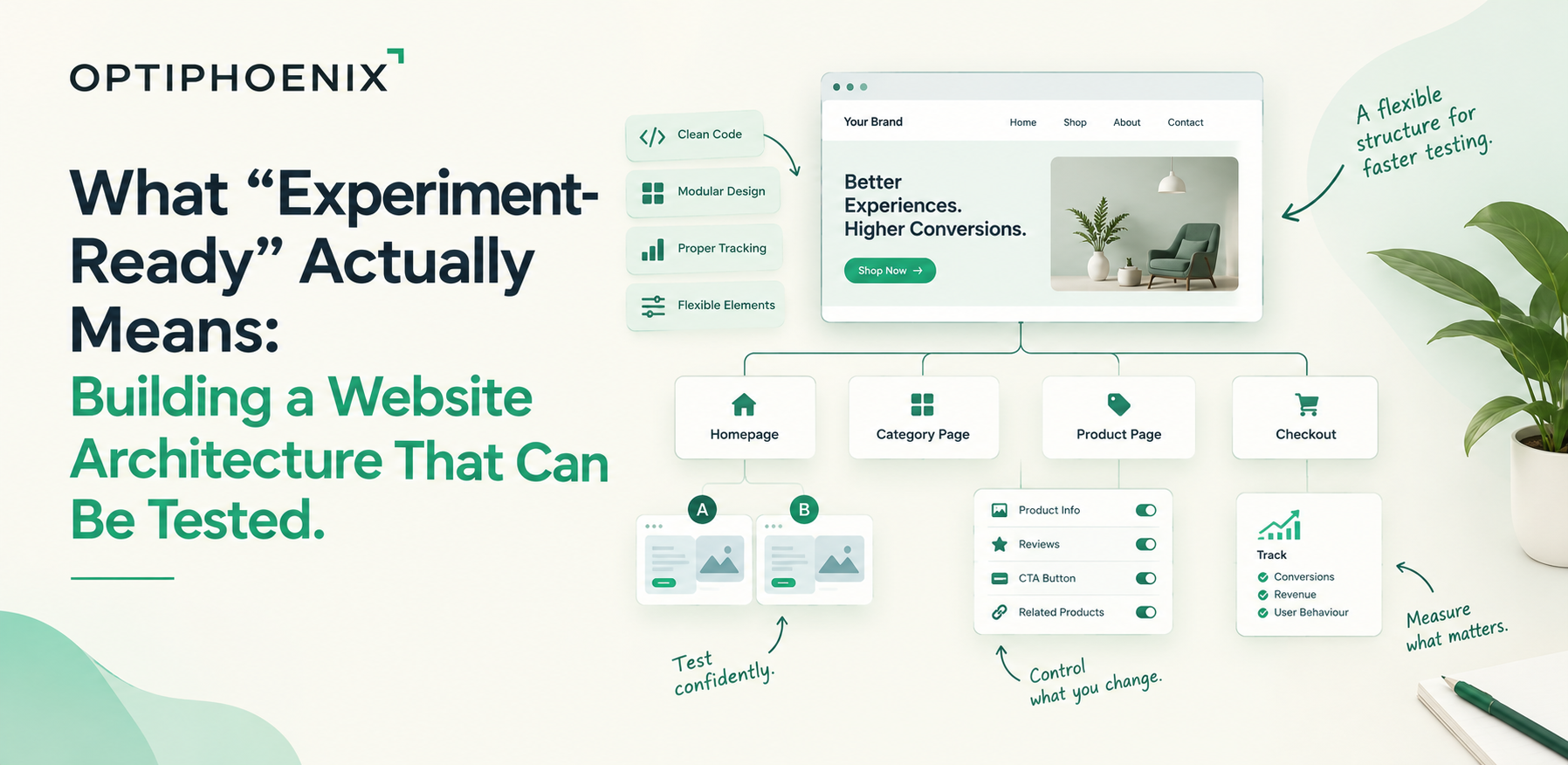
Your Audit Is Done. Now What Do You Test First?
A website can pass every design review and still lose customers at the point that matters most: conversion. Web development is often treated as a one-time creative project, judged by how a homepage looks in a client presentation rather than how it performs after launch. The most common web development mistakes that kill conversions rarely show up in a design mockup at all.
They show up in analytics dashboards, weeks after launch, when traffic stays flat but conversions drop. This article covers the four mistakes that quietly cost growth, and what CRO-focused web development looks like when it is done correctly.
Most websites are built, launched, and then left alone. Any future change requires a developer, a deployment cycle, and often a queue of other requests ahead of it. That structure works fine for a brochure site. It fails a growth team that needs to test headlines, layouts, or checkout flows on a weekly basis.
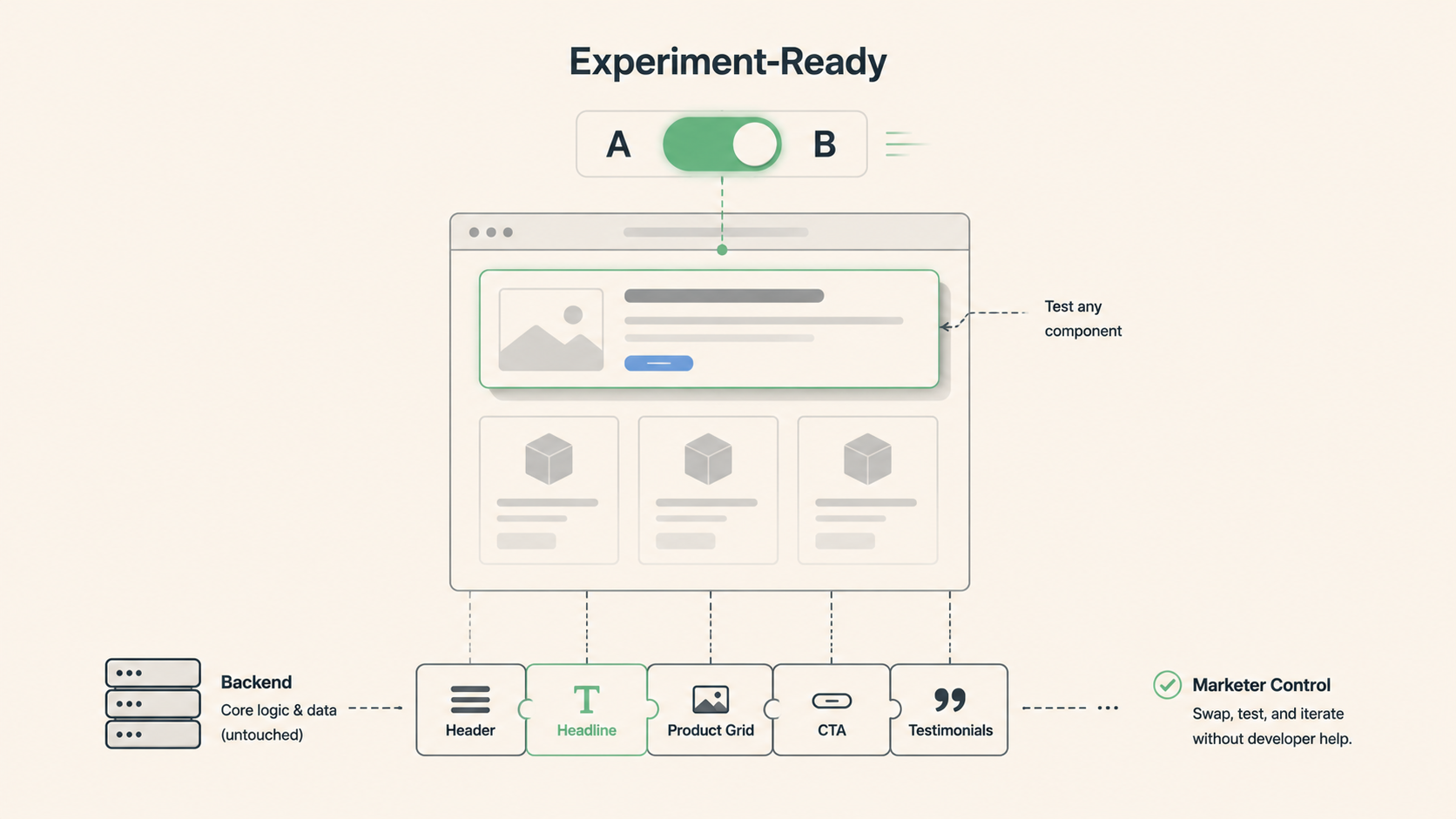
Experiment-ready website architecture is built differently from the start. It separates content, layout, and logic so that variations can be built and shipped without touching core code. Practically, this means:
Without this foundation, every experimentation program inherits the same bottleneck: a website that was never built to change. This is closely tied to how design decisions and CRO actually work together. A page can look finished and still be structurally unready for the kind of testing that improves it over time.
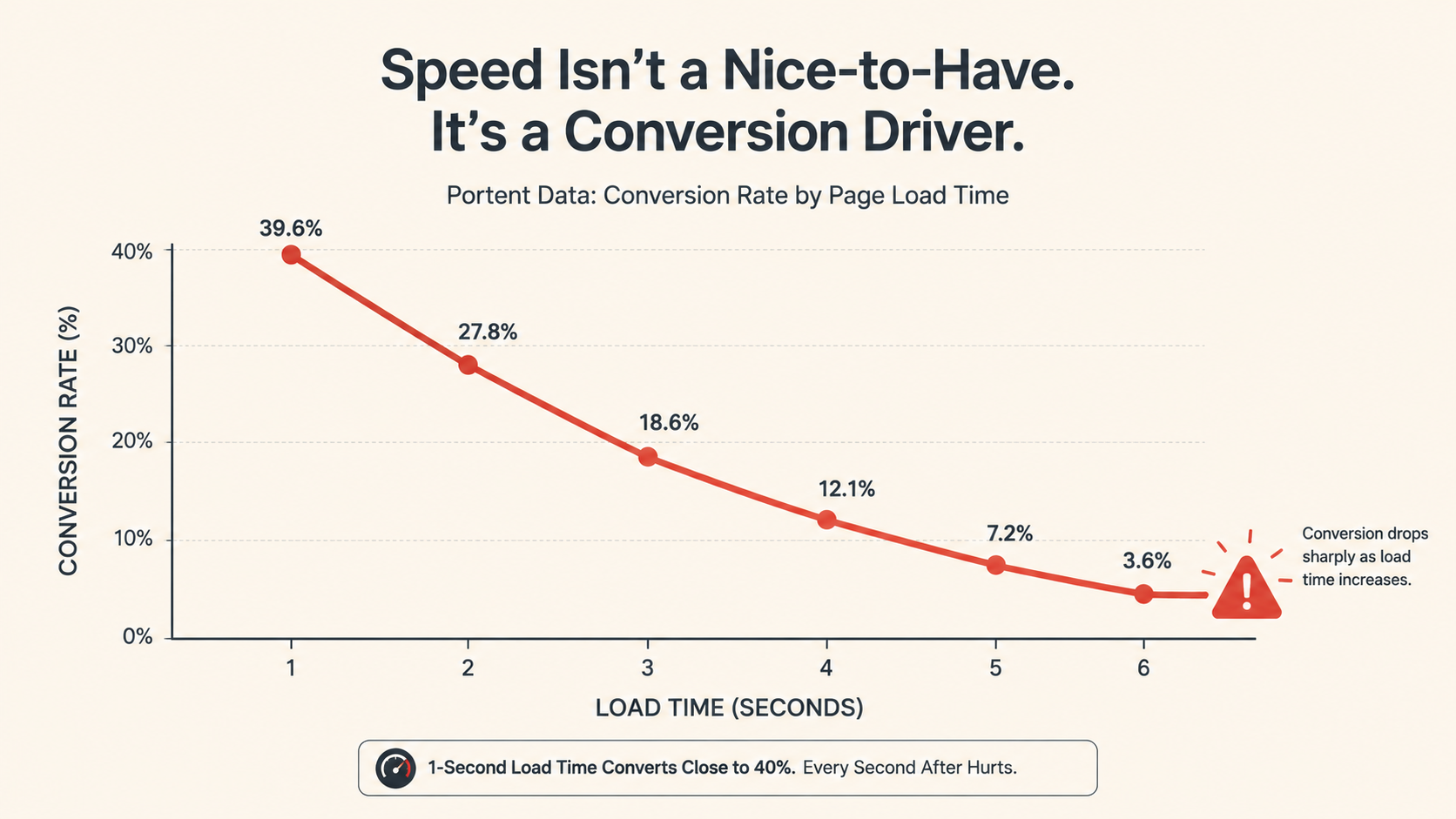
Website speed and conversion rate move together, and the relationship is well documented. Portent’s analysis of more than 100 million page views across 20 B2B and B2C sites found that pages loading in one second convert at close to 40 percent, while conversion rates decline steadily as load time increases and level off around the six-second mark.
Common causes of slow load times in web development projects include:
Speed is not a final polish step. It has to be a build requirement from the first sprint, not an optimization task added after launch. Treating speed as an afterthought is one of the most common web development mistakes that kill conversions, because by the time it shows up in the analytics, months of traffic have already been affected. The problem is often worse on mobile than these averages suggest, mobile experience optimization research shows that pages tested on a flagship phone over office wifi rarely reflect what most visitors experience on a mid-range device over a real mobile network.
CMS choice is a growth decision, not just a technical one. Picking the wrong platform for your traffic and testing needs is one of the quieter web development mistakes that kill conversions, since it rarely causes an immediate problem, only a slow performance ceiling that shows up months later. The two most common paths are traditional WordPress and headless CMS architecture, and they perform differently once traffic and complexity increase.
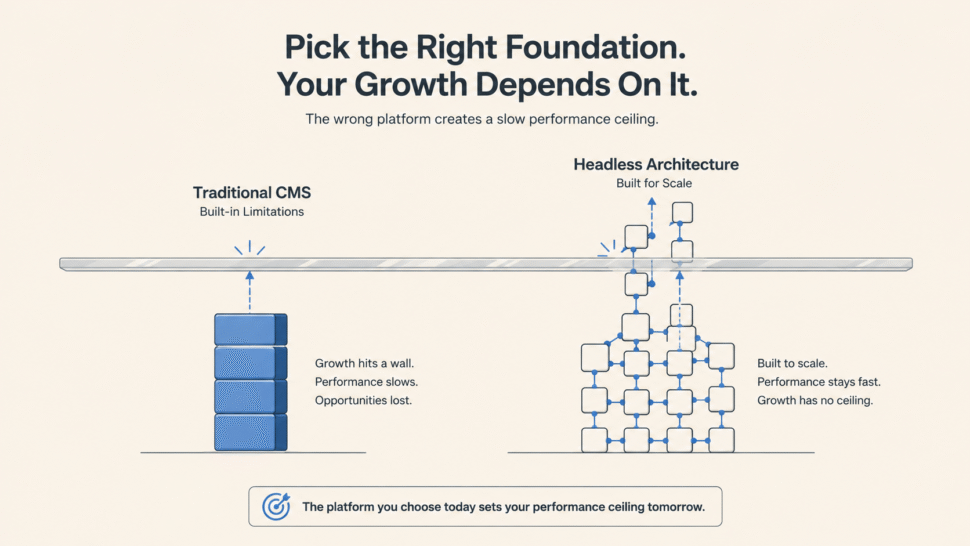
According to the HTTP Archive Web Almanac 2024, only about 40 percent of WordPress mobile sites pass all Core Web Vitals checks. Headless architectures generally score higher, largely because pages can be pre-rendered and served through a CDN instead of being generated on every request.
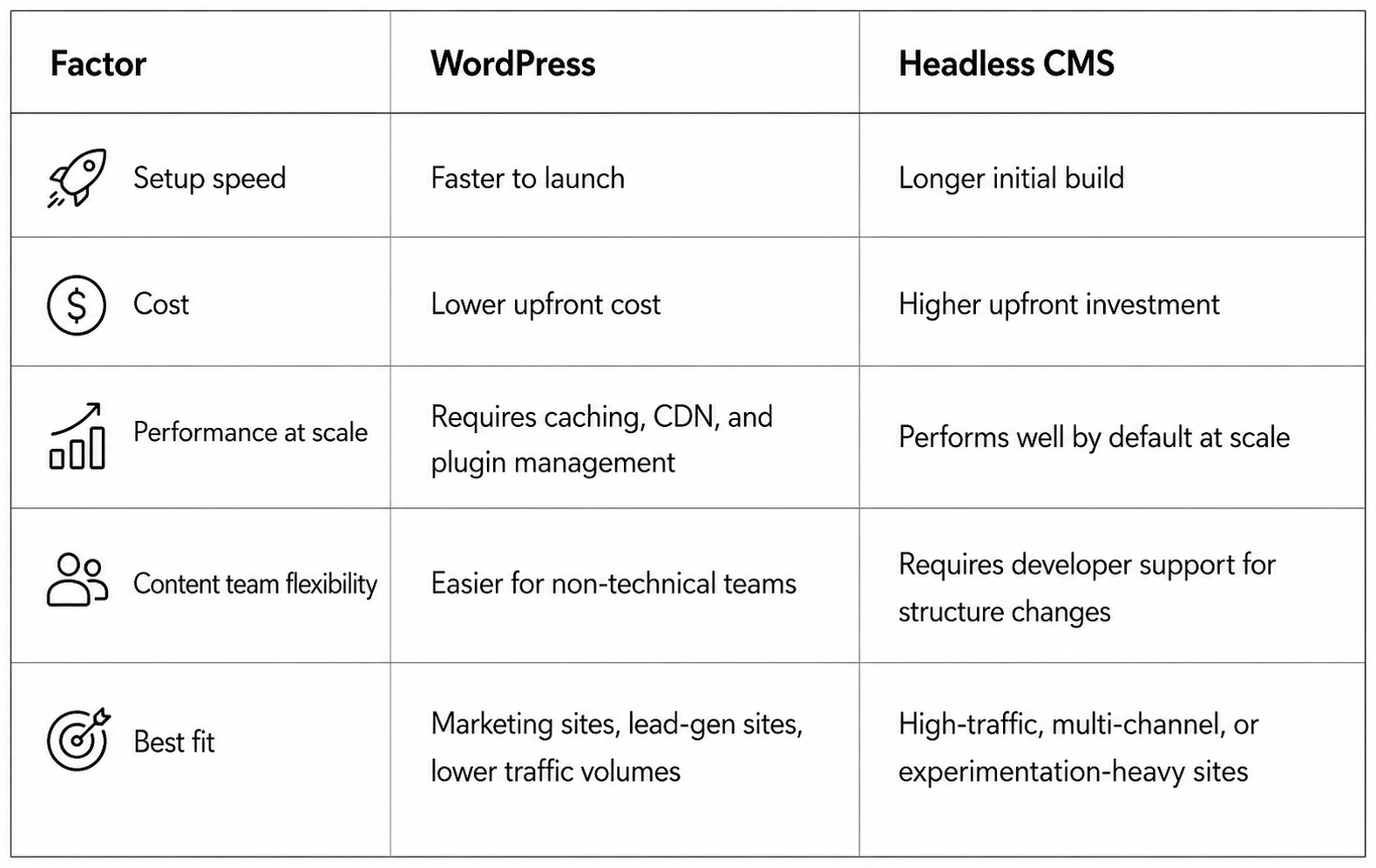
Neither option is universally correct. A well-optimized WordPress build with proper caching and a CDN can perform close to a headless setup for many mid-traffic marketing sites. Headless becomes the stronger choice once a business needs omnichannel delivery, heavy experimentation, or is already seeing performance ceilings on WordPress that plugins cannot fix.
A redesign is often greenlit because a site “looks dated,” not because of a clear conversion goal. That framing is the mistake. One agency’s 12-month review of pre- and post-launch performance data across more than 60 client redesign projects found that fewer than 25 percent produced a measurable improvement in conversion rate. Most produced no change at all, and a meaningful share saw conversions drop, typically due to page speed regressions or the removal of content elements that were quietly driving conversions but looked cluttered.
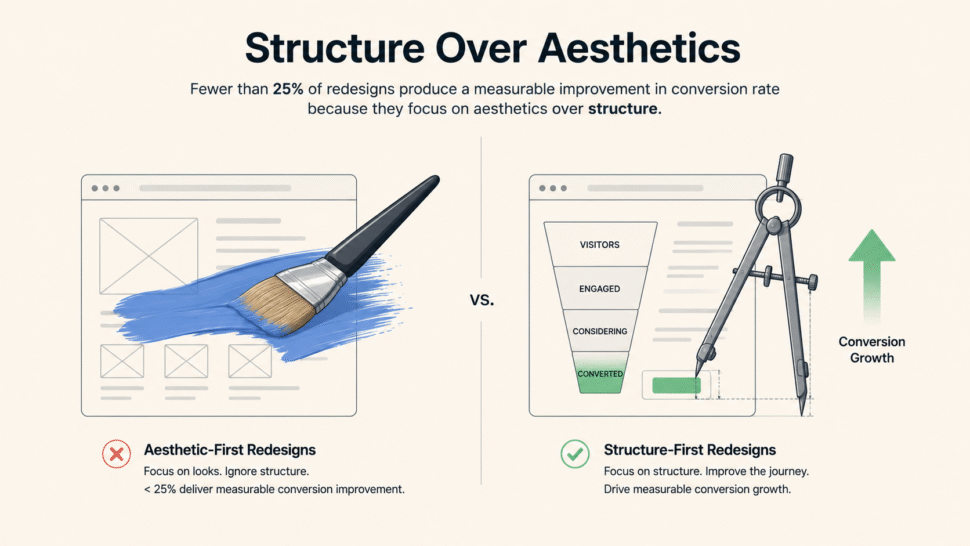
Redesigns fail for structural reasons, not aesthetic ones:
A redesign should be scoped and measured the same way any CRO initiative is: with a baseline, a hypothesis, and a defined success metric. Running a conversion rate audit before a redesign begins is what turns “this looks dated” into a specific, evidence-backed list of what is actually costing conversions.
Custom website development built around conversion, rather than visuals alone, follows a consistent pattern regardless of industry:
If most of these come back as “no,” the build is optimized for how the site looks, not how it performs. That gap is where most web development mistakes that kill conversions originate and it is the difference between a website that gets rebuilt every few years out of frustration and one that keeps improving through ongoing, measured iteration.
It is a web development approach where conversion rate, not just visual design, is a build requirement. Tracking, testing infrastructure, and performance targets are planned from the start rather than added after launch.
Load time has a direct, measurable relationship with conversion rate. Data from Portent’s analysis of over 100 million page views shows conversion rates are highest when pages load in about one second and decline steadily as load time increases.
It depends on traffic and complexity. Headless CMS architectures tend to outperform WordPress on Core Web Vitals at scale, according to the HTTP Archive Web Almanac 2024, but a properly optimized WordPress site with caching and a CDN can perform well for many marketing and lead-generation sites.
Most redesigns are scoped around visual updates rather than conversion goals. Without a baseline and a measurable hypothesis, teams cannot tell whether a redesign actually improved performance or simply changed appearance.
An experiment-ready website has modular components, built-in tracking, and a QA environment separate from production, so A/B tests and personalization can be built and shipped without requiring a full development cycle for each change.
Templates are faster and cheaper to launch but limit how much a site can be tailored to a specific funnel or tested over time. Custom development costs more upfront but removes the structural limitations that make experimentation difficult later.
Most web development mistakes that kill conversions come down to the same root cause: a site built to look right at launch, not to keep performing after it.