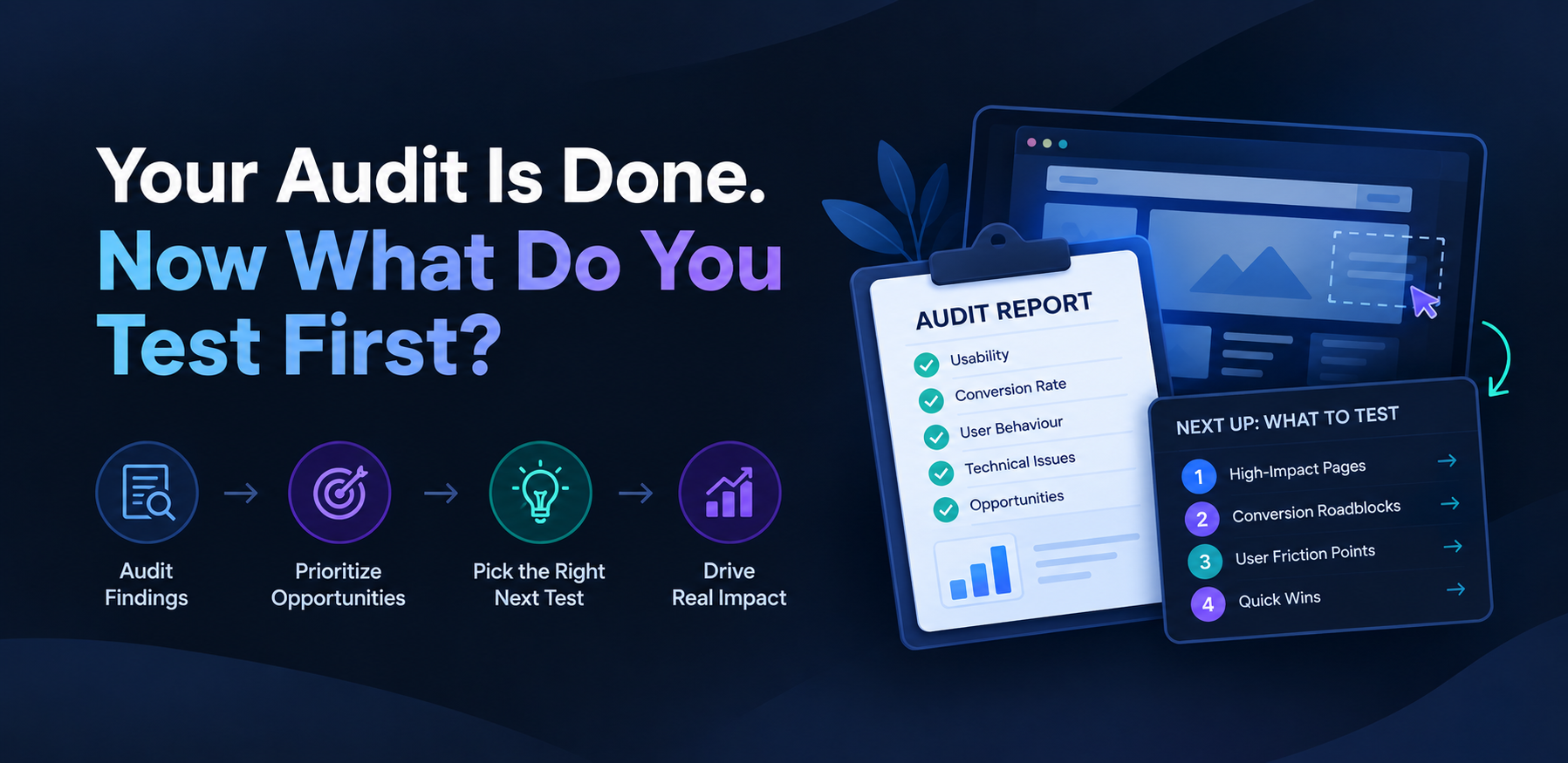
Your Audit Is Done. Now What Do You Test First?
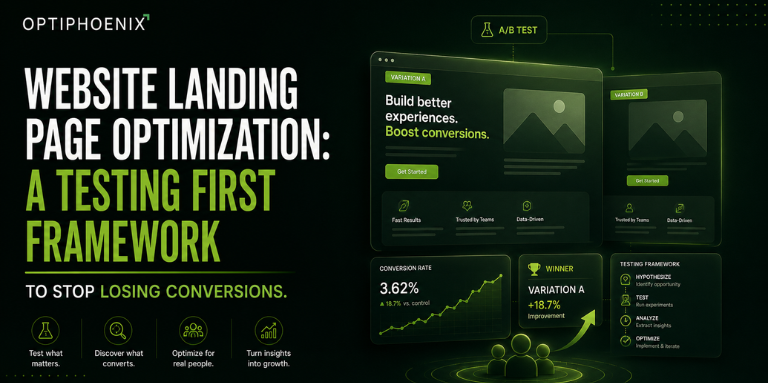
The median landing page conversion rate across all industries sits at 6.6%, based on Unbounce’s Q4 2024 analysis of 41,000 landing pages. Top performers, however, consistently hit 10% or above through systematic optimization. That gap does not come from better design budgets or longer copy. It comes from a different approach to decision making.
Most teams treat landing page optimization as a design problem. They move headlines, change button colors and shorten forms based on what looks right. Some of those changes produce a lift. Most produce noise. None of them build organizational knowledge that compounds over time.
This framework is for teams who want to stop losing conversions to untested assumptions.
Website landing page optimization is the process of improving a landing page’s ability to convert visitors into leads, customers or any defined action, through structured diagnosis, hypothesis driven testing and documented learning.
The word “optimization” is often misapplied. Changing a button color is not an optimization. Publishing a redesigned page is not an optimization. These are changes. Optimization is a repeatable process that tells you why a change worked or did not and preserves that knowledge for every future decision.
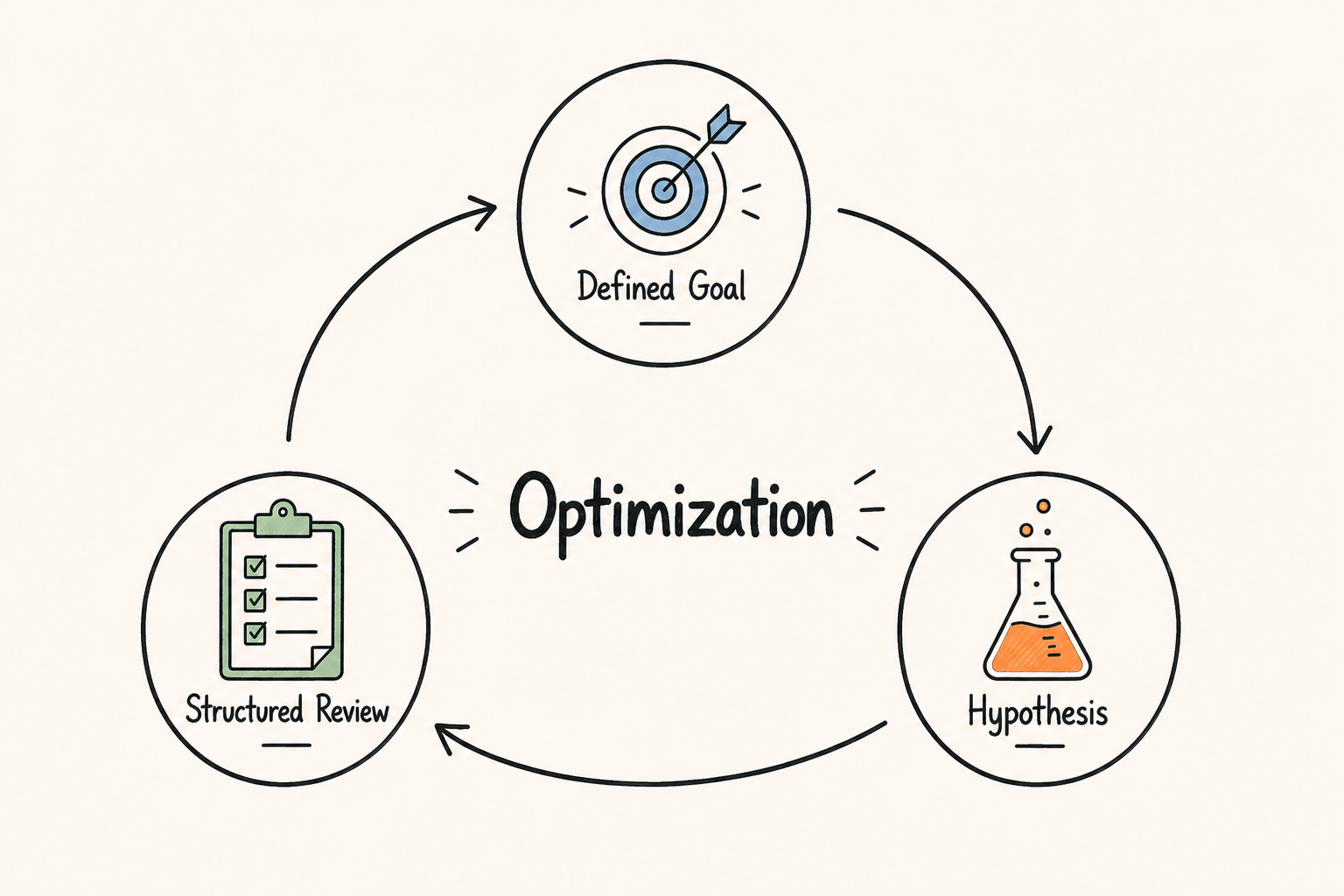
Three things separate optimization from iteration:
Without all three, a team can run dozens of tests and still not understand their own landing page.
Every landing page starts with decisions made by people who are not the visitor. The copy reflects what the brand wants to say. The layout reflects what the designer found intuitive. The CTA reflects what the marketing team believed would convert.
These decisions are not wrong. They are simply untested.
The growing importance of experimentation is evident in current marketing practices. Ascend2’s 2025 A/B Testing Report found that 84% of marketers conduct A/B tests at least monthly, including 38% who test weekly and 22% who test daily. This trend shows that continuous testing has become a fundamental part of successful marketing strategies. (Kameleoon)
The problem is not making design decisions before testing. The problem is treating those decisions as final.
A testing first mindset means every significant element on a landing page is treated as a hypothesis until data confirms it. The headline is a hypothesis. The form length is a hypothesis. The presence or absence of navigation is a hypothesis.
The most common reason landing page tests produce inconclusive results is that teams test the wrong things. They focus on what is visible rather than what is causing friction.
Diagnosis comes first.
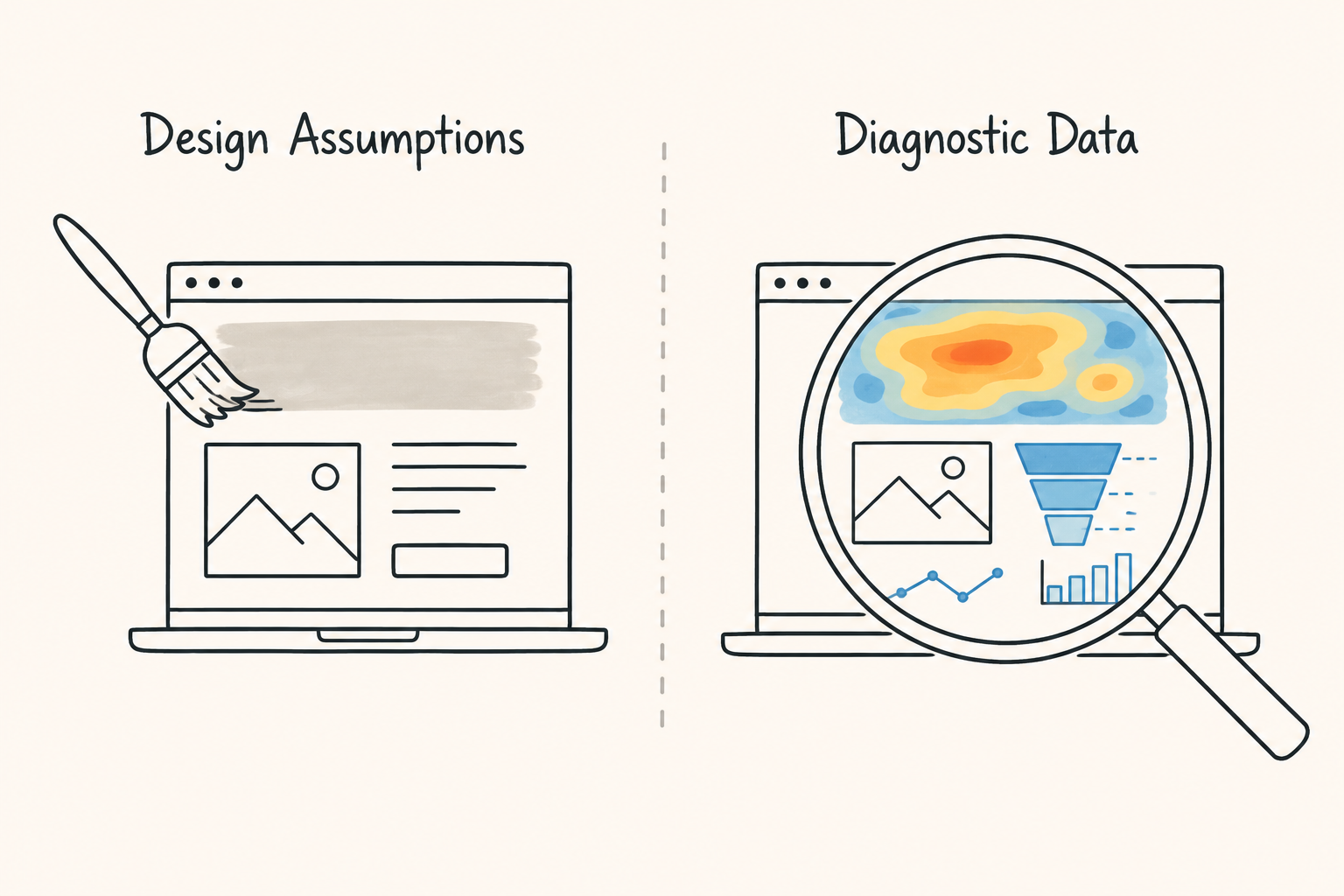
Before running a single test, map where visitors are dropping off and why. The data sources that inform this diagnosis include:
Quantitative signals
Qualitative signals
These are the same visitor behavior analytics methods used to diagnose friction anywhere on a site, applied here specifically to the landing page layer.
In one documented case, a team used heatmap analysis to discover that most visitors never scrolled past the hero section of their landing page. When they redesigned to move the most critical form into the hero, conversions increased immediately by 15%. SEO Content Guy
The redesign was not the insight. The scroll data was the insight.
A hypothesis is not “let us try a different headline.” A hypothesis is a structured prediction that connects a specific observation to a proposed change and an expected outcome.
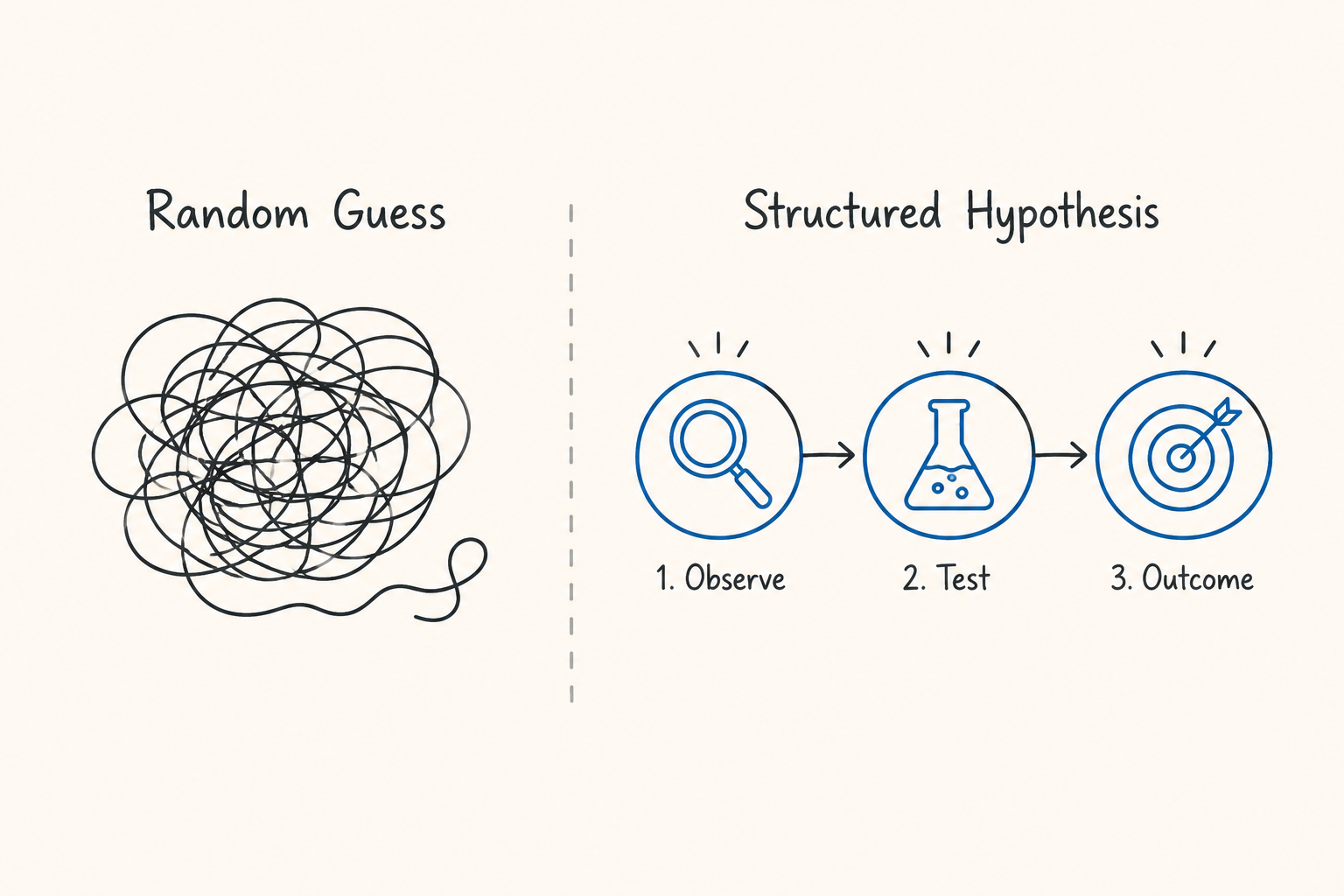
The correct format:
“Because [data or observation], we believe that [specific change] will [expected outcome] for [defined audience or segment].”
Examples:
Each hypothesis is testable, specific and grounded in a data observation. If a hypothesis cannot be written this way, it is not ready to test.
A poorly structured test produces data that cannot be trusted. Before running any landing page test, it helps to have the fundamentals of running a valid A/B test in place, since the errors below are the same ones that invalidate tests on any page type. The most frequent structural errors on landing page tests:
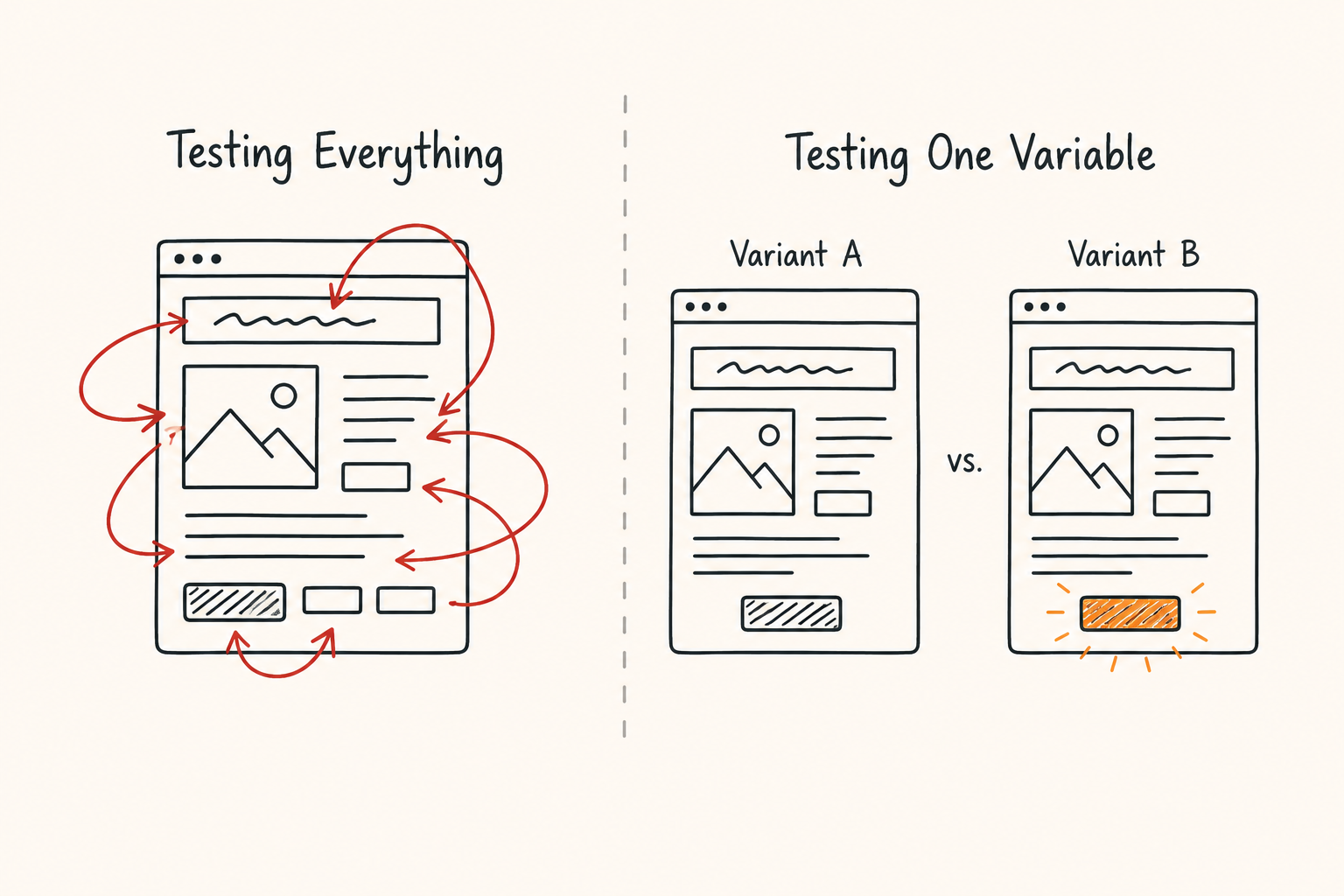
Testing multiple variables at once Changing the headline and the CTA and the form length in the same test makes it impossible to know which change drove the result. Test one variable at a time unless running a full multivariate test with sufficient traffic to support it.
Stopping the test early A positive result on day three is not a result. It is noise. Tests need to run until they reach statistical significance. Calling a winner early based on an encouraging trend is one of the most common sources of false positives in CRO programs.
Splitting traffic unevenly Both variants need to receive traffic from the same sources, at the same times, under the same conditions. A test where Variant A received weekend traffic and Variant B received weekday traffic is not a valid comparison.
Ignoring segment behavior A result that shows no overall winner may still contain a significant win for a specific segment; mobile visitors, paid traffic or returning visitors. Always review results by segment before closing a test.
Companies using A/B testing grow revenue 1.5 to 2 times faster and statistically significant tests can boost conversion rates by 49%, according to industry data. That performance gap comes from running tests correctly, not just frequently. OMNIUS
Confirmation bias is the biggest threat to a landing page testing program. Teams that believe in their hypothesis tend to find evidence for it and teams that invested in a design tend to interpret ambiguous results in its favor.
Disciplined result review follows these rules:
Let statistical significance determine the winner, not the trend line. A test that reaches 95% significance with a 12% lift in form completions is a result. A test that shows a 12% lift after two days with 200 visitors is not.
Record the result even if the variant is lost. A failed hypothesis is not a failed test. It is a confirmed understanding of what does not work, which has equal value to knowing what does.
Look for secondary metrics before closing. A variant that increases form submissions but decreases quality of leads is not a winner. Review downstream metrics before declaring a result.
Document the reason, not just the outcome. “Variant B increased conversions by 14%” is a data point. “Variant B increased conversions by 14%, likely because the benefit-first CTA reduced uncertainty about what happens after the click” is a learning that can be applied across other pages.
This is the step most teams skip and it is the step that separates a CRO program from a series of unconnected tests.
Every completed test should be recorded with:
This documentation becomes the institutional memory of your optimization program. When a new team member joins, or when a similar decision arises on a different page or campaign, the record of past tests provides a foundation that does not exist in any individual’s head.
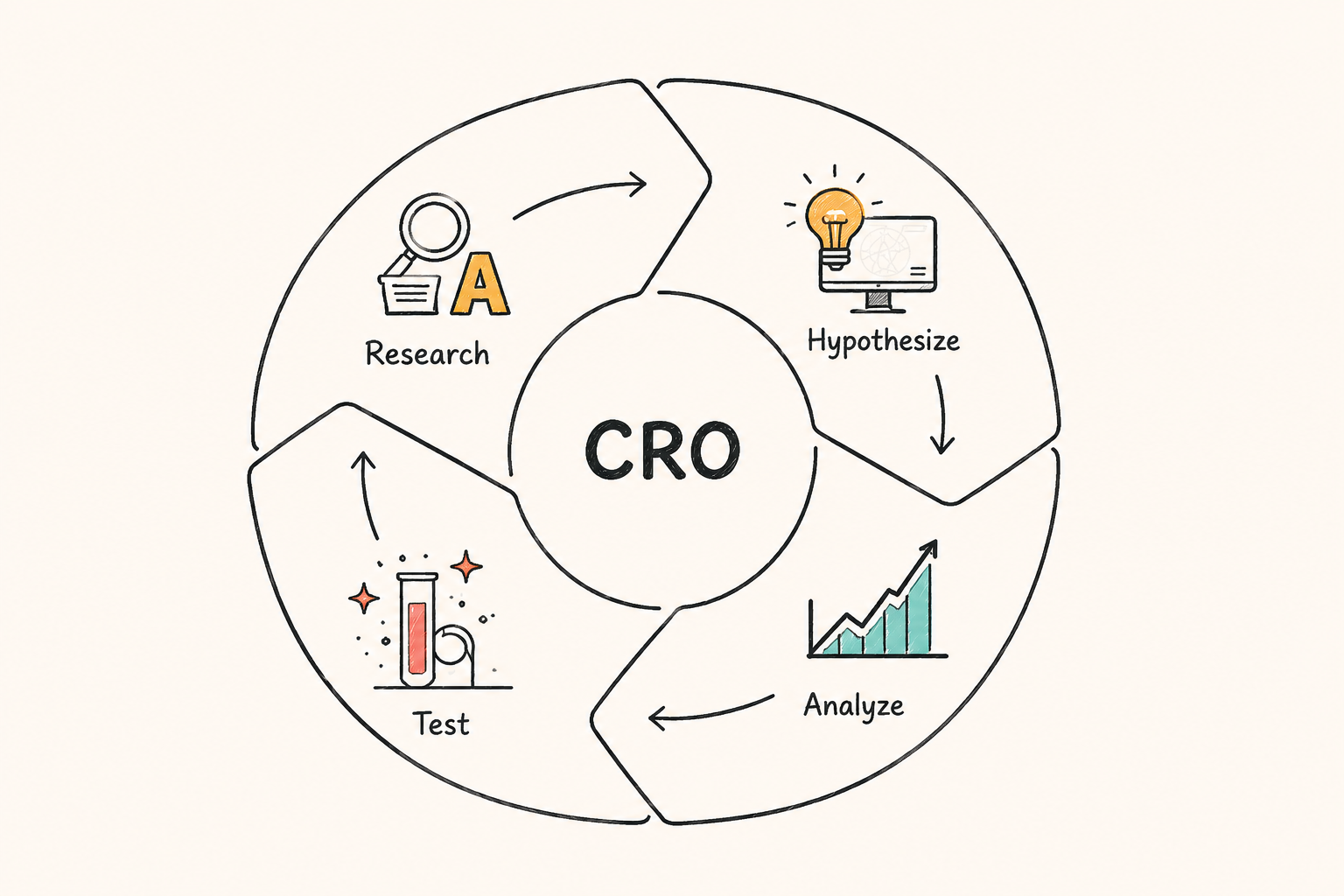
Without documentation, every new test starts from zero. With it, each test builds on the last.
Based on published testing data, the following elements produce the most consistent and measurable impact on landing page conversion:
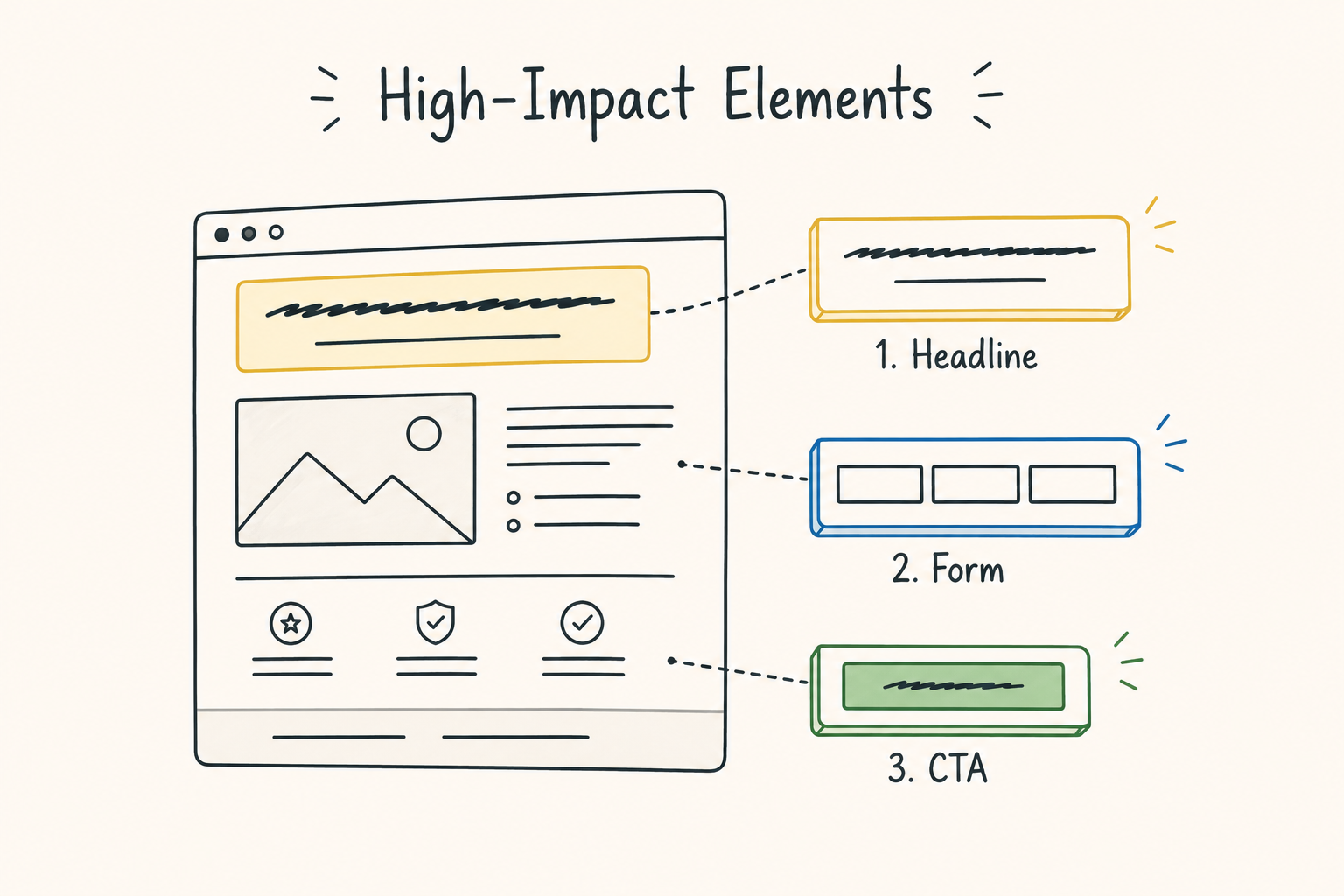
Headline and sub headline Research shows that using the right headline can increase conversions by up to 307%. The headline is the first decision a visitor makes about whether to stay. Test benefit led versus feature led framing and match the headline to the specific ad or traffic source that brought the visitor. Anatta
CTA copy and placement Personalized CTA buttons convert 202% better than generic ones. Generic CTAs like “Submit” or “Click Here” tell the visitor nothing about what they will receive. Test action-oriented, benefit-specific language (“Get Your Free CRO Audit”) against the current default. Anatta
Form length and structure Reducing form fields to five or fewer can double completion rates, with 81% of users abandoning forms after starting them. Test which fields are genuinely necessary for qualification versus which were added for internal convenience.
Social proof placement Despite research clearly showing the impact of testimonials, 76.8% of marketers still overlook social proof on their landing pages. Test testimonials above versus below the CTA, and test specific outcome based testimonials against generic ones. Growthmethod
Page navigation Removing navigation from a landing page eliminates exit paths. VWO documented a case where removing navigation doubled the conversion rate from 3% to 6%.
Mobile experience Despite mobile devices driving 83% of traffic, mobile converts 8% lower than desktop, representing a significant revenue gap for most businesses. Mobile specific tests on form layout, CTA size, and above the fold content often produce the largest conversion gains.
Page load speed Every additional second of load time costs 7% in conversions, with the critical performance threshold at 2 seconds. This is one of several conversion killers we’ve broken down before, and it applies to landing pages just as much as any other page type. Speed improvements are not A/B tests but they are optimization, and they often outperform creative changes in impact.
Changing the page during a live test Any mid-test change to the control or variant introduces a variable that cannot be controlled. If a change must be made, end the test, make the change and restart.
Running tests on low-traffic pages A page receiving 200 visitors per month cannot reach statistical significance on most tests within a reasonable timeframe. Prioritize high-traffic pages for testing and use qualitative methods on low-traffic pages.
Treating a one-time lift as a permanent truth, A winning variant from six months ago may not win today. Visitor behavior changes with traffic source mix, seasonality and market conditions. Periodically retest previous winners, particularly after significant changes in traffic source or audience.
Optimizing in isolation A landing page does not exist independently. The ad that brought the visitor, the email that sent them and the next step in the funnel all affect what a landing page needs to do. Test with the full visitor journey in mind.
Website landing page optimization is the process of improving a landing page’s ability to convert visitors into a defined action such as a form fill, demo request or purchase through structured testing, data analysis and documented learning. It differs from redesign in that every change is hypothesis driven and measured against a baseline.
A landing page A/B test should run until it reaches statistical significance, typically set at 95% confidence. The minimum duration depends on traffic volume and the size of the expected effect. For most landing pages, two to four weeks is a baseline to prevent day-of-week bias from skewing results. Stopping a test early based on promising early data is one of the most common testing errors.
The current median landing page conversion rate is 6.6%, based on Unbounce’s Q4 2024 data from 41,000 pages. A rate of around 10% is considered good and puts a page well above average. Benchmarks vary significantly by industry, traffic source, and offer type. BrillMark
Start where your data shows the most friction. If scroll depth analysis shows visitors leaving before the form, test above-the-fold layout. If form abandonment is high, test form length and CTA copy. Diagnosis should determine testing priority, not assumption.
Most failed tests result from structural problems: testing multiple variables simultaneously, stopping tests before statistical significance or testing the wrong elements. A test that is run incorrectly does not produce a failed result. It produces an unreliable one.
Each additional second of page load time reduces conversions by approximately 7%, with the critical threshold sitting at two seconds. Speed improvements are among the highest return optimization activities because they affect every visitor, not just a test segment.
Basic A/B tests can be run with tools like Google Optimize alternatives or built-in testing features on platforms like HubSpot or Unbounce. The tool matters less than the discipline of the testing process. A structured test run on a simple tool produces more value than an unstructured test run on an enterprise platform.
Most landing pages are not failing because of bad design. They are failing because the decisions behind them have never been tested.
A structured optimization program does not require a complete rebuild. It requires a diagnostic process, a hypothesis, a correctly run test and a record of what was learned.
If you want to understand where your landing page is losing conversions and what to test first, OptiPhoenix runs structured CRO audits that diagnose friction, prioritize test opportunities, and build the foundation for an optimization program that compounds over time.